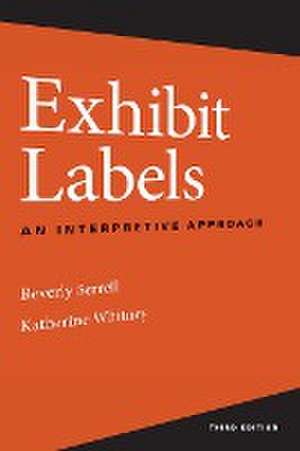
Exhibit Labels: An Interpretive Approach
Autor Beverly Serrell, Katherine Whitneyen Limba Engleză Hardback – 22 ian 2024
Preț: 498.98 lei
Preț vechi: 693.32 lei
-28%
Puncte Express: 748
Carte tipărită la comandă
Livrare economică 19 noiembrie-03 decembrie
Livrare prin curier în România Termenul estimat este afișat lângă disponibilitate.
Transport gratuit pentru acest produs Plată online sau ramburs, în funcție de opțiunile comenzii.
Retur gratuit în 14 zile Comandă securizată și suport în română.
Specificații
ISBN-13: 9781538160459
ISBN-10: 1538160455
Pagini: 362
Ilustrații: 80 BW Photos, 4 Tables, 48 Textboxes
Dimensiuni: 182 x 256 x 26 mm
Greutate: 0.84 kg
Ediția:Third Edition
Editura: Bloomsbury Publishing
Colecția Rowman & Littlefield
Locul publicării:New York, United States
ISBN-10: 1538160455
Pagini: 362
Ilustrații: 80 BW Photos, 4 Tables, 48 Textboxes
Dimensiuni: 182 x 256 x 26 mm
Greutate: 0.84 kg
Ediția:Third Edition
Editura: Bloomsbury Publishing
Colecția Rowman & Littlefield
Locul publicării:New York, United States
Descriere
Beverly Serrell and Katherine Whitney cover the essentials of the processes of exhibit label planning, writing, design, and production. In this third edition, Serrell's classic guide to writing interpretive exhibit labels is updated to include new voices, current scholarship and the unique issues the museum field is grappling with in the 21st century. With high quality photographs and new sections, this edition is more accessible and easier to use for all museum professionals, from label writers to museum directors to exhibit designers.
Cuprins
Preface
PART I: INTRODUCTION
1. Guidelines and Essentials
PART II: OVERVIEW
2. Behind It All: The Big Idea
3. What Are Interpretive Labels?
4. Types of Labels in an Exhibition
5. The Importance of Captions
6. Label Systems
Photo Figures for Part IIxx
PART III: CONSIDERING THE AUDIENCE
7. Who Is The Audience?
8. Audience Segmentation
9. The Number of Words
10. Readability Issues
11. Multilingual Labels
12. The Labels Voice: Who's Talking to Me?
Photo Figures for Part III
PART IV: ENHANCING THE VISITOR EXPERIENCE
13. Improving Orientation
14. Being Visitor Friendly
15. Making Words and Images Work Together
16. Labels That Ask Questions
17. Labels for Interactive Exhibits
18. Digital Label Strategies
Photo Figures for Part IV
PART V: TASKS
19. Getting Started, and Getting Done
20. Prototyping
21. Typographic Considerations
22. Production Materials and Issues
23. Evaluation After Opening
Photo Figures for Part V
PART VI: VOICES FROM THE FIELD
PART VII: CONCLUSIONS
24. What Research Tells Us About Visitors
25. Essentials Takeaway
Acknowledgements
Photo Figure Index
Bibliography
Index
PART I: INTRODUCTION
1. Guidelines and Essentials
PART II: OVERVIEW
2. Behind It All: The Big Idea
3. What Are Interpretive Labels?
4. Types of Labels in an Exhibition
5. The Importance of Captions
6. Label Systems
Photo Figures for Part IIxx
PART III: CONSIDERING THE AUDIENCE
7. Who Is The Audience?
8. Audience Segmentation
9. The Number of Words
10. Readability Issues
11. Multilingual Labels
12. The Labels Voice: Who's Talking to Me?
Photo Figures for Part III
PART IV: ENHANCING THE VISITOR EXPERIENCE
13. Improving Orientation
14. Being Visitor Friendly
15. Making Words and Images Work Together
16. Labels That Ask Questions
17. Labels for Interactive Exhibits
18. Digital Label Strategies
Photo Figures for Part IV
PART V: TASKS
19. Getting Started, and Getting Done
20. Prototyping
21. Typographic Considerations
22. Production Materials and Issues
23. Evaluation After Opening
Photo Figures for Part V
PART VI: VOICES FROM THE FIELD
PART VII: CONCLUSIONS
24. What Research Tells Us About Visitors
25. Essentials Takeaway
Acknowledgements
Photo Figure Index
Bibliography
Index
Recenzii
In this third edition, Beverly Serrell and Katherine Whitney remind me of what's important and challenge me to do better-with humor, humility, and references to the great work colleagues have done creating and evaluating exhibit interpretation. This book provides inspiration, examples and connections to other museum colleagues and organizations who have navigated similar interpretive labyrinths. I can't imagine working without it by my side and on my team.
Real objects and phenomena are the great differential asset of the museographic language and what gives uniqueness to an exhibition. However, written language -properly used- is also an essential support for an exhibition with communicative capacity. This new edition consolidates the relevance of a completely essential book in this aspect.
This latest edition of Exhibit Labels serves as the perfect antidote to those who claim, "Nobody reads the labels!" Serrell and Whitney, through wonderful illustrated examples and pithy, actionable tips, inspire everyone who works for, or with, museums to craft labels that everyone will want to read!
Real objects and phenomena are the great differential asset of the museographic language and what gives uniqueness to an exhibition. However, written language -properly used- is also an essential support for an exhibition with communicative capacity. This new edition consolidates the relevance of a completely essential book in this aspect.
This latest edition of Exhibit Labels serves as the perfect antidote to those who claim, "Nobody reads the labels!" Serrell and Whitney, through wonderful illustrated examples and pithy, actionable tips, inspire everyone who works for, or with, museums to craft labels that everyone will want to read!