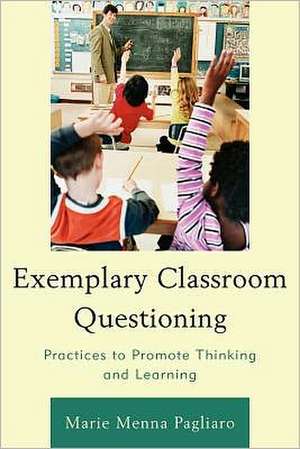
Exemplary Classroom Questioning: Practices to Promote Thinking and Learning
Autor Marie Menna Pagliaroen Limba Engleză Paperback – sep 2011
Preț: 219.35 lei
Preț vechi: 292.20 lei
-25%
Puncte Express: 329
Carte tipărită la comandă
Livrare economică 28 noiembrie-12 decembrie
Livrare prin curier în România Termenul estimat este afișat lângă disponibilitate.
Transport gratuit de la 400.00 lei Plată online sau ramburs, în funcție de opțiunile comenzii.
Retur gratuit în 14 zile Comandă securizată și suport în română.
Specificații
ISBN-13: 9781610484572
ISBN-10: 1610484576
Pagini: 159
Ilustrații: black & white line drawings, black & white tables, figures
Dimensiuni: 150 x 226 x 14 mm
Greutate: 0.27 kg
Editura: Bloomsbury Publishing
Colecția R&L Education
Locul publicării:New York, United States
ISBN-10: 1610484576
Pagini: 159
Ilustrații: black & white line drawings, black & white tables, figures
Dimensiuni: 150 x 226 x 14 mm
Greutate: 0.27 kg
Editura: Bloomsbury Publishing
Colecția R&L Education
Locul publicării:New York, United States
Cuprins
Chapter 1 Establishing an Effective Environment for Questioning
Chapter 2 Reasons for Asking (and Not Asking) Questions
Chapter 3 Effective Questioning Practices When Framing and Delivering Questions
Chapter 4 Ineffective Questioning Practices When Framing and Delivering Questions
Chapter 5 Effective Questioning Practices When Responding to Students' Answers
Chapter 6 Ineffective Questioning Practices When Responding to Students' Answers
Chapter 7 Encouraging Student Questioning
Chapter 8 Using Taxonomies to Formulate Questions
Chapter 9 Questioning for Critical Thinking
Chapter 10 Socratic Questioning
Chapter 11 Critical Questioning to Evaluate the Validity of Information
Chapter 12 Implementing Questioning Skills
Chapter 2 Reasons for Asking (and Not Asking) Questions
Chapter 3 Effective Questioning Practices When Framing and Delivering Questions
Chapter 4 Ineffective Questioning Practices When Framing and Delivering Questions
Chapter 5 Effective Questioning Practices When Responding to Students' Answers
Chapter 6 Ineffective Questioning Practices When Responding to Students' Answers
Chapter 7 Encouraging Student Questioning
Chapter 8 Using Taxonomies to Formulate Questions
Chapter 9 Questioning for Critical Thinking
Chapter 10 Socratic Questioning
Chapter 11 Critical Questioning to Evaluate the Validity of Information
Chapter 12 Implementing Questioning Skills
Recenzii
I found Exemplary Classroom Questioning quite compelling as I have been visiting classrooms of late where the issues of questioning students, structuring questioning , anticipating possible responses, and dealing with unexpected responses have become crucial in shaping a more effective lesson. Classroom questioning has emerged as an unexplored area in lessons that needs explicit attention and examination. This book solves the problem for me.
Exemplary Classroom Questioning readily provides the ideal resource for both the veteran teacher who seeks to improve his/her sense of efficacy in the art of student questioning for critical thinking and the first year novice who wants to design classroom instruction around questions that promote enthusiastic learning and reduce behavior issues. Full of concise, easy to understand, research-driven examples of the various genres of classroom questioning, this book can equally serve as a personal self-reflection tool or as a campus-wide book study.
This book has inspired important discussions with teachers on the power of thoughtful questioning. Her insightful suggestions, clear examples, and research-supported reasoning make it a valuable resource for both elementary and secondary teachers.
This book is a true treasure for the classroom teacher and an invaluable asset to the administrator. Pagliaro solidly lays the groundwork to take teachers from their current daily questioning skills to potentially full mastery whereby teachers' questioning develops deep and critical thinking in their students. The book provides an abundance of examples, clear summaries and charts to further illustrate text and enhance memory of its contents, and gentle guidance toward amplification of understanding. It is most practical in its illustration of both effective and ineffective techniques; it equips teachers with the language and methods to implement effective techniques. This book is compelling reading for K-12 teachers and administrators, forever changing practice for those who read it.
Exemplary Classroom Questioning provides a concrete and much needed 'how to' for teaching teachers to become coaches and facilitators of learning at all grade levels. The emphasis on twenty-first century skills compels teachers to move students from acquiring facts to analyzing and evaluating information from product to process. This book encourages teachers to reinvent the learning environment so that students are encouraged to question, reflect, and synthesize information. Teachers are also taught to make the learning relevant to the students' lives and prepare them for the new economy. Dr. Pagliaro's directions transform teachers into facilitators and coaches themselves so they can transform the learning process for their students. This book is a must-have for both veteran and new teachers.
Exemplary Classroom Questioning readily provides the ideal resource for both the veteran teacher who seeks to improve his/her sense of efficacy in the art of student questioning for critical thinking and the first year novice who wants to design classroom instruction around questions that promote enthusiastic learning and reduce behavior issues. Full of concise, easy to understand, research-driven examples of the various genres of classroom questioning, this book can equally serve as a personal self-reflection tool or as a campus-wide book study.
This book has inspired important discussions with teachers on the power of thoughtful questioning. Her insightful suggestions, clear examples, and research-supported reasoning make it a valuable resource for both elementary and secondary teachers.
This book is a true treasure for the classroom teacher and an invaluable asset to the administrator. Pagliaro solidly lays the groundwork to take teachers from their current daily questioning skills to potentially full mastery whereby teachers' questioning develops deep and critical thinking in their students. The book provides an abundance of examples, clear summaries and charts to further illustrate text and enhance memory of its contents, and gentle guidance toward amplification of understanding. It is most practical in its illustration of both effective and ineffective techniques; it equips teachers with the language and methods to implement effective techniques. This book is compelling reading for K-12 teachers and administrators, forever changing practice for those who read it.
Exemplary Classroom Questioning provides a concrete and much needed 'how to' for teaching teachers to become coaches and facilitators of learning at all grade levels. The emphasis on twenty-first century skills compels teachers to move students from acquiring facts to analyzing and evaluating information from product to process. This book encourages teachers to reinvent the learning environment so that students are encouraged to question, reflect, and synthesize information. Teachers are also taught to make the learning relevant to the students' lives and prepare them for the new economy. Dr. Pagliaro's directions transform teachers into facilitators and coaches themselves so they can transform the learning process for their students. This book is a must-have for both veteran and new teachers.