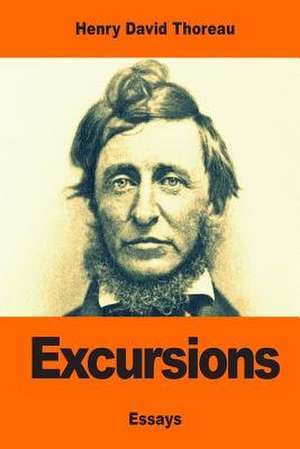
Excursions
Autor Henry David Thoreauen Limba Engleză Paperback
Preț: 80.59 lei
Puncte Express: 121
Carte tipărită la comandă
Livrare economică 01-15 decembrie
Livrare prin curier în România Termenul estimat este afișat lângă disponibilitate.
Transport gratuit de la 400.00 lei Plată online sau ramburs, în funcție de opțiunile comenzii.
Retur gratuit în 14 zile Comandă securizată și suport în română.
Specificații
ISBN-13: 9781542944335
ISBN-10: 1542944333
Pagini: 184
Dimensiuni: 152 x 229 x 10 mm
Greutate: 0.25 kg
ISBN-10: 1542944333
Pagini: 184
Dimensiuni: 152 x 229 x 10 mm
Greutate: 0.25 kg
V-ar putea interesa
-
 -28%Preț: 361.34 lei502.19 lei
 -
 Forests: A Very Short IntroductionJaboury Ghazoul-20%Preț: 56.65 lei70.82 lei
 -
 Notebooks from New Guinea: Field Notes of a Tropical BiologistVojtech Novotny-19%Preț: 87.70 lei107.86 lei
 -
 OverstoryRobert Leo HeilmanPreț: 157.69 lei
 -
 -9%Preț: 817.08 lei897.89 lei
 -
 Hiking North Carolina's National ForestsJohnny MolloyPreț: 148.44 lei
 -
 Ecological Forest Management HandbookGuy R Larocque-18%Preț: 1416.15 lei1727.00 lei
 -
 On the EdgeClaude MartinPreț: 204.20 lei
 -
 Preț: 165.32 lei
 -
 Walden oder Leben in den WäldernHenry David ThoreauPreț: 153.75 lei
 -
 Vom Glück, durch die Natur zu gehenHenry David ThoreauPreț: 46.98 lei
 -
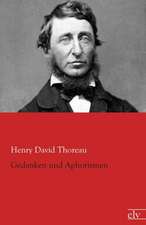 Gedanken und AphorismenHenry David ThoreauPreț: 74.99 lei
Notă biografică
Henry David Thoreau (July 12, 1817 - May 6, 1862) was an American essayist, poet, philosopher, abolitionist, naturalist, tax resister, development critic, surveyor, yogi,[3] and historian. A leading transcendentalist,[4] Thoreau is best known for his book Walden, a reflection upon simple living in natural surroundings, and his essay "Civil Disobedience" (originally published as "Resistance to Civil Government"), an argument for disobedience to an unjust state.
Thoreau's books, articles, essays, journals, and poetry amount to more than 20 volumes. Among his lasting contributions are his writings on natural history and philosophy, in which he anticipated the methods and findings of ecology and environmental history, two sources of modern-day environmentalism. His literary style interweaves close observation of nature, personal experience, pointed rhetoric, symbolic meanings, and historical lore, while displaying a poetic sensibility, philosophical austerity, and Yankee attention to practical detail.[5] He was also deeply interested in the idea of survival in the face of hostile elements, historical change, and natural decay; at the same time he advocated abandoning waste and illusion in order to discover life's true essential needs.
He was a lifelong abolitionist, delivering lectures that attacked the Fugitive Slave Law while praising the writings of Wendell Phillips and defending the abolitionist John Brown. Thoreau's philosophy of civil disobedience later influenced the political thoughts and actions of such notable figures as Leo Tolstoy, Mahatma Gandhi, and Martin Luther King Jr.
Thoreau is sometimes referred to as an anarchist.[7][8] Though "Civil Disobedience" seems to call for improving rather than abolishing government-"I ask for, not at once no government, but at once a better government"[9]-the direction of this improvement contrarily points toward anarchism: "'That government is best which governs not at all;' and when men are prepared for it, that will be the kind of government which they will have."
Thoreau had a distinctive appearance, with a nose that he called his "most prominent feature".[15] Of his appearance and disposition, Ellery Channing wrote:[16]
His face, once seen, could not be forgotten. The features were quite marked: the nose aquiline or very Roman, like one of the portraits of Caesar (more like a beak, as was said); large overhanging brows above the deepest set blue eyes that could be seen, in certain lights, and in others gray,-eyes expressive of all shades of feeling, but never weak or near-sighted; the forehead not unusually broad or high, full of concentrated energy and purpose; the mouth with prominent lips, pursed up with meaning and thought when silent, and giving out when open with the most varied and unusual instructive sayings.
Thoreau's books, articles, essays, journals, and poetry amount to more than 20 volumes. Among his lasting contributions are his writings on natural history and philosophy, in which he anticipated the methods and findings of ecology and environmental history, two sources of modern-day environmentalism. His literary style interweaves close observation of nature, personal experience, pointed rhetoric, symbolic meanings, and historical lore, while displaying a poetic sensibility, philosophical austerity, and Yankee attention to practical detail.[5] He was also deeply interested in the idea of survival in the face of hostile elements, historical change, and natural decay; at the same time he advocated abandoning waste and illusion in order to discover life's true essential needs.
He was a lifelong abolitionist, delivering lectures that attacked the Fugitive Slave Law while praising the writings of Wendell Phillips and defending the abolitionist John Brown. Thoreau's philosophy of civil disobedience later influenced the political thoughts and actions of such notable figures as Leo Tolstoy, Mahatma Gandhi, and Martin Luther King Jr.
Thoreau is sometimes referred to as an anarchist.[7][8] Though "Civil Disobedience" seems to call for improving rather than abolishing government-"I ask for, not at once no government, but at once a better government"[9]-the direction of this improvement contrarily points toward anarchism: "'That government is best which governs not at all;' and when men are prepared for it, that will be the kind of government which they will have."
Thoreau had a distinctive appearance, with a nose that he called his "most prominent feature".[15] Of his appearance and disposition, Ellery Channing wrote:[16]
His face, once seen, could not be forgotten. The features were quite marked: the nose aquiline or very Roman, like one of the portraits of Caesar (more like a beak, as was said); large overhanging brows above the deepest set blue eyes that could be seen, in certain lights, and in others gray,-eyes expressive of all shades of feeling, but never weak or near-sighted; the forehead not unusually broad or high, full of concentrated energy and purpose; the mouth with prominent lips, pursed up with meaning and thought when silent, and giving out when open with the most varied and unusual instructive sayings.
Cuprins
List of Illustrations; Foreword by Jeffrey S. Cramer; Biographical Sketch by Ralph Waldo Emerson; Natural History of Massachusetts; A Walk to Wachusett; The Landlord; A Winter Walk; The Succession of Forest Trees; Walking; Autumnal Tints; Wild Apples; Night and Moonlight.