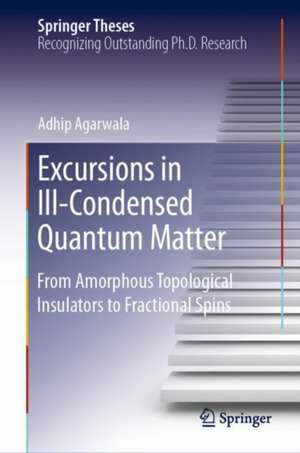
Excursions in Ill-Condensed Quantum Matter: Springer Theses
Autor Adhip Agarwalaen Limba Engleză Hardback – 25 iun 2019
Din seria Springer Theses
- 15%
 Preț: 663.23 lei
 - 15%
 Preț: 661.49 lei
 - 15%
 Preț: 660.04 lei
 - 18%
 Preț: 1438.89 lei
 -
 Preț: 397.39 lei
 - 18%
 Preț: 1150.06 lei
 - 18%
 Preț: 1261.12 lei
 - 15%
 Preț: 665.20 lei
 -
 Preț: 404.91 lei
 -
 Preț: 401.44 lei
 - 18%
 Preț: 1151.50 lei
 -
 Preț: 410.46 lei
 - 18%
 Preț: 1034.72 lei
 - 18%
 Preț: 977.51 lei
 - 18%
 Preț: 1144.10 lei
 - 15%
 Preț: 663.23 lei
 - 18%
 Preț: 1031.60 lei
 - 15%
 Preț: 638.81 lei
 - 18%
 Preț: 978.49 lei
 -
 Preț: 398.83 lei
 - 15%
 Preț: 667.93 lei
 -
 Preț: 399.72 lei
 - 15%
 Preț: 658.80 lei
 - 15%
 Preț: 663.97 lei
 - 15%
 Preț: 664.46 lei
 - 18%
 Preț: 1263.02 lei
 - 15%
 Preț: 663.48 lei
 - 18%
 Preț: 1035.90 lei
 - 18%
 Preț: 1273.75 lei
 - 18%
 Preț: 1152.69 lei
 - 15%
 Preț: 661.99 lei
 - 18%
 Preț: 1152.90 lei
 - 18%
 Preț: 1264.69 lei
 - 18%
 Preț: 1038.03 lei
 - 18%
 Preț: 1036.63 lei
 - 18%
 Preț: 1156.95 lei
 - 18%
 Preț: 1036.70 lei
 - 18%
 Preț: 979.42 lei
 - 15%
 Preț: 642.59 lei
 - 15%
 Preț: 665.96 lei
 - 18%
 Preț: 976.57 lei
 - 18%
 Preț: 1443.18 lei
 -
 Preț: 401.44 lei
 -
 Preț: 399.14 lei
 - 18%
 Preț: 1034.98 lei
 - 18%
 Preț: 1148.15 lei
 - 15%
 Preț: 658.33 lei
 - 15%
 Preț: 662.51 lei
 - 15%
 Preț: 659.03 lei
 - 15%
 Preț: 659.78 lei
Preț: 663.68 lei
Preț vechi: 780.80 lei
-15%
Puncte Express: 996
Carte tipărită la comandă
Livrare economică 03-17 decembrie
Livrare prin curier în România Termenul estimat este afișat lângă disponibilitate.
Transport gratuit pentru acest produs Plată online sau ramburs, în funcție de opțiunile comenzii.
Retur gratuit în 14 zile Comandă securizată și suport în română.
Specificații
ISBN-13: 9783030215101
ISBN-10: 3030215105
Pagini: 188
Ilustrații: XXIII, 163 p. 59 illus., 49 illus. in color.
Dimensiuni: 160 x 241 x 16 mm
Greutate: 0.4 kg
Ediția:1st ed. 2019
Editura: Springer
Colecția Springer Theses
Seria Springer Theses
Locul publicării:Cham, Switzerland
ISBN-10: 3030215105
Pagini: 188
Ilustrații: XXIII, 163 p. 59 illus., 49 illus. in color.
Dimensiuni: 160 x 241 x 16 mm
Greutate: 0.4 kg
Ediția:1st ed. 2019
Editura: Springer
Colecția Springer Theses
Seria Springer Theses
Locul publicării:Cham, Switzerland
Cuprins
Introduction.- Tenfold Way.- Topological Insulators in Amorphous Systems.- Seeking Topological Phases in Fractals.- Seeking Topological Phases in Fractals.- Killing the Hofstadter Butterfly.- Fractional Spins and Kondo Effect.- Structure of Many-Body Hamiltonians in Different Symmetry Classes.- Epilogue.
Notă biografică
A physics major from Hindu College, University of Delhi and a Masters in Physics from Indian Institute of Technology (Delhi), Adhip Agarwala pursued his PhD from Department of Physics, Indian Institute of Science, Bangalore (India). Currently, he is a postdoctoral researcher based at the International Centre for Theoretical Sciences, Tata Institute of Fundamental Research, Bangalore. He works in the field of theoretical quantum condensed matter with focus on topological systems, strongly correlated materials and driven systems.
Textul de pe ultima copertă
Impurities, disorder or amorphous systems – ill-condensed matter – are mostly considered inconveniences in the study of materials, which is otherwise heavily based on idealized perfect crystals. The Kondo effect and the scaling theory of localization are among the fundamental and early discoveries which revealed the novelty hidden in impure or disordered systems. Recent advances in condensed matter physics have emphasized the role of topology, spin-orbit coupling, and certain discrete symmetries such as time reversal in many physical phenomena. These have irreversibly transformed the essential ideas and purview of condensed matter physics, both in theoretical and experimental directions. However, many of these recent developments and their implications are limited to, or by, ideas that pertain to clean systems. This thesis deals with various aspects of these new developments, but in the case of unclean systems. The author introduces new ideas such as amorphous topological insulators, fractalized metals and fractionalized spins.
Caracteristici
Nominated as an outstanding Ph.D. thesis by the Indian Institute of Science, Bangalore, India Quick and easy introduction to topological phases, disorder physics and the Kondo effect Detailed discussion and derivation of tenfold way of free fermion symmetry classification with explicit examples