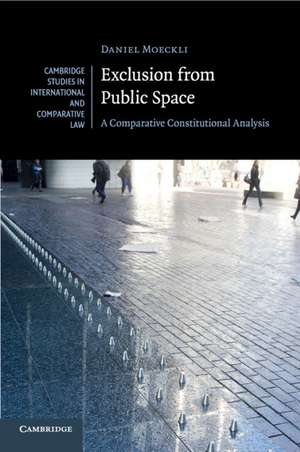
Exclusion from Public Space: Cambridge Studies in International and Comparative Law
Autor Daniel Moecklien Limba Engleză Paperback – 31 aug 2018
Din seria Cambridge Studies in International and Comparative Law
-
 Preț: 206.54 lei
 - 14%
 Preț: 720.49 lei
 -
 Preț: 365.55 lei
 - 14%
 Preț: 728.40 lei
 - 14%
 Preț: 730.76 lei
 -
 Preț: 333.50 lei
 -
 Preț: 230.37 lei
 - 14%
 Preț: 803.88 lei
 - 11%
 Preț: 670.55 lei
 - 14%
 Preț: 747.62 lei
 -
 Preț: 366.32 lei
 - 14%
 Preț: 913.09 lei
 -
 Preț: 334.85 lei
 - 14%
 Preț: 738.37 lei
 -
 Preț: 318.53 lei
 - 8%
 Preț: 246.79 lei
 - 14%
 Preț: 1035.14 lei
 -
 Preț: 293.36 lei
 -
 Preț: 249.68 lei
 -
 Preț: 250.80 lei
 -
 Preț: 296.51 lei
 -
 Preț: 371.42 lei
 -
 Preț: 369.08 lei
 - 14%
 Preț: 1043.86 lei
 -
 Preț: 330.67 lei
 -
 Preț: 330.13 lei
 -
 Preț: 297.25 lei
 -
 Preț: 289.48 lei
 -
 Preț: 412.92 lei
 -
 Preț: 364.81 lei
 -
 Preț: 331.60 lei
 -
 Preț: 294.84 lei
 - 14%
 Preț: 745.70 lei
 -
 Preț: 333.65 lei
 - 14%
 Preț: 863.81 lei
 -
 Preț: 292.43 lei
 - 14%
 Preț: 914.21 lei
Preț: 444.65 lei
Puncte Express: 667
Carte tipărită la comandă
Livrare economică 13-27 iulie
Livrare prin curier în România Termenul estimat este afișat lângă disponibilitate.
Transport gratuit pentru acest produs Plată online sau ramburs, în funcție de opțiunile comenzii.
Retur gratuit în 14 zile Comandă securizată și suport în română.
Specificații
ISBN-13: 9781316608296
ISBN-10: 1316608298
Pagini: 578
Dimensiuni: 152 x 229 x 31 mm
Greutate: 0.83 kg
Editura: Cambridge University Press
Seria Cambridge Studies in International and Comparative Law
Locul publicării:Cambridge, United Kingdom
ISBN-10: 1316608298
Pagini: 578
Dimensiuni: 152 x 229 x 31 mm
Greutate: 0.83 kg
Editura: Cambridge University Press
Seria Cambridge Studies in International and Comparative Law
Locul publicării:Cambridge, United Kingdom
V-ar putea interesa
-
 -33%Preț: 751.60 lei1129.24 lei
 -
 Human Rights and Non-discrimination in the 'War on Terror'Daniel Moeckli-14%Preț: 887.70 lei1032.21 lei
 -
 The Nature of Customary Law: Legal, Historical and Philosophical PerspectivesAmanda Perreau-SaussinePreț: 407.80 lei
 -
 The Judicial Assessment of Expert EvidenceDéirdre Dwyer-14%Preț: 915.78 lei1064.87 lei
 -
 Internet Law: Text and MaterialsChris Reed-19%Preț: 509.62 lei629.16 lei
 -
 Legal Ethics: Text and MaterialsRichard O'DairPreț: 455.43 lei
 -
 French Legal CulturesJohn Bell-11%Preț: 445.79 lei500.89 lei
 -
 Rethinking EvidenceWilliam Twining-11%Preț: 545.93 lei613.41 lei
 -
 Strategic Legal WritingDonald N. ZillmanPreț: 275.41 lei
 -
 The Nature and Authority of PrecedentNeil DuxburyPreț: 340.07 lei
 -
 Law and Market Economy: Reinterpreting the Values of Law and EconomicsRobin Paul MalloyPreț: 349.38 lei
 -
 Law and NatureDavid Delaney-14%Preț: 866.38 lei1007.41 lei
 -
 Rethinking PunishmentLeo Zaibert-14%Preț: 665.48 lei773.81 lei
 -
 Le Barreau de Paris, 1810-1870 (Éd.1895)Jules FabrePreț: 470.28 lei
 -
 Preț: 353.27 lei
 -
 Répertoire Général Des Lois, Décrets, Ordonnances, Instructions Sur La Marine (Éd.1849-1859)Claude-François BlanchardPreț: 376.94 lei
 -
 Répertoire Universel Et Raisonné de Jurisprudence. Edition 4, Tome 14 (Éd.1812-1825)Philippe-Antoine MerlinPreț: 353.27 lei
 -
 Preț: 338.16 lei
 -
 Répertoire Universel Et Raisonné de Jurisprudence. Tome 13, Edition 4 (Éd.1812-1825)Philippe-Antoine MerlinPreț: 345.62 lei
 -
 Répertoire Universel Et Raisonné de Jurisprudence. Tome 15, Edition 4 (Éd.1812-1825)Philippe-Antoine MerlinPreț: 295.78 lei
 -
 Preț: 296.15 lei
 -
 Sabbats Ou Synagogues Sur Les Bords Du Lac d'Annecy (2e Éd.) (Éd.1896)Joseph-Marie LavanchyPreț: 83.88 lei
 -
 Société de la morale chrétienne. Comité pour l'abolition de la traite des noirs (Éd.1826)Auguste-Louis de Staël-HolsteinPreț: 83.68 lei
 -
 Traité de Législation Et d'Exploitation Postales (Éd.1891)Paul JaccotteyPreț: 402.60 lei
 -
 Traité Élémentaire de Droit Commercial, (Éd.1898)Edmond-Eugène ThallerPreț: 432.47 lei
 -
 Traité Historique Et Pratique Des Droits Seigneuriaux (Éd.1765)Joseph RenauldonPreț: 354.39 lei
 -
 Preț: 316.77 lei
 -
 Preț: 397.86 lei
 -
 Preț: 370.05 lei
 -
 La propriété intellectuelle du salariéDimitri ProkhorovPreț: 260.89 lei
Cuprins
Summary contents; Contents; Abbreviations; 1. Introduction: 1.1 Exclusion from public space and its challenges to liberal democracy; 1.2 Methodology; 1.3 Scope of research; 1.4 Language and terminology; 1.5 Structure of the study; 2. Public Space and its Transformation: 2.1 The definition of 'public space' and related concepts; 2.2 Historical background; 2.3 The importance of public space; 2.4 Regulation of the use of public spac; 2.5 The transformation of public space; 2.6 Conclusion; 3. Exclusion from Public Space: 3.1 Historical background: the decline of banishment; 3.2 The resurgence of exclusion; 3.3 The targets of exclusio; 3.4 A typology of exclusion measures; 3.5 Conclusion; 4. Rule of Law: 4.1 The rule of law/Rechtsstaatsprinzip; 4.2 Principle of legality; 4.3 Requirement of sufficient precision; 4.4 Procedural safeguards and access to justice; 4.5 Conclusion; 5. Fundamental Rights: Liberty: 5.1 Fundamental and human rights; 5.2 Scope of protection; 5.3 Limitations; 5.4 Conclusion; 6. Fundamental Rights: Equality: 6.1 The right to equality and non-discrimination; 6.2 Exclusion from public space and the right to equality and non-discrimination; 6.3 Conclusion; 7. Democracy: 7.1 Democracy; 7.2 The democratic legitimacy of exclusion measures; 7.3 The consequences of exclusion measures for democracy; 7.4 Conclusion; 8. A Right (of Access) to Public Space?: 8.1 'Reclaiming public space'?; 8.2 De lege lata: is there a right to public space?; 8.3 De lege ferenda: is there a need for a right to public space?; 8.4 Conclusion; 9. Synthesis: 9.1 Conclusion: exclusion measures in conflict with liberal democracy; 9.2 Outlook: the importance of civic responsibility; Bibliography; Annex I. Overview of the most important exclusion norms; Annex II. Typology of exclusion norms.
Descriere
This book explores the implications of banning people from public space for the rule of law, fundamental rights, and democracy.