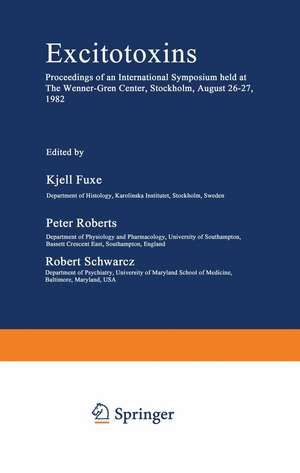
Excitotoxins: Proceedings of an International Symposium held at The Wenner-Gren Center, Stockholm, August 26–27, 1982: Wenner-Gren Center International Symposium Series, cartea 39
Editat de Kjell Fuxeen Limba Engleză Paperback – 8 oct 2012

Preț: 622.11 lei
Preț vechi: 731.90 lei
-15%
Puncte Express: 933
Carte tipărită la comandă
Livrare economică 01-15 decembrie
Livrare prin curier în România Termenul estimat este afișat lângă disponibilitate.
Transport gratuit pentru acest produs Plată online sau ramburs, în funcție de opțiunile comenzii.
Retur gratuit în 14 zile Comandă securizată și suport în română.
Specificații
ISBN-13: 9781475703863
ISBN-10: 1475703864
Pagini: 380
Ilustrații: XII, 363 p. 83 illus., 5 illus. in color.
Dimensiuni: 170 x 244 x 20 mm
Greutate: 0.6 kg
Ediția:1983
Editura: Springer Us
Colecția Springer
Seria Wenner-Gren Center International Symposium Series
Locul publicării:New York, NY, United States
ISBN-10: 1475703864
Pagini: 380
Ilustrații: XII, 363 p. 83 illus., 5 illus. in color.
Dimensiuni: 170 x 244 x 20 mm
Greutate: 0.6 kg
Ediția:1983
Editura: Springer Us
Colecția Springer
Seria Wenner-Gren Center International Symposium Series
Locul publicării:New York, NY, United States
V-ar putea interesa
-
 -10%Preț: 373.73 lei413.20 lei
 -
 -34%Preț: 570.52 lei867.38 lei
 -
 Collective EmotionsChristian von Scheve-31%Preț: 813.66 lei1174.88 lei
 -
 Plants and the Human BrainDavid O. Kennedy-34%Preț: 681.03 lei1035.97 lei
 -
 Explorations in Learning and the BrainTon De De JongPreț: 364.08 lei
 -
 Myth of Mirror NeuronsGregory HickokPreț: 282.88 lei
 -
 Curious BehaviorRobert R. ProvinePreț: 207.21 lei
 -
 Neurobehavioral Disorders of ChildhoodRobert Melillo-5%Preț: 1675.02 lei1763.18 lei
 -
 IncognitoDavid EaglemanPreț: 93.83 lei
 -
 The Autistic BrainTemple Grandin-24%Preț: 97.04 lei128.05 lei
 -
 Biopsy Diagnosis of Peripheral NeuropathyJuan M. Bilbao-5%Preț: 1530.78 lei1611.34 lei
Public țintă
ResearchCuprins
Session I Excitotoxic Amino Acids: Localization, Chemistry, Physiology, Pharmacology and Biochemistry.- Identification of excitatory amino acid pathways in the mammalian nervous system.- Electrophysiological actions of kainate and other excitatory amino acids, and the structure of their receptors.- Two types of excitatory amino acid responses in the cat caudate nucleus.- Recent advances in the pharmacology of excitatory amino acids in the mammalian central nervous system.- Alteration by kainate of energy stores and neuronal-glial metabolism of glutamate in vitro.- Receptors for excitotoxins.- Overview Lecture.- Excitotoxins: An overview.- Session II Mechanisms of Excitotoxicity.- Neuronal degeneration after intracerebral injections of excitotoxins. A histological analysis of kainic acid, ibotenic acid and quinolinic acid lesions in the rat.- Kainic acid: Insight into its receptor-mediated neurotoxic mechanisms.- The neurodegenerative properties of intracerebral quinolinic acid and its structural analog cis-2,3- piperidine dicarboxylic acid.- Studies on excitatory amino acid receptors and their interactions and regulation of pre- and postsynaptic dopaminergic mechanism in the rat telencephalon.- Electrophysiological and pharmacological studies on kainic acid-induced neuronal activation.- An analysis of bioelectrical phenomena evoked by microiontophoretically applied excitotoxic amino-acids in the feline spinal cord.- The role of seizures in kainic acid induced brain damage.- Excitatory amino acid transmitters in cerebellum and optic tectum.- Mechanisms of excitotoxins examined in organotypic cultures of rat central nervous system.- Session III Excitotoxins as Tools in Neuroscience.- Ibotenate as a tool in neurobiology. Studies on dopaminergic and cholecystokinin immunoreactive neurons after ibotenate induced lesions.- Characterization of striatal ibotenate lesions and of 6-hydroxydopamine induced nigral lesions by morphometric and densitometric approaches.- Effects of ibotenate acid stereotactically injected into striatum or hippocampus on local blood flow and glucose utilization in rats.- Synaptic rearrangements in the kainic acid model of ammon’s horn sclerosis.- On the problem of distant lesions in behavioural studies utilizing kainic acid.- Kainic acid injections into the rat neostriatum: Effects on learning and exploration.- Effects of neurotoxic excitatory amino acids on neuroendocrine regulation.- Session IV Clinical Aspects.- Adverse reactions in humans thought to be related to ingestion of elevated levels of free monosodium glutamate (MSG) (Chinese Restaurant Syndrome and Other Reactions).- Temporal lobe epilepsy, excitotoxins and the mechanism of selective neuronal loss.- Huntington’s disease: anti-neurotoxic therapeutic strategies.- Excitotoxicity in ageing and dementia.