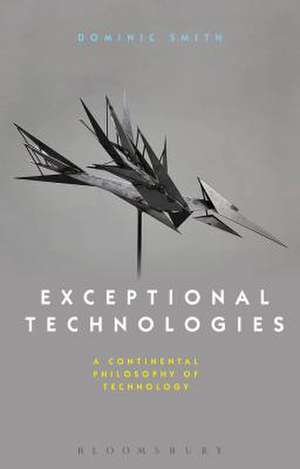
Exceptional Technologies: A Continental Philosophy of Technology
Autor Dominic Smithen Limba Engleză Hardback – 23 aug 2018
Philosophy of technology regularly draws on key thinkers in the Continental tradition, including Husserl, Heidegger, and Foucault. Yet because of the problematic legacy of the 'empirical turn', it often criticizes 'bad' continental tendencies - lyricism, pessimism, and an outdated view of technology as an autonomous, transcendental force. This misconception is based on a faulty image of Continental thought, and in addressing it Smith productively redefines our concept of technology.
By closely engaging key texts, and by examining 'exceptional technologies' such as imagined, failed, and impossible technologies that fall outside philosophy of technology's current focus, this book offers a practical guide to thinking about and using continental philosophy and philosophy of technology. It outlines and enacts three key characteristics of philosophy as practiced in the continental tradition: close reading of the history of philosophy; focus on critique; and openness to other disciplinary fields. Smith deploys the concept of exceptional technologies to provide a novel way of widening discussion in philosophy of technology, navigating the relationship between philosophy of technology and Continental philosophy; the history of both these fields; the role of imagination in relation to technologies; and the social function of technologies themselves.
Preț: 581.47 lei
Preț vechi: 768.21 lei
-24%
Puncte Express: 872
Carte tipărită la comandă
Livrare economică 05-19 decembrie
Livrare prin curier în România Termenul estimat este afișat lângă disponibilitate.
Transport gratuit pentru acest produs Plată online sau ramburs, în funcție de opțiunile comenzii.
Retur gratuit în 14 zile Comandă securizată și suport în română.
Specificații
ISBN-13: 9781350015609
ISBN-10: 1350015601
Pagini: 180
Dimensiuni: 156 x 234 x 14 mm
Greutate: 0.43 kg
Ediția:HPOD
Editura: Bloomsbury Publishing
Colecția Bloomsbury Academic
Locul publicării:London, United Kingdom
ISBN-10: 1350015601
Pagini: 180
Dimensiuni: 156 x 234 x 14 mm
Greutate: 0.43 kg
Ediția:HPOD
Editura: Bloomsbury Publishing
Colecția Bloomsbury Academic
Locul publicării:London, United Kingdom
Cuprins
List of Figures
Acknowledgements
Introduction: Picturing Technology
1. Picturing Technology Today
2. Key Terms
3. Structure and Limits
Chapter One: A Sense of the Transcendental
1. Malabou's Sense
2. Expanding Sense
3. Expanding Further: From Minimal to Maximal Sense
4. Philosophy of Technology: Making Sense of Many Turns
Chapter Two: The Blank Page
1. 'This White Paper'
2. Varying Conditions
3. Re-Imagining Relevance (1)
4. Re-Imagining Relevance (2)
Chapter Three: Embodiment Conditions
1. On the Internet
2. A Developing Body of Work
3. Situating Embodiment Conditions: 4e
4. Crossover Potentials: Between Philosophy of Technology, Media Theory and 4e
Chapter Four: Three Exceptional Technologies
1. Everything but the Network: Vannevar Bush's Memex
2. 'Pictorial Statistics': Francis Galton's Composite Photography
3. 'Machine with Concrete': Arthur Ganson's Gestural Engineering
4. Problems and Prospects
Chapter Five: Which Way to Turn?
1. The Empirical Turn: An Enduring Influence in Philosophy of Technology?
2. The Speculative Turn: A New Beginning in Continental Philosophy?
3. An Alternative Picture: Method as 'Mapping'
4. A Shared Field of Exceptional Complexities
Conclusion: Exceptional Technologies, Not Technological Exceptionalism
Notes
References
Index
Acknowledgements
Introduction: Picturing Technology
1. Picturing Technology Today
2. Key Terms
3. Structure and Limits
Chapter One: A Sense of the Transcendental
1. Malabou's Sense
2. Expanding Sense
3. Expanding Further: From Minimal to Maximal Sense
4. Philosophy of Technology: Making Sense of Many Turns
Chapter Two: The Blank Page
1. 'This White Paper'
2. Varying Conditions
3. Re-Imagining Relevance (1)
4. Re-Imagining Relevance (2)
Chapter Three: Embodiment Conditions
1. On the Internet
2. A Developing Body of Work
3. Situating Embodiment Conditions: 4e
4. Crossover Potentials: Between Philosophy of Technology, Media Theory and 4e
Chapter Four: Three Exceptional Technologies
1. Everything but the Network: Vannevar Bush's Memex
2. 'Pictorial Statistics': Francis Galton's Composite Photography
3. 'Machine with Concrete': Arthur Ganson's Gestural Engineering
4. Problems and Prospects
Chapter Five: Which Way to Turn?
1. The Empirical Turn: An Enduring Influence in Philosophy of Technology?
2. The Speculative Turn: A New Beginning in Continental Philosophy?
3. An Alternative Picture: Method as 'Mapping'
4. A Shared Field of Exceptional Complexities
Conclusion: Exceptional Technologies, Not Technological Exceptionalism
Notes
References
Index
Recenzii
Smith's critical reconsideration of the transcendental in technoscientific life seems to mark out a promising way forward.
In Exceptional Technologies, Smith offers a completely new take on philosophy of technology via the tradition of transcendental thought in continental philosophy. He shows us how usual notions of contemporary philosophy of technology, usually conceived as wedded to the empirical turn, can be revitalised when technology is thought in relation to the transcendental. By using the example of exceptional technologies - such as failed inventions, artworks with impossible aims and other marginalised technologies - Smith has produced a book that is insightful, exciting, entirely compelling and a must read for anyone interested in staying at the cutting-edge of philosophy and media theory in the contemporary era.
Dominic Smith offers a timely study, just when the popular empirical turn in technoscience studies is beginning to feel more constraining than liberating. He presents no "reification of Technology" of the sort empiricists oppose. Instead he recommends a transcendental analysis of "general conditions" in technoscientific life whose presence is just as empirical as any artifact's. What makes Exceptional Technologies original and noteworthy, however, is Smith's discussion of "exceptional" (i.e., failed) technologies. Precisely as exceptional, he argues, they are uniquely effective reminders that generally accepted conditions are what typically go unnoticed when we are happily preoccupied with concrete technologies that work.
In this important contribution to the philosophy of technology, Smith engages with some of the most interesting topics in media and technology, from photography, to the Internet, and even the humble sheet of paper, that most helpful technology for the writing of philosophy. Advocating for a renewed sense of the transcendental, Smith focuses on the conditions of possibility that structure and define any given technology, both successful technologies and failed ones, hypothetical devices and impossible ones. Such marginal or paradoxical exceptions come to define what technology is, and, most importantly, what technology might become.
In Exceptional Technologies, Smith offers a completely new take on philosophy of technology via the tradition of transcendental thought in continental philosophy. He shows us how usual notions of contemporary philosophy of technology, usually conceived as wedded to the empirical turn, can be revitalised when technology is thought in relation to the transcendental. By using the example of exceptional technologies - such as failed inventions, artworks with impossible aims and other marginalised technologies - Smith has produced a book that is insightful, exciting, entirely compelling and a must read for anyone interested in staying at the cutting-edge of philosophy and media theory in the contemporary era.
Dominic Smith offers a timely study, just when the popular empirical turn in technoscience studies is beginning to feel more constraining than liberating. He presents no "reification of Technology" of the sort empiricists oppose. Instead he recommends a transcendental analysis of "general conditions" in technoscientific life whose presence is just as empirical as any artifact's. What makes Exceptional Technologies original and noteworthy, however, is Smith's discussion of "exceptional" (i.e., failed) technologies. Precisely as exceptional, he argues, they are uniquely effective reminders that generally accepted conditions are what typically go unnoticed when we are happily preoccupied with concrete technologies that work.
In this important contribution to the philosophy of technology, Smith engages with some of the most interesting topics in media and technology, from photography, to the Internet, and even the humble sheet of paper, that most helpful technology for the writing of philosophy. Advocating for a renewed sense of the transcendental, Smith focuses on the conditions of possibility that structure and define any given technology, both successful technologies and failed ones, hypothetical devices and impossible ones. Such marginal or paradoxical exceptions come to define what technology is, and, most importantly, what technology might become.