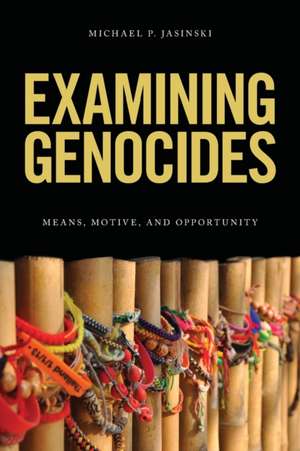
Examining Genocides: Means, Motive, and Opportunity
Autor Michael P. Jasinskien Limba Engleză Paperback – 31 mai 2017
Examining Genocide considers these questions by interrogating the interaction of three sets of conditions. These are: a societal crisis that creates a need for mass mobilization to "heal" the fractured public and address its material concerns; the stereotype associated with an "eligible target" for scapegoating; and the leadership preferences and skills of the chief executive of an authoritarian or poorly institutionalized state in question. Exploring case studies that cover various levels and instances of genocide, this book offers new insights to this highly researched field for scholars and students alike.
Preț: 329.49 lei
Preț vechi: 407.21 lei
-19%
Puncte Express: 494
Carte tipărită la comandă
Livrare economică 01-15 decembrie
Livrare prin curier în România Termenul estimat este afișat lângă disponibilitate.
Transport gratuit de la 400.00 lei Plată online sau ramburs, în funcție de opțiunile comenzii.
Retur gratuit în 14 zile Comandă securizată și suport în română.
Specificații
ISBN-13: 9781783489183
ISBN-10: 1783489189
Pagini: 240
Dimensiuni: 151 x 228 x 19 mm
Greutate: 0.36 kg
Editura: Bloomsbury Publishing
Colecția Rowman & Littlefield
Locul publicării:New York, United States
ISBN-10: 1783489189
Pagini: 240
Dimensiuni: 151 x 228 x 19 mm
Greutate: 0.36 kg
Editura: Bloomsbury Publishing
Colecția Rowman & Littlefield
Locul publicării:New York, United States
Cuprins
1. Introduction / 2. Genocide as Product of Means, Motive, and Opportunity / 3. Ottoman Empire and Turkey / 4. Germany in Two World Wars / 5. Eastern Europe and the Holocaust / 6. USSR and Cambodia / 7. The Rwanda Genocide / 8. Conclusions
Recenzii
Examining Genocides is an attempt to understand events that seems to defy explanation. Jasinski (Univ. of Wisconsin-Oshkosh) takes a semi-legal perspective in his analysis, determining that genocide can occur only when there is proper means, motive, and opportunity. The window of opportunity consists of two elements-conditions in which scapegoating becomes advantageous and there is a collectivity available for scapegoating. However, opportunity alone is not enough for genocide to occur. After opportunity arises, there must be an intentional decision to exploit the opportunity, usually made by the political leaders of the country. Finally, the means to commit genocide must be within the control of the political entrepreneurs. After proposing these elements to genocide, Jasinski uses several cases of genocide to examine whether they follow the means, motive, opportunity trifecta. Jasinski's material is interesting...Advanced students and scholars will find this work of interest. Summing Up: Recommended. Graduate students through faculty.
Lucidly written and cogently argued. Jasinski so perceptively identifies the forces at play that have led to the most heinous crimes of our era.
Lucidly written and cogently argued. Jasinski so perceptively identifies the forces at play that have led to the most heinous crimes of our era.