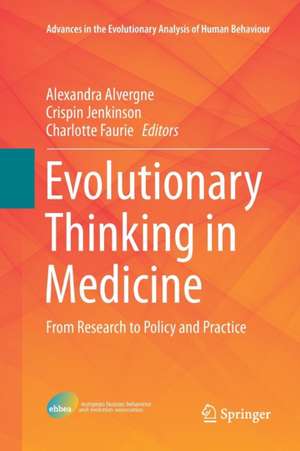
Evolutionary Thinking in Medicine: Advances in the Evolutionary Analysis of Human Behaviour
Editat de Alexandra Alvergne, Crispin Jenkinson, Charlotte Faurieen Limba Engleză Paperback – 27 mai 2018
Observăm în Evolutionary Thinking in Medicine o schimbare de paradigmă esențială: abordarea „conflictului fetal-matern” nu doar ca fenomen biologic, ci ca algoritm clinic pentru înțelegerea rezultatelor adverse în sarcina umană. Analizând dilema obstetrică a travaliului obstrucționat, volumul propune o metodologie de diagnostic ce depășește simptomatologia imediată, căutând cauzele proximale în adaptarea evolutivă a speciei noastre. Găsim în această primă ediție o structură riguroasă, care ghidează cititorul de la fundamentele teoretice către aplicații complexe în cardiologie și oncologie. De exemplu, capitolul dedicat strategiilor darwiniene pentru evitarea rezistenței la medicamente în cancer oferă un protocol de gândire strategică pentru oncologi, transformând biologia evoluționistă dintr-o disciplină abstractă într-un instrument de management terapeutic. Pe linia clinică a lucrării Evolutionary Medicine de Stephen C. Stearns, dar cu un accent mult mai pronunțat pe politici de sănătate publică și practică medicală directă, acest manual integrează date despre nutriție (raportul omega-6/omega-3) și sănătate mintală (binge eating) într-un cadru coerent. Structura progresivă a cărții facilitează tranziția de la originile dezvoltării sănătății la patologiile civilizației moderne, fiecare capitol fiind susținut de casete explicative și glosare care fac informația accesibilă atât cercetătorilor, cât și practicienilor. Recomandăm acest volum pentru rigoarea cu care tratează amprentele evolutive asupra fiziopatologiei cardiovasculare, oferind o perspectivă integrată asupra omului modern.
Preț: 598.75 lei
Preț vechi: 630.26 lei
-5%
Carte tipărită la comandă
Livrare economică 24 noiembrie-08 decembrie
Specificații
ISBN-10: 3319806343
Pagini: 396
Ilustrații: XIV, 382 p. 37 illus., 17 illus. in color.
Dimensiuni: 155 x 235 x 22 mm
Greutate: 0.6 kg
Ediția:Softcover reprint of the original 1st edition 2016
Editura: Springer
Colecția Advances in the Evolutionary Analysis of Human Behaviour
Seria Advances in the Evolutionary Analysis of Human Behaviour
Locul publicării:Cham, Switzerland
V-ar putea interesa
-
 Basic Radiology, Second EditionMichael Chen-34%Preț: 569.65 lei863.87 lei
 -
 Quality of Life Measurement in Neurodegenerative and Related ConditionsCrispin Jenkinson-5%Preț: 389.10 lei409.58 lei
 -
 -5%Preț: 351.20 lei369.69 lei
 -
 Forced to Care – Coercion and Caregiving in AmericaEvelyn Nakano Glenn-5%Preț: 230.97 lei243.12 lei
 -
 Science Occupational HealthLundberg-5%Preț: 338.82 lei356.65 lei
 -
 Actualidades En Preservación De CadáveresEdmundo Denis Rodríguez-5%Preț: 122.84 lei129.30 lei
 -
 It's Your DecisionCamille M. Renella-5%Preț: 131.72 lei138.66 lei
 -
 Nanobioceramics for Healthcare ApplicationsEng San Thian-5%Preț: 902.96 lei950.48 lei
 -
 -19%Preț: 169.70 lei210.30 lei
 -
 Measuring Health And Medical OutcomesCrispin Jenkinson-5%Preț: 576.07 lei606.38 lei
 -
 Percepção de mulheres grávidas sobre a atuação dos profissionaisJanaína Alvarenga Aragão-5%Preț: 242.35 lei255.10 lei
 -
 Épanchements pleuraux post traumatiques : L'apport de l'échographieHichem Malhloufi-5%Preț: 608.68 lei640.71 lei
 -
 -5%Preț: 435.05 lei457.95 lei
 -
 Agua y ElectrolitosJean Le'Clerc Nicolas-5%Preț: 242.72 lei255.50 lei
 -
 Canalización eco guiada por EnfermeríaAna Belén Sánchez - García-5%Preț: 240.96 lei253.64 lei
 -
 Síndrome FebriI en el Trópico: Viajeros y Salud InternacionalJuan Fco. Plaza Torres-5%Preț: 649.09 lei683.26 lei
 -
 -5%Preț: 240.96 lei253.64 lei
 -
 Conocimientos de métodos anticonceptivos en jóvenes mexicanosJavier Salazar M-5%Preț: 433.28 lei456.08 lei
 -
 La Medicina Verde en la salud AnimalFrancisco José Delmás Bello-5%Preț: 332.10 lei349.58 lei
 -
 -5%Preț: 241.80 lei254.52 lei
 -
 A Book for You Living with DementiaSwedish Dementia Centre-5%Preț: 92.61 lei97.48 lei
De ce să citești această carte
Recomandăm această carte profesioniștilor din sănătate care doresc să înțeleagă rădăcinile biologice ale bolilor cronice și acute. Cititorul câștigă o perspectivă sistemică asupra medicinei, învățând să aplice principii evoluționiste în decizii clinice și de politici publice. Este o resursă indispensabilă pentru a înțelege de ce anumite tratamente eșuează din cauza rezistenței evolutive și cum putem adapta protocoalele medicale la biologia umană reală, nu doar la simptome izolate.
Despre autor
Volumul este coordonat de o echipă de experți de renume. Alexandra Alvergne este specialistă în antropologie evoluționistă, cercetările sale concentrându-se pe intersecția dintre biologie, sănătate și comportament uman. Alături de ea, Crispin Jenkinson aduce o vastă experiență în metodologie și rezultatele raportate de pacienți, fiind profesor la Universitatea Oxford. Charlotte Faurie completează echipa editorială cu expertiza sa în ecologie umană și biologie evoluționistă. Împreună, acești editori au reușit să sintetizeze contribuțiile unor cercetători de top pentru a oferi o viziune unitară asupra modului în care trecutul nostru biologic modelează medicina contemporană.
Descriere scurtă
Cuprins
Recenzii
Notă biografică
Charlotte Faurie is a CNRS researcher in Human Evolutionary Biology at the Institutefor Evolutionary Sciences in Montpellier University, France. She trained as an evolutionary biologist, focusing on the evolution of the polymorphism of hand preference in human populations. She then held a Marie Curie Post-doctoral Fellowship in the UK, in the Department of Animal and Plant Sciences at Sheffield University, where she investigated the effects of competitive and cooperative interactions among siblings on life-history traits. Back in France, she focused on questions about parental investment, and how sexual selection shapes the evolution of cooperation in humans. She currently leads research programs on human genetic and behavioural adaptations, and on the medicalization of birth. She teaches evolutionary biology and medicine in several master’s programs in France. She is also a student at the Medical School of Montpellier.
Crispin Jenkinson is Professor of Health Services Research, and Director of the Health Services Research Unit (HSRU), at the Nuffield Department of Population Health and a Senior Research Fellow of Harris Manchester College in the University of Oxford. He graduated from Bedford College (University of London) before coming to Oxford where he gained an MSc in Psychology and then undertook research on the psychological impact of long-term illness for a DPhil. Prior to joining the HSRU in 1992, he was a research fellow at Nuffield College, Oxford. His main research interests include patient reported outcomes and health status measurement, the evaluation of patient experiences of medical care, and methodology. He has extensive experience of developing and validating outcome measures and, in collaboration with others, has conducted randomised controlled trials in which such instruments have been primary end-points.