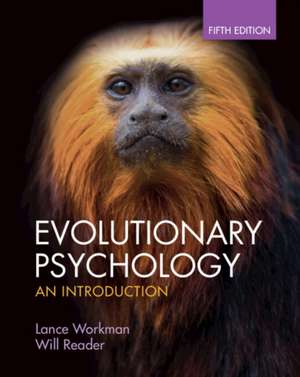
Evolutionary Psychology
Autor Lance Workman, Will Readeren Limba Engleză Hardback – sep 2025
Preț: 911.88 lei
Preț vechi: 1184.26 lei
-23%
Puncte Express: 1368
Carte tipărită la comandă
Livrare economică 01-15 decembrie
Livrare prin curier în România Termenul estimat este afișat lângă disponibilitate.
Transport gratuit pentru acest produs Plată online sau ramburs, în funcție de opțiunile comenzii.
Retur gratuit în 14 zile Comandă securizată și suport în română.
Specificații
ISBN-13: 9781009452939
ISBN-10: 1009452932
Pagini: 520
Dimensiuni: 208 x 260 x 32 mm
Greutate: 1.27 kg
Ediția:5th edition
Editura: Cambridge University Press
ISBN-10: 1009452932
Pagini: 520
Dimensiuni: 208 x 260 x 32 mm
Greutate: 1.27 kg
Ediția:5th edition
Editura: Cambridge University Press
V-ar putea interesa
-
 The Oxford Handbook of Evolutionary Psychology and ReligionJames R. Liddle-32%Preț: 928.22 lei1365.57 lei
 -
 Foundations of ConsciousnessAntti RevonsuoPreț: 339.58 lei
 -
 -15%Preț: 444.99 lei523.51 lei
 -
 Preț: 366.51 lei
 -
 -11%Preț: 495.57 lei556.82 lei
Cuprins
1. Introduction to evolutionary psychology; 2. Principles of evolutionary change; 3. Sexual selection; 4. The evolution of human mate choice; 5. Cognitive development and the innateness issue; 6. Social development; 7. The evolutionary psychology of social behaviour: kin relationships and conflict; 8. The evolutionary psychology of social behaviour: reciprocity and group behaviour; 9. Evolution, thought and cognition; 10. The evolution of language; 11. The evolution of emotion; 12. Evolutionary psychopathology and Darwinian medicine; 13. Evolution and individual differences; 14. Evolutionary psychology and culture; Glossary; References; Index.
Notă biografică
Will Reader is Senior Lecturer in Psychology at Sheffield Hallam University in the UK. Previously he taught at the Robert Gordon University in Aberdeen, at Cardiff University, at the University of Glamorgan (now the University of South Wales), and The University of York, where he completed his DPhil in 1994.
Lance Workman is Visiting Professor of Psychology at the University of South Wales in the UK. Previously head of the Psychology Department at Bath Spa University, he received an undergraduate degree in psychology and biology (BA Joint Hons) from Keele University and his doctorate (DPhil) in animal behaviour from the University of Sussex. In 1990 he set up the first undergraduate module in Evolutionary Psychology at a British University.
Lance Workman is Visiting Professor of Psychology at the University of South Wales in the UK. Previously head of the Psychology Department at Bath Spa University, he received an undergraduate degree in psychology and biology (BA Joint Hons) from Keele University and his doctorate (DPhil) in animal behaviour from the University of Sussex. In 1990 he set up the first undergraduate module in Evolutionary Psychology at a British University.
Recenzii
'This is a clearly written, well-organized and massively comprehensive introduction to evolutionary psychology. Disciplinary boundaries are kept loose, and Workman and Reader do not hesitate to discuss adjacent fields when these are relevant. There is a reassuringly friendly tone to the textbook, and readers always know that the authors are on their side, anticipating difficulties and helpfully resolving them as one reads along.' Jerome H. Barkow, Dalhousie University, Canada
'To paraphrase the great molecular biologist and Nobel laureate Jacques Monod, 'A curious aspect of evolutionary psychology is that everybody thinks he understands it'. This book by Workman and Reader enables just that for everyone. Among the many strengths of this highly recommended undergraduate textbook are that it is simple, clear and well written, and it introduces important topics in evolutionary psychology without any need of prior knowledge in the field.' Damjan Franjevic, University of Zagreb, Croatia
'Workman and Reader present evolutionary psychology as a useful perspective for understanding the way the human mind functions today in light of our species' history. The strengths of this textbook include the attractive box sections containing discussions of particularly interesting theories and research results, as well as the vivid, engaging narrative that makes the content accessible not only to psychologists but also to anyone interested in the social sciences.' Łukasz Jach, University of Silesia in Katowice, Poland
'The fourth edition of Evolutionary Psychology by Lance Workman and Will Reader is the continuation of a proven formula: it's easy and pleasant to read, and it provides all the basic information in the field. However, this edition also contains a few important changes: many chapters have been updated with new theories and data from empirical research, and the visual materials are refreshed, extended and printed in colour. I highly recommend this textbook.' Sylwester Orzechowski, University of Wrocław, Poland
'Lance Workman and Will Reader provide an excellent overview of evolutionary psychology in the latest instalment of this textbook. Over fourteen well-written and balanced chapters, they explore key themes relating to how the mind may be shaped through evolution. This textbook is ideally suited for undergraduate students, as well as people interested in an introduction to the field.' Thomas Alrik Sørensen, Aalborg University, Denmark
'Psychology remains in a fragmented state, desperately in need of integration across its sub-disciplines, and this work can provide just such integration. With the organizing framework of evolutionary psychology, it illuminates links between this perspective and cognitive, social, developmental and biological psychologies. Concepts are very well explained, and it contains beautiful illustrations. Criticisms of evolutionary psychology are discussed and addressed in a well-balanced way. I welcome and can strongly recommend this fourth edition, which carries the torch of the earlier very successful editions.' Frederick Toates, The Open University, UK
'Now in its fourth edition, Evolutionary Psychology remains a must-read book for anyone interested in what it means to be human. Drawing on a dazzling range of data and ideas, it presents a brilliant synthesis for students, specialists and the public alike.' Simon Underdown, Oxford Brookes University, UK
'To paraphrase the great molecular biologist and Nobel laureate Jacques Monod, 'A curious aspect of evolutionary psychology is that everybody thinks he understands it'. This book by Workman and Reader enables just that for everyone. Among the many strengths of this highly recommended undergraduate textbook are that it is simple, clear and well written, and it introduces important topics in evolutionary psychology without any need of prior knowledge in the field.' Damjan Franjevic, University of Zagreb, Croatia
'Workman and Reader present evolutionary psychology as a useful perspective for understanding the way the human mind functions today in light of our species' history. The strengths of this textbook include the attractive box sections containing discussions of particularly interesting theories and research results, as well as the vivid, engaging narrative that makes the content accessible not only to psychologists but also to anyone interested in the social sciences.' Łukasz Jach, University of Silesia in Katowice, Poland
'The fourth edition of Evolutionary Psychology by Lance Workman and Will Reader is the continuation of a proven formula: it's easy and pleasant to read, and it provides all the basic information in the field. However, this edition also contains a few important changes: many chapters have been updated with new theories and data from empirical research, and the visual materials are refreshed, extended and printed in colour. I highly recommend this textbook.' Sylwester Orzechowski, University of Wrocław, Poland
'Lance Workman and Will Reader provide an excellent overview of evolutionary psychology in the latest instalment of this textbook. Over fourteen well-written and balanced chapters, they explore key themes relating to how the mind may be shaped through evolution. This textbook is ideally suited for undergraduate students, as well as people interested in an introduction to the field.' Thomas Alrik Sørensen, Aalborg University, Denmark
'Psychology remains in a fragmented state, desperately in need of integration across its sub-disciplines, and this work can provide just such integration. With the organizing framework of evolutionary psychology, it illuminates links between this perspective and cognitive, social, developmental and biological psychologies. Concepts are very well explained, and it contains beautiful illustrations. Criticisms of evolutionary psychology are discussed and addressed in a well-balanced way. I welcome and can strongly recommend this fourth edition, which carries the torch of the earlier very successful editions.' Frederick Toates, The Open University, UK
'Now in its fourth edition, Evolutionary Psychology remains a must-read book for anyone interested in what it means to be human. Drawing on a dazzling range of data and ideas, it presents a brilliant synthesis for students, specialists and the public alike.' Simon Underdown, Oxford Brookes University, UK