Cantitate/Preț
Produs

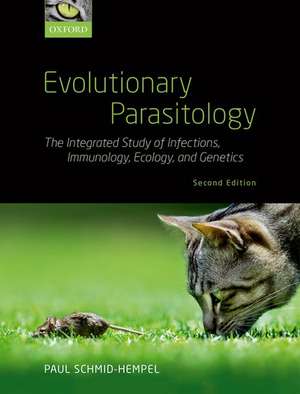
Evolutionary Parasitology: The Integrated Study of Infections, Immunology, Ecology, and Genetics

Autor Paul Schmid-Hempel
en Limba Engleză Hardback – 15 iul 2021

Ceea ce aduce nou această a doua ediție a lucrării Evolutionary Parasitology este o actualizare profundă a unui domeniu care a progresat rapid de la publicarea primei ediții, devenită deja referință standard. Suntem de părere că această revizuire este esențială pentru a include progresele recente din domenii precum genomica evolutivă, filodinamica și studiul microbiotei, elemente care au redefinit înțelegerea noastră asupra modului în care infecțiile modelează lumea naturală. Textul nu se limitează la descrierea paraziților, ci propune o sinteză între imunologie, ecologie și genetică, explorând lupta co-evoluționistă dintre gazde și agenții patogeni.

Structura volumului ghidează cititorul de la bazele moleculare ale interacțiunilor până la strategiile adaptive și consecințele lor ecologice la scară largă. Considerăm că integrarea datelor despre epidemiologia evolutivă și imunologia ecologică oferă o perspectivă holistică, rară în manualele clasice de biologie. Comparabil cu Host-parasite Evolution de Dale H. Clayton în rigurozitatea cu care tratează selecția sexuală și comportamentul, volumul lui Paul Schmid-Hempel se distinge prin actualizarea masivă a datelor privind bolile emergente și evoluția în interiorul gazdei. Vizual, cele 190 de ilustrații color și 71 de tabele sprijină argumentația teoretică, transformând datele complexe în modele accesibile. Este o lucrare care depășește granițele parazitologiei tradiționale, ancorând studiul infecțiilor în centrul biologiei evoluționiste moderne.

Citește tot Restrânge

Preț: 61195 lei

Preț vechi: 86002 lei
-29%

Puncte Express: 918

Carte tipărită la comandă

Livrare economică 28 mai-03 iunie


Specificații

ISBN-13: 9780198832140
ISBN-10: 0198832141
Pagini: 576
Ilustrații: 190 colour line figures and illustrations; 71 tables
Dimensiuni: 194 x 252 x 32 mm
Greutate: 0.14 kg
Ediția:2nd edition
Editura: OUP OXFORD
Colecția OUP Oxford
Locul publicării:Oxford, United Kingdom

De ce să citești această carte

Recomandăm această carte studenților și cercetătorilor care doresc să înțeleagă mecanismele evolutive din spatele bolilor infecțioase. Veți câștiga o perspectivă integrată asupra modului în care paraziții influențează ecosistemele și genetica populațiilor. Este un instrument indispensabil pentru cei care lucrează în sănătate publică, conservare sau epidemiologie, oferind rigoarea științifică necesară pentru a descifra complexitatea interacțiunilor biologice actuale.


Despre autor

Paul Schmid-Hempel este profesor de ecologie experimentală la prestigioasa universitate ETH din Zürich, Elveția. Recunoscut la nivel internațional ca lider al unui grup de cercetare dedicat ecologiei evolutive a interacțiunilor gazdă-parazit, munca sa se concentrează pe modul în care selecția naturală modelează sistemele imunitare și strategiile de supraviețuire ale agenților patogeni. Expertiza sa vastă în biologie experimentală și ecologie comportamentală conferă acestei lucrări o autoritate academică incontestabilă, îmbinând cercetarea de teren cu modelele teoretice avansate.


Descriere

Parasites and infectious diseases are everywhere and represent some of the most potent forces shaping the natural world. They affect almost every aspect imaginable in the life of their hosts, even as far as the structure of entire ecosystems. Hosts, in turn, have evolved complex defences, with immune systems being among the most sophisticated processes known in nature. In response, parasites have again found ways to manipulate and exploit their hosts. Ever since life began, hosts and parasites have taken part in this relentless co-evolutionary struggle with far-reaching consequences for us all.Today, concepts borrowed from evolution, ecology, parasitology, and immunology have formed a new synthesis for the study of host-parasite interactions. Evolutionary parasitology builds on these established fields of scientific enquiry but also includes some of the most successful inter-disciplinary areas of modern biology such as evolutionary epidemiology and ecological immunology. The first edition of this innovative text quickly became the standard reference text for this new discipline. Since then, the field has progressed rapidly and an update is now required. This new edition has been thoroughly revised to provide a state-of-the-art overview, from the molecular bases to adaptive strategies and their ecological and evolutionary consequences. It includes completely new material on topics such as microbiota, evolutionary genomics, phylodynamics, within-host evolution, epidemiology, disease spaces, and emergent diseases.Evolutionary Parasitology is suitable for advanced undergraduates, graduate level students, and interdisciplinary researchers from a variety of fields including immunology, genetics, sexual selection, population ecology, behavioural ecology, epidemiology, and evolutionary biology. Those studying and working in adjacent fields such as conservation biology, virology, medicine, and public health will also find it an invaluable resource for connecting to the bases of their science.

Recenzii

Review from previous edition ... a wonderful and updated introduction to parasitology, full of fascinating examples and thought-provoking ideas. I think any current researcher in parasitology, or anyone with a slight interest in the field, would undoubtedly benefit from reading at least some of the various topics presented in this book.

Notă biografică

Paul Schmid-Hempel is Emeritus Professor of Biology at the Institute of Integrative Biology (IBZ) and Genetic Diversity Centre at ETH Zürich University, Switzerland. He has made major contributions to the study of strategies of animal behaviour, ecological immunology, and evolutionary ecology, with a focus on social insects and their parasites. Experimentation, field work, laboratory studies, and genetic tools combined these studies. Paul has published several books, taught evolution and ecology at ETH Zurich, and was involved in the public outreach of science. He has served several learned societies, was Vice-President of the European Society for Evolutionary Biology, a Permanent Fellow of the Berlin Institute for Advanced Study (Wissenschaftskolleg) and is a member of the German National Academy of Sciences (Leopoldina).