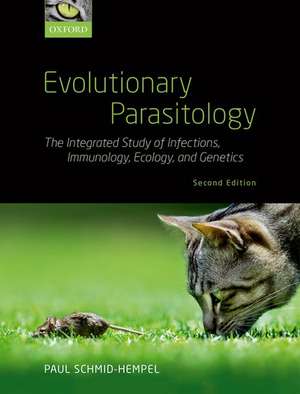
Evolutionary Parasitology
Autor Paul Schmid-Hempelen Limba Engleză Hardback – 25 oct 2021
| Toate formatele și edițiile | Preț | Express |
|---|---|---|
| Paperback (1) | 380.73 lei 44-50 zile | +101.42 lei 7-11 zile |
| OUP OXFORD – 15 iul 2021 | 380.73 lei 44-50 zile | +101.42 lei 7-11 zile |
| Hardback (1) | 741.21 lei 44-50 zile | |
| Oxford University Press – 25 oct 2021 | 741.21 lei 44-50 zile |
Preț: 741.21 lei
Preț vechi: 935.46 lei
-21%
Puncte Express: 1112
Preț estimativ în valută:
131.08€ • 153.82$ • 113.69£
131.08€ • 153.82$ • 113.69£
Carte tipărită la comandă
Livrare economică 12-18 martie
Specificații
ISBN-13: 9780198832140
ISBN-10: 0198832141
Pagini: 576
Ilustrații: 190 colour line figures and illustrations; 71 tables
Dimensiuni: 197 x 249 x 32 mm
Greutate: 1.41 kg
Ediția:2nd edition
Editura: Oxford University Press
Locul publicării:Oxford, United Kingdom
ISBN-10: 0198832141
Pagini: 576
Ilustrații: 190 colour line figures and illustrations; 71 tables
Dimensiuni: 197 x 249 x 32 mm
Greutate: 1.41 kg
Ediția:2nd edition
Editura: Oxford University Press
Locul publicării:Oxford, United Kingdom
Recenzii
Review from previous edition ... a wonderful and updated introduction to parasitology, full of fascinating examples and thought-provoking ideas. I think any current researcher in parasitology, or anyone with a slight interest in the field, would undoubtedly benefit from reading at least some of the various topics presented in this book.
Notă biografică
Paul Schmid-Hempel is Emeritus Professor of Biology at the Institute of Integrative Biology (IBZ) and Genetic Diversity Centre at ETH Zürich University, Switzerland. He has made major contributions to the study of strategies of animal behaviour, ecological immunology, and evolutionary ecology, with a focus on social insects and their parasites. Experimentation, field work, laboratory studies, and genetic tools combined these studies. Paul has published several books, taught evolution and ecology at ETH Zurich, and was involved in the public outreach of science. He has served several learned societies, was Vice-President of the European Society for Evolutionary Biology, a Permanent Fellow of the Berlin Institute for Advanced Study (Wissenschaftskolleg) and is a member of the German National Academy of Sciences (Leopoldina).