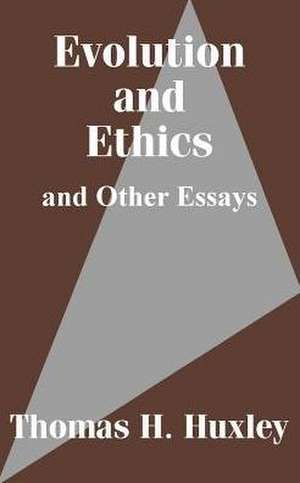
Evolution and Ethics and Other Essays
Autor Thomas Henry Huxleyen Limba Engleză Paperback – 30 noi 2002
Preț: 114.79 lei
Puncte Express: 172
Carte tipărită la comandă
Livrare economică 03-17 decembrie
Livrare prin curier în România Termenul estimat este afișat lângă disponibilitate.
Transport gratuit de la 400.00 lei Plată online sau ramburs, în funcție de opțiunile comenzii.
Retur gratuit în 14 zile Comandă securizată și suport în română.
Specificații
ISBN-13: 9781410203540
ISBN-10: 1410203549
Pagini: 352
Dimensiuni: 127 x 203 x 20 mm
Greutate: 0.31 kg
Editura: University Press of the Pacific
Locul publicării:United States
ISBN-10: 1410203549
Pagini: 352
Dimensiuni: 127 x 203 x 20 mm
Greutate: 0.31 kg
Editura: University Press of the Pacific
Locul publicării:United States
V-ar putea interesa
-
 LIFE UNAUTHORIZED BIOGRAPHY PBRichard ForteyPreț: 108.60 lei
 -
 Darwin's Dangerous IdeaDaniel C. Dennett-27%Preț: 89.72 lei122.95 lei
 -
 The Diversity of LifeEdward O. Wilson-19%Preț: 76.45 lei93.95 lei
 -
 -19%Preț: 68.56 lei85.15 lei
 -
 Darwin: A Very Short IntroductionJonathan Howard-19%Preț: 57.26 lei71.00 lei
 -
 -14%Preț: 255.92 lei296.09 lei
 -
 Origins of Life: From the Birth of Life to the Origin of LanguageJohn Maynard Smith-17%Preț: 162.40 lei195.86 lei
 -
 The Origin and Early Evolution of LifeTom Fenchel-28%Preț: 377.94 lei528.22 lei
 -
 -28%Preț: 421.40 lei582.39 lei
 -
 Genomics and Evolution of Microbial EukaryotesLaura A. Katz-28%Preț: 407.25 lei567.11 lei
 -
 Language EvolutionMorten H. Christiansen-28%Preț: 389.54 lei540.46 lei
 -
 Human Nature and the Limits of ScienceJohn Dupré-20%Preț: 364.38 lei453.29 lei
 -
 Darwin's Legacy: What Evolution Means TodayJohn Dupré-17%Preț: 99.96 lei119.80 lei
 -
 -28%Preț: 84.33 lei116.62 lei
 -
 Charles Darwin: VoyagingJanet BrownePreț: 214.22 lei
 -
 -19%Preț: 75.97 lei93.44 lei
Notă biografică
English scientist and anthropologist Thomas Henry Huxley, was an expert in comparative anatomy. Because of his support of Charles Darwin's theory of evolution, he has come to be known as "Darwin's Bulldog". Although some historians believe that the surviving account of Huxley's well-known 1860 Oxford evolution discussion with Samuel Wilberforce is a later fabrication, the debate was a turning point in both his professional life and the broader acceptance of evolution. The day before, Huxley was about to depart Oxford, but he changed his mind and chose to participate in the debate after seeing Vestiges author Robert Chambers. Richard Owen, Wilberforce's coach, and Huxley engaged in an argument concerning the degree of human-ape relatedness. Huxley publicly endorsed Darwin despite being hesitant to embrace some of his theories, such as gradualism and his ambiguity on natural selection. He battled against the more radical interpretations of religious heritage and was crucial in the development of scientific education in Britain.