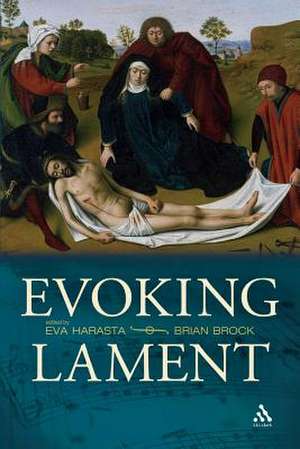
Evoking Lament: A Theological Discussion
Autor Dr Eva Harasta, Dr Brian Brocken Limba Engleză Paperback – 10 oct 2009
Harasta and Brock show how lament seems to introduce notes of mistrust into an otherwise confident relationship with faith, God and His will. In prayer all experiences may be brought to God in openness and trust. Yet lament seems to introduce notes of mistrust into a relationship properly characterized by confident faith in God and His will. Sustained attention to lament presents a challenge to theological reflection in reminding it of the acuteness of the experience of suffering and evil. This volume suggests that a robust concept and practice of lament is an appropriate response to questions of evil and suffering in its refusal to close off questions that cannot and should not be closed. Lament takes place in the eye of the storm of theodicy, and when the distinct content of Christian lament is discovered here the question of theodicy is transformed. The first section reflects on the anthropological conditions of lament, describing it as a hermeneutic for negotiating adverse experiences that transcends the simple opposition of innocent suffering and guilt. The second section reflects on why and how lament has faded from modern theological thought that is over reliant on systematic accounts of evil and whose abstractions have drifted free of religious experience. The third section develops an understanding of trust that includes expressions of lament while not sanitizing its rawness. The final section inquires after the distinct Christian profile of lament. Lament, even as an experience of isolation, stands within the believing community and its traditions. Moreover, because Christian lament is based on Christ's passion and resurrection, Christ endorses and shapes the believers' lament as he shapes their praise.
Preț: 380.62 lei
Preț vechi: 481.67 lei
-21%
Carte tipărită la comandă
Livrare economică 27 noiembrie-11 decembrie
Specificații
ISBN-10: 0567033902
Pagini: 240
Dimensiuni: 156 x 234 x 20 mm
Greutate: 0.36 kg
Ediția:New.
Editura: Bloomsbury Publishing
Colecția T&T Clark
Locul publicării:London, United Kingdom
V-ar putea interesa
-
 The Ecumenical Movement & the Making of the European CommunityLucian Leustean-31%Preț: 790.33 lei1147.20 lei
 -
 The Church for the World: A Theology of Public WitnessJennifer McBride-13%Preț: 303.36 lei347.27 lei
 -
 -35%Preț: 884.53 lei1355.17 lei
 -
 Preț: 152.99 lei
 -
 A Political History of Early ChristianityAllen Brent-11%Preț: 325.76 lei366.12 lei
 -
 Chesterton and Tolkien as TheologiansRev'd Canon Professor Alison MilbankPreț: 276.19 lei
 -
 The Problem of EvilDaniel SpeakPreț: 140.19 lei
 -
 Jesus or NothingDan DeWittPreț: 81.00 lei
 -
 The Edge of Words: God and the Habits of LanguageThe Rt Hon Rowan Williams-31%Preț: 131.11 lei190.88 lei
 -
 How to Share Your Faith with AnyoneTerry BarberPreț: 85.57 lei
 -
 Accidental Theologians: Four Women Who Shaped ChristianityElizabeth A. DreyerPreț: 117.77 lei
 -
 Passionate PursuitJames W. GollPreț: 93.23 lei
 -
 Are Non-Christians Saved?Ambrose MongPreț: 171.21 lei
Descriere
Cuprins
Introduction (Eva Harasta and Brian Brock) 01 Lament and the phenomenon of suffering Rebekka A. Klein: The Phenomenology of Lament and the Presence of God in Time Jonas Bauer: Enquiring into the Absence of Lament - A Study of the Entwining of Suffering and Guilt in Lament Christian Polke: God, lament, contingency: An essay in fundamental theology 02 The assault of lament on systematic thought Matthias D. Wüthrich: Lament for Naught? An Inquiry into the Suppression of Lament in Systematic Theology: On the Example of Karl Barth Martin Wendte: Lamentation between Contradiction and Obedience: Hegel and Barth as diametrically opposed brothers in the spirit of modernity Marius Timmann Mjaaland: The Fractured Unity of God: Lament as a challenge to the very nature of God 03 Lament for God's sake? Claudia Welz: Trust and Lament: Faith in the Face of Godforsakenness Henrike Frey-Anthes: Praise, Petition, Lament - and Back: On the Significance of Lament in the Book of Tobit Markus Öhler: To mourn, weep, lament and groan: On the heterogeneity of the New Testament's statements on lament 04 Lamenting in Christ Stephen Lakkis: 'Have you any right to be angry?' Lament as a metric of socio-political and theological context Brian Brock: Augustine's Incitement to Lament, from the Enarrationes in Psalmos Eva Harasta: Crucified Praise and Resurrected Lament Biographical information on the authors
Recenzii
'What is lament? What are its effects in personal and in public life? How does it shape piety and its relation to God? In this book, an international and interdisciplinary group of twelve young scholars deals with these questions. They focus on aspects such as lament as a response to pain - and as a response to evil; lament of the helpless - and of the guilty; lament of justice - and of love; lament as a radical form of the question of theodicy - and as an indirect doxology; lament for our sakes - and for God's sake. The tensions addressed here lead to provocative insights and promise an illuminating reading.' - Michael Welker, Faculty of Theology Heidelberg University, Heidelberg, Germany
'This volume demonstrates convincingly that lament merits a central place in Christian theology and worship. The various essays explore how lament is related to despair and hope, to guilt, trust, and praise, and also to the perennial and deeply biblical problem of theodicy. Such a nuanced and multi-faceted theological understanding is essential for the responsible Christian practice of lament.' - Ellen F. Davis, Duke Divinity School, Durham, NC, USA
'This excellent book speaks to us with new promise about the oft forgotten practice of lament and opens up a theological conversation that is long overdue. Lamenting faithfully is a vital gift that is central to the practices of the church. The author's of this book help us to accept that gift and to understand why it may be difficult for us to do so. Lament may have been in some senses forgotten but it is imperative that it is remembered. The book is a major contribution to theology and the practices of the church.' - John Swinton, School of Divinity, History and Philosophy, King's College, University of Aberdeen, UK.
"Theologians, most from Europe, investigate why lament is an essential theme in theological ethics and dogmatics. They cover lament and the phenomenon of suffering, the assault of lament on systematic thought, lamenting for God's sake, and lamenting in Christ. Among specific topics are the entwining of suffering and guilt in lament, Hegel and Barth as diametrically opposed brothers in the spirit of modernity, the heterogeneity of the New Testament's statements on lament and Augustine's incitement to lament from the Enarrationes in Psalmos." -Eithne O' Leyne, BOOK NEWS, Inc.
mention in Interpretation, July 2010
'Altogether these essays represent a powerful call to take lament seriously in the Western church. The scholarship is erudite and convincing... I recommend this book for all seminary libraries. In addition, seminary professors might find some selections herein useful for courses on prayer or evil.'
'Altogether these essays represent a powerful call to take lament seriously in the Western church. The scholarship is erudite and convincing... I recommend this book for all seminary libraries. In addition, seminary professors might find some selections herein useful for courses on prayer or evil.'