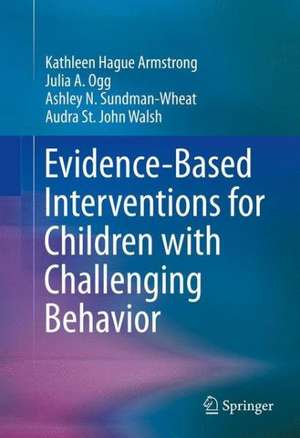
Evidence-Based Interventions for Children with Challenging Behavior
Autor Kathleen Hague Armstrong, Julia A. Ogg, Ashley N. Sundman-Wheat, Audra St. John Walshen Limba Engleză Hardback – 5 aug 2013
The authors of Evidence-Based Interventions for Children with Challenging Behavior take a preventive approach in this concise, well-detailed guide. Offering best practices from an extensive Response to Intervention (RTI) evidence base, the book provides guidelines for recognizing the extent of feeding, sleeping, toileting, aggression, and other issues, and supplies successful primary, secondary, and tertiary interventions with rationales. Case examples integrate developmental theories and behavior principles into practice, illustrate how strategies work, and show how to ensure that parents and caregivers can implement them consistently for maximum effect. Progress charts, content questions, and other helpful features make this an invaluable resource for students and professionals alike.
Included in the coverage:
- The prevention model and problem solving.
- Screening techniques.
- Evidence-based practices with children and their caregivers.
- Behavior principles and their application.
- Monitoring progress and evaluating outcomes.
- Plushelpful appendices, resource links, and other learning tools.
You can access a class syllabus that works as a companion to this book at http://health.usf.edu/nocms/medicine/pediatrics/child_dev_neuro/babybehavior/
Preț: 549.47 lei
Preț vechi: 646.44 lei
-15%
Puncte Express: 824
Carte tipărită la comandă
Livrare economică 07-21 decembrie
Livrare prin curier în România Termenul estimat este afișat lângă disponibilitate.
Transport gratuit pentru acest produs Plată online sau ramburs, în funcție de opțiunile comenzii.
Retur gratuit în 14 zile Comandă securizată și suport în română.
Specificații
ISBN-13: 9781461478065
ISBN-10: 1461478065
Pagini: 240
Ilustrații: X, 234 p.
Dimensiuni: 160 x 241 x 19 mm
Greutate: 0.48 kg
Ediția:2014
Editura: Springer
Locul publicării:New York, NY, United States
ISBN-10: 1461478065
Pagini: 240
Ilustrații: X, 234 p.
Dimensiuni: 160 x 241 x 19 mm
Greutate: 0.48 kg
Ediția:2014
Editura: Springer
Locul publicării:New York, NY, United States
V-ar putea interesa
-
 -27%Preț: 471.97 lei647.11 lei
-
 -5%Preț: 479.48 lei504.71 lei
-
 Clinical LinguisticsLouise Cummings-14%Preț: 250.22 lei289.95 lei
-
 The Psychology of Language: From Data to TheoryTrevor A. Harley-5%Preț: 573.89 lei604.10 lei
-
 Handbook of Vowels and Vowel DisordersMartin J. Ball-5%Preț: 1966.84 lei2070.36 lei
-
 -5%Preț: 120.25 lei126.57 lei
-
 Speech and Language Therapy InterventionKaren Bunning-8%Preț: 480.60 lei522.39 lei
-
 Speech and Language TherapyCarolyn Anderson-5%Preț: 371.78 lei391.35 lei
-
 Differential Diagnosis and Treatment 2eBarbara Dodd-5%Preț: 568.19 lei598.09 lei
-
 Speech and Language 2eAlison Ross-5%Preț: 364.37 lei383.55 lei
Public țintă
GraduateCuprins
Chapter 1: Common Early Childhood Behavior Problems.- Chapter 2: Early Childhood Development Theories.- Chapter 3: The Prevention Model and Problem Solving.- Chapter 4: Screening Techniques.- Chapter 5: Evidence-Based Practices with Children and their Caregivers.- Chapter 6: Behavioral Terms and Principles.- Chapter 7: Applying Principles of Behavior.- Chapter 8: Progress Monitoring.- Chapter 9: Evaluating Outcomes.- Chapter 10: Summary & Conclusions of Best Practices in Providing Services for YCCB.- Appendix A: Developmental Milestones References.- Appendix B: ABC Chart for Determining a Behavior’s Function.- Appendix C: HOT DOCS Behavior Chart.- Appendix D: Graphing by Hand.- Glossary of Terms.- References.
Recenzii
From the reviews:
“This text is written in really simple language, and balances the practical needs of practitioners with evidence-based intervention techniques. … Really very useful for clinicians and college students. A great resource to keep on the bookshelf as a quick reference guide.” (CouragePsyc, couragepsyc.blogspot.com.au, March, 2014)
“This text is written in really simple language, and balances the practical needs of practitioners with evidence-based intervention techniques. … Really very useful for clinicians and college students. A great resource to keep on the bookshelf as a quick reference guide.” (CouragePsyc, couragepsyc.blogspot.com.au, March, 2014)
Notă biografică
Kathleen Hague Armstrong, Ph.D., is a Professor of Pediatrics at the University of South Florida College of Medicine, Past President of the Florida Association for Infant Mental Health, and current President of the Rotary Club of Temple Terrace. She is the Director of Pediatric Psychology at USF College of Medicine, with expertise in the care for children with developmental disabilities and behavioral health disorders. Dr. Armstrong prepares graduate and medical students and residents to provide integrated care within the pediatric medical home. In addition to her busy clinical and teaching schedule, Dr. Armstrong is an author and researcher. Among her articles and books, Helping Our Toddlers, Developing Our Children's Skills (HOT DOCS) and Evidence-Based Interventions for Children with Challenging Behavior stand out as contributions to improving children's outcomes. Dr. Armstrong's research has been supported by federal, state, and foundation grants. She hasbeen honored by her profession as Florida's School Psychologist of the Year and by her community as a finalist for the Medical Hero award.
Heather Agazzi, Ph.D., is a pediatric school psychologist and Associate Professor in the University of South Florida Morsani College of Medicine. Dr. Agazzi has an active clinical practice at USF, in which she takes care of children from infancy through the teenage years and their families and trains pediatric providers in evidence-based treatments. Her research includes the promotion of infant-caregiver attachment, behavioral parent training, and interdisciplinary consultation to enhance pediatric behavioral health services. Dr. Agazzi has authored several articles and book chapters and coauthored a treatment manual called Helping Our Toddlers, Developing Our Children's Skills (HOT DOCS).
Emily J. Shaffer-Hudkins, Ph.D., is a pediatric school psychologist and Assistant Professor in the University of South Florida Morsani College of Medicine. As the Assistant Clinical Director for the local Part C early intervention program, she oversees all of the developmental evaluation and early intervention/therapy services provided to the 2,000 children enrolled. Her research includes the promotion of infant-caregiver attachment, health-related quality of life issues, and the use of evidence-based practices and interdisciplinary consultation to enhance pediatric behavioral health services.
Textul de pe ultima copertă
When a child has difficulties eating or sleeping, or throws frequent tantrums, many parents cross their fingers and hope it's a phase to be outgrown soon. But when they persist, challenging behaviors can follow children to school, contributing to academic problems, social difficulties, and further problems in adolescence and adulthood.
The authors of Evidence-Based Interventions for Children with Challenging Behavior take a preventive approach in this concise, well-detailed guide. Offering best practices from an extensive Response to Intervention (RTI) evidence base, the book provides guidelines for recognizing the extent of feeding, sleeping, toileting, aggression, and other issues, and supplies successful primary, secondary, and tertiary interventions with rationales. Case examples integrate developmental theories and behavior principles into practice, illustrate how strategies work, and show how to ensure that parents and caregivers can implement them consistently for maximum effect. Progress charts, content questions, and other helpful features make this an invaluable resource for students and professionals alike.
Included in the coverage:
- The prevention model and problem solving.
- Screening techniques.
- Evidence-based practices with children and their caregivers.
- Behavior principles and their application.
- Monitoring progress and evaluating outcomes.
- Plus helpful appendices, resource links, and other learning tools.
Caracteristici
Differentiates between normal childhood behaviors and those that may require early intervention to promote long-term healthy development Explores early childhood prevention and intervention using problem-solving strategies based in a response-to-intervention approach Provides a model for tailoring interventions to the unique needs of young children Discusses how to monitor progress and evaluate outcomes ? Includes supplementary material: sn.pub/extras