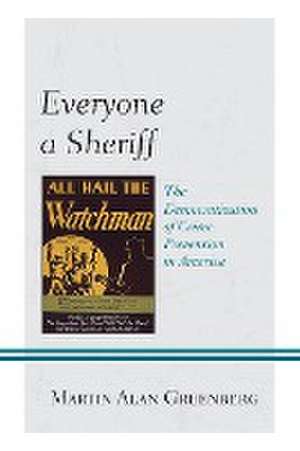
Everyone a Sheriff: The Democratization of Crime Prevention in America: Policing Perspectives and Challenges in the Twenty-First Century
Autor Martin Alan Greenberg Cuvânt înainte de John B. Wilten Limba Engleză Paperback – 22 aug 2023


Preț: 261.48 lei
Preț vechi: 353.15 lei
-26%
Puncte Express: 392
Carte tipărită la comandă
Livrare economică 05-19 decembrie
Livrare prin curier în România Termenul estimat este afișat lângă disponibilitate.
Transport gratuit de la 400.00 lei Plată online sau ramburs, în funcție de opțiunile comenzii.
Retur gratuit în 14 zile Comandă securizată și suport în română.
Specificații
ISBN-13: 9781793642721
ISBN-10: 1793642729
Pagini: 392
Dimensiuni: 154 x 231 x 28 mm
Greutate: 0.57 kg
Editura: Bloomsbury Publishing
Colecția Lexington Books
Seria Policing Perspectives and Challenges in the Twenty-First Century
Locul publicării:New York, United States
ISBN-10: 1793642729
Pagini: 392
Dimensiuni: 154 x 231 x 28 mm
Greutate: 0.57 kg
Editura: Bloomsbury Publishing
Colecția Lexington Books
Seria Policing Perspectives and Challenges in the Twenty-First Century
Locul publicării:New York, United States
Cuprins
Chapter 1: The Invention of the Police
Chapter 2: Teen Involvement in Military and Homeland Defense
Chapter 3: Public Service Programs for Youth
Chapter 4: The Neighborhood Watch Program
Chapter 5: Adult Citizen and Junior Police Academies
Chapter 6: Volunteer Police: United Kingdom, Former Soviet Union, and Russia
Chapter 7: VIPS, Civil Defense, and the Detroit Experience
Chapter 8: Peacemaking and Community Prosecution
Chapter 9: The Citizen's Role in Gun Violence Reduction
Chapter 10: The Citizen's Role in School Safety
Conclusion: The Citizen's Role in Crime Prevention
Chapter 2: Teen Involvement in Military and Homeland Defense
Chapter 3: Public Service Programs for Youth
Chapter 4: The Neighborhood Watch Program
Chapter 5: Adult Citizen and Junior Police Academies
Chapter 6: Volunteer Police: United Kingdom, Former Soviet Union, and Russia
Chapter 7: VIPS, Civil Defense, and the Detroit Experience
Chapter 8: Peacemaking and Community Prosecution
Chapter 9: The Citizen's Role in Gun Violence Reduction
Chapter 10: The Citizen's Role in School Safety
Conclusion: The Citizen's Role in Crime Prevention
Recenzii
Everyone a Sheriff illustrates the importance of citizen involvement for the health and wellbeing of our communities. The theoretical perspective is supported by practical national and international examples to stress how community engagement and collaborative partnerships are beneficial to all involved. In other words, safety is everyone's responsibility.
Greenberg's book is a refreshing and necessary conversation for the future of the criminal justice field. The historical and current citizen roles in policing provide a well-rounded discussion and demonstrate the need for community support in policing.
Though much was already known about public law enforcement, private police forces, private security entities, police ancillary groups, community groups that assist in preventing and solving crimes, and the use of confidential informants, the reading of Everyone a Sheriff: The Democratization of Crime Prevention in America was catalytic. The book reveals an abundance of practices for the engagement of the citizenry in service and order maintenance functions. Author Martin Greenberg captures the "big picture" thinking necessary to perpetually prepare today's policing environment for tomorrow through the integration of more innovative roles and expanded partnerships. The author's underlying central thesis is compellingly presented in both content and context.
Everyone a Sheriff presents a very detailed history of volunteered public service in American History. More specifically, the author makes a solid argument for his case for partnership in crime control; and citizenship involvement in policing. In other words, for crime control, while police play the role of Batman figure, the public becomes the sidekick, Robin, because crime cannot be eradicated without help from the crowd. The book's simplistic but vibrant language style makes it very easy to read, making the reader's journey from policing ancient times to America's modern-day metropolises as smooth as it gets. The vivid descriptions of each historical anecdote event and figure make me feel like living the era and specific time again. The book has done a great job by delving into the origin story of almost every significant organization and introducing the many historical faces in America.
Dr. Greenberg provides historical context and uses a sociological perspective to explore the important role citizens play in community safety. He presents an evidence-based framework to develop better approaches to crime prevention moving forward. Breaking down divisions between officer and citizen through volunteerism can help develop mutual respect and understanding among these two, often divided, groups. By engaging the help of community members, including youth, through voluntary partnerships, promising potential for greater safety and improved police-citizen relationships emerges. Through detailed research of existing and historical programs, Dr. Greenberg offers a refreshing perspective and gives hope during some dark times.
Greenberg's book is a refreshing and necessary conversation for the future of the criminal justice field. The historical and current citizen roles in policing provide a well-rounded discussion and demonstrate the need for community support in policing.
Though much was already known about public law enforcement, private police forces, private security entities, police ancillary groups, community groups that assist in preventing and solving crimes, and the use of confidential informants, the reading of Everyone a Sheriff: The Democratization of Crime Prevention in America was catalytic. The book reveals an abundance of practices for the engagement of the citizenry in service and order maintenance functions. Author Martin Greenberg captures the "big picture" thinking necessary to perpetually prepare today's policing environment for tomorrow through the integration of more innovative roles and expanded partnerships. The author's underlying central thesis is compellingly presented in both content and context.
Everyone a Sheriff presents a very detailed history of volunteered public service in American History. More specifically, the author makes a solid argument for his case for partnership in crime control; and citizenship involvement in policing. In other words, for crime control, while police play the role of Batman figure, the public becomes the sidekick, Robin, because crime cannot be eradicated without help from the crowd. The book's simplistic but vibrant language style makes it very easy to read, making the reader's journey from policing ancient times to America's modern-day metropolises as smooth as it gets. The vivid descriptions of each historical anecdote event and figure make me feel like living the era and specific time again. The book has done a great job by delving into the origin story of almost every significant organization and introducing the many historical faces in America.
Dr. Greenberg provides historical context and uses a sociological perspective to explore the important role citizens play in community safety. He presents an evidence-based framework to develop better approaches to crime prevention moving forward. Breaking down divisions between officer and citizen through volunteerism can help develop mutual respect and understanding among these two, often divided, groups. By engaging the help of community members, including youth, through voluntary partnerships, promising potential for greater safety and improved police-citizen relationships emerges. Through detailed research of existing and historical programs, Dr. Greenberg offers a refreshing perspective and gives hope during some dark times.
Notă biografică
Martin Alan Greenberg, JD, PhD, the author of nine books concerning community safety, has directed criminal justice programs at colleges throughout the United States. He was also court attaché in New York City, an auxiliary police deputy inspector, and served as president of the Auxiliary Police Benevolent Association of the City of New York and the Virginia Association of Criminal Justice Educators.