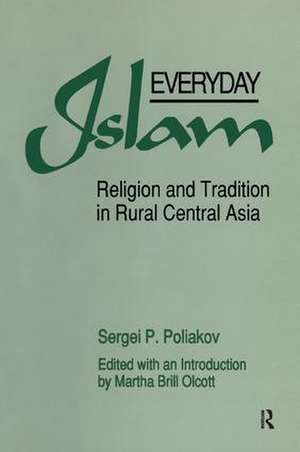
Everyday Islam: Religion and Tradition in Rural Central Asia
Autor Sergei P. Poliakov, Martha Brill Olcotten Limba Engleză Hardback – 28 feb 1992
Preț: 1248.98 lei
Preț vechi: 1523.15 lei
-18%
Puncte Express: 1873
Carte tipărită la comandă
Livrare economică 07-21 decembrie
Livrare prin curier în România Termenul estimat este afișat lângă disponibilitate.
Transport gratuit pentru acest produs Plată online sau ramburs, în funcție de opțiunile comenzii.
Retur gratuit în 14 zile Comandă securizată și suport în română.
Specificații
ISBN-13: 9780873326735
ISBN-10: 0873326733
Pagini: 180
Ilustrații: Ill.
Dimensiuni: 152 x 229 x 20 mm
Greutate: 0.45 kg
Ediția:1
Editura: Taylor & Francis
Colecția Routledge
Locul publicării:Oxford, United Kingdom
ISBN-10: 0873326733
Pagini: 180
Ilustrații: Ill.
Dimensiuni: 152 x 229 x 20 mm
Greutate: 0.45 kg
Ediția:1
Editura: Taylor & Francis
Colecția Routledge
Locul publicării:Oxford, United Kingdom
V-ar putea interesa
-
 Viper PilotDan HamptonPreț: 73.62 lei
 -
 -18%Preț: 1295.58 lei1579.97 lei
 -
 Gandhi and RevolutionDevi Prasad-18%Preț: 1304.77 lei1591.19 lei
 -
 -15%Preț: 463.52 lei545.32 lei
 -
 -18%Preț: 1308.91 lei1596.24 lei
 -
 -15%Preț: 422.47 lei497.01 lei
 -
 The Economy of Modern IndiaB. R. TomlinsonPreț: 232.12 lei
 -
 -39%Preț: 84.45 lei139.24 lei
 -
 Return of a King: The Battle for AfghanistanWilliam Dalrymple-32%Preț: 75.77 lei110.93 lei
 -
 A Fort of Nine TowersQais Akbar Omar-22%Preț: 92.12 lei118.25 lei
Cuprins
Part I Background; Chapter 1 Central Asian Traditionalism; Chapter 2 Sources of Information; Chapter 3 Some History; Part II Economic Bases of Traditionalism; Chapter 4 Traditionalism and the Economic Structure; Chapter 5 Commercial Operations; Chapter 6 Demographics and Employment; Chapter 7 Private Enterprise and Livestock; Part III Traditionalism and the Family; Chapter 8 Central Asian Family Structure; Chapter 9 Traditional Child Rearing; Chapter 10 The Mahalla; Chapter 11 Gender and Behavior; Chapter 12 The Family Budget; Part IV The Role of Religion in the Community; Chapter 13 Religious Institutions; Chapter 14 The Clergy; partV Social Dynamics of Traditionalism; Chapter 15 Traditionalism and the Working Class; Chapter 16 Traditionalism and the Intelligentsia; Chapter 17 Social Tensions;
Notă biografică
Authored by Poliakov, Sergei P.; Olcott, Martha Brill
Descriere
With a growing population, deteriorating economic conditions, and an unstable imperial centre, Soviet Central Asia would seem destined to become a trouble spot. Instead Islamic traditionalism has survived and flourished in Central Asia. This book looks at the reasons why.