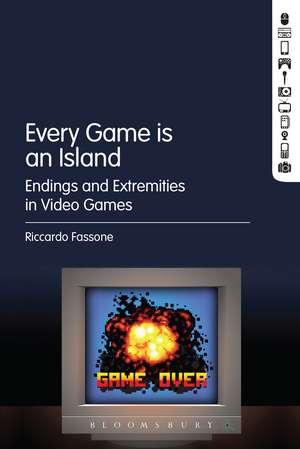
Every Game is an Island: Endings and Extremities in Video Games
Autor Dr. Riccardo Fassoneen Limba Engleză Hardback – 23 feb 2017
Preț: 734.92 lei
Preț vechi: 1111.86 lei
-34%
Puncte Express: 1102
Carte tipărită la comandă
Livrare economică 08-22 iunie
Specificații
ISBN-13: 9781501316616
ISBN-10: 1501316613
Pagini: 208
Dimensiuni: 152 x 229 x 20 mm
Greutate: 0.45 kg
Editura: Bloomsbury Publishing
Colecția Bloomsbury Academic
Locul publicării:New York, United States
ISBN-10: 1501316613
Pagini: 208
Dimensiuni: 152 x 229 x 20 mm
Greutate: 0.45 kg
Editura: Bloomsbury Publishing
Colecția Bloomsbury Academic
Locul publicării:New York, United States
V-ar putea interesa
-
 Preț: 168.85 lei
 -
 Strategic Political Communication: Rethinking Social Influence, Persuasion, and PropagandaKaren S. Johnson-Cartee-25%Preț: 251.43 lei333.54 lei
 -
 Guardians of Power: The Myth of the Liberal MediaDavid EdwardsPreț: 199.91 lei
 -
 Comparative Media HistoryJane L ChapmanPreț: 332.98 lei
 -
 The Mediated Construction of RealityNick CouldryPreț: 169.47 lei
 -
 Digital HumanitiesDavid M. BerryPreț: 143.18 lei
 -
 Media DiscourseMary Talbot-18%Preț: 170.80 lei208.48 lei
 -
 Political CommunicationSteven Foster-14%Preț: 144.48 lei167.06 lei
 -
 Media Studies: A Complete Introduction: Teach YourselfJoanne Hollows-28%Preț: 73.89 lei102.43 lei
 -
 Media and Translation: An Interdisciplinary ApproachDr Dror Abend-David-25%Preț: 269.10 lei360.58 lei
Cuprins
ACKNOWLEDGEMENTS
LIST OF ILLUSTRATIONS
INTRODUCTION
A BOOK ABOUT EXTREMITIES
Ryu's closure
Every game is an island and no game is an island
Against currentness
STRUCTURE OF THE BOOK
Three levels and some wordplay
1. TWO NON-DEFINITIVE DEFINITIONS
WHAT IS A VIDEO GAME?
Doing away with definitions
Video games change through time
What I mean by "video game"
THE EXCEPTIONALITY OF VIDEO GAMES
Digital exceptionalism
The inflexible code
Authoritative video games
COMPUTER-MEDIATED GAMES
Interaction?
State machines and cybertexts
The cybernetic player
DESIGNED PROCEDURAL EXPERIENCES
The project of experience
Design
Procedures
Experience
2. GAME <> GAME
CLOSURE
The finite model of an infinite universe
An archaeology of digital closure
Finishing the game
Closure in Super Metroid
CAESURA
Continue?
Prescribed ending
The death and rebirth of game over
Game over and over: A rhetoric of repetition
Bodily pleasures: Game over as spectacular device in Dead Space 2
ENDLESSNESS
Playing indefinitely
A compact history of infinite games
From arcade to casual
The utopic castle: Battlezone
OPENNESS
Video games as toys
Expressive players and simulation savvies
Super Scribblenauts The winged guitarist
3. GAME <> METAGAME
FRAGMENTATION
Overlooked and underrated
Player-operated breaks: PAUSE
Machine-operated breaks: LOADING
Is this life reality? Eternal Darkness: Sanity's Requiem
METAGAMING
Playing outside the game
The legacy of dice
Knights of Pen and Paper: role-playing revisited
IMMERSION
The utopia of total immersion
Immersive fallacies
Immersion, metacommunication, incorporation
Through the eyes of Riddick: Escape from Butcher Bay
HOLISM
Flow: a scholarly tradition
Designing for flow?
Total interface: Uplink
4. GAME <> GAMES
UNIQUENESS
In search of the golden cartridge
Curiosity and A Slow Year Distancing strategies
A game I will never play Chain World
EPHEMERALITY
Reconsidering OSGONS
Catharsis and procedures
Review your choices: One Single Life
MODULARITY
Opera aperta 2.0
Mods and modules: Game engines as branch systems
The flex of the wrist: Garry's Mod
SERIALIZATION
Playing nostalgia
Xbox Live Arcade: series and/as archives
Sub-series, meta-games
Old new games: Final Fight Double Impact
5. CONCLUSIONS
FROM THE OUTSIDE IN
Mom's heart
Games are about ending
Moving forward
BIBLIOGRAPHY
LUDOGRAPHY
FILMOGRAPHY
LIST OF ILLUSTRATIONS
INTRODUCTION
A BOOK ABOUT EXTREMITIES
Ryu's closure
Every game is an island and no game is an island
Against currentness
STRUCTURE OF THE BOOK
Three levels and some wordplay
1. TWO NON-DEFINITIVE DEFINITIONS
WHAT IS A VIDEO GAME?
Doing away with definitions
Video games change through time
What I mean by "video game"
THE EXCEPTIONALITY OF VIDEO GAMES
Digital exceptionalism
The inflexible code
Authoritative video games
COMPUTER-MEDIATED GAMES
Interaction?
State machines and cybertexts
The cybernetic player
DESIGNED PROCEDURAL EXPERIENCES
The project of experience
Design
Procedures
Experience
2. GAME <> GAME
CLOSURE
The finite model of an infinite universe
An archaeology of digital closure
Finishing the game
Closure in Super Metroid
CAESURA
Continue?
Prescribed ending
The death and rebirth of game over
Game over and over: A rhetoric of repetition
Bodily pleasures: Game over as spectacular device in Dead Space 2
ENDLESSNESS
Playing indefinitely
A compact history of infinite games
From arcade to casual
The utopic castle: Battlezone
OPENNESS
Video games as toys
Expressive players and simulation savvies
Super Scribblenauts The winged guitarist
3. GAME <> METAGAME
FRAGMENTATION
Overlooked and underrated
Player-operated breaks: PAUSE
Machine-operated breaks: LOADING
Is this life reality? Eternal Darkness: Sanity's Requiem
METAGAMING
Playing outside the game
The legacy of dice
Knights of Pen and Paper: role-playing revisited
IMMERSION
The utopia of total immersion
Immersive fallacies
Immersion, metacommunication, incorporation
Through the eyes of Riddick: Escape from Butcher Bay
HOLISM
Flow: a scholarly tradition
Designing for flow?
Total interface: Uplink
4. GAME <> GAMES
UNIQUENESS
In search of the golden cartridge
Curiosity and A Slow Year Distancing strategies
A game I will never play Chain World
EPHEMERALITY
Reconsidering OSGONS
Catharsis and procedures
Review your choices: One Single Life
MODULARITY
Opera aperta 2.0
Mods and modules: Game engines as branch systems
The flex of the wrist: Garry's Mod
SERIALIZATION
Playing nostalgia
Xbox Live Arcade: series and/as archives
Sub-series, meta-games
Old new games: Final Fight Double Impact
5. CONCLUSIONS
FROM THE OUTSIDE IN
Mom's heart
Games are about ending
Moving forward
BIBLIOGRAPHY
LUDOGRAPHY
FILMOGRAPHY
Recenzii
.Every Game is an Island is an important work in formalist game studies, one which serves to situate the video game object in relation to wider discourses of textuality and the media object.
While Riccardo Fassone is talking about limitations, endings and closures, he is doing it with an amazing open mind. He is in fact pushing boundaries, pointing us new areas to consider, encouraging us to pay attention to details and, above all, showing us how far game studies have come since we have started to explore videoludic islands. If I can extend the metaphor, I'll say that Fassone is a great voyager.
In Every Game Is an Island Riccardo Fassone provides us with a fascinating look at what games look like and how they can be understood, when approached from their ends and boundaries. Are games finite and clearly defined objects to start with, or are games' procedural and performance related dimensions pre-empting all attempts to capture them in their entirety? How is the aesthetic value of games related to their ephemerality? This study makes use of dazzling array of scholarship from multiple fields, ranging from computer science to continental philosophy, building bridges between disciplines, thereby also lessening the chance of intellectual endeavours related to games remaining as islands, isolated from each other. This is one of the best works that fully recognises the enormous diversity and complexity of game form, written so far.
In a medium obsessed with openness and possibility, Fassone shows why boundaries and limitations offer a better measure for games.
Every Game is an Island is a provocative and necessary book for game studies. In this book, Riccardo Fassone proposes an irreverent, well-read, and productive approach to many of the key topics in game studies, from immersion to nostalgia. Every Game is an Island delivers comprehensive readings and re-rereadings of games and game scholarship, encouraging us to think extremely about the extremes of games.
While Riccardo Fassone is talking about limitations, endings and closures, he is doing it with an amazing open mind. He is in fact pushing boundaries, pointing us new areas to consider, encouraging us to pay attention to details and, above all, showing us how far game studies have come since we have started to explore videoludic islands. If I can extend the metaphor, I'll say that Fassone is a great voyager.
In Every Game Is an Island Riccardo Fassone provides us with a fascinating look at what games look like and how they can be understood, when approached from their ends and boundaries. Are games finite and clearly defined objects to start with, or are games' procedural and performance related dimensions pre-empting all attempts to capture them in their entirety? How is the aesthetic value of games related to their ephemerality? This study makes use of dazzling array of scholarship from multiple fields, ranging from computer science to continental philosophy, building bridges between disciplines, thereby also lessening the chance of intellectual endeavours related to games remaining as islands, isolated from each other. This is one of the best works that fully recognises the enormous diversity and complexity of game form, written so far.
In a medium obsessed with openness and possibility, Fassone shows why boundaries and limitations offer a better measure for games.
Every Game is an Island is a provocative and necessary book for game studies. In this book, Riccardo Fassone proposes an irreverent, well-read, and productive approach to many of the key topics in game studies, from immersion to nostalgia. Every Game is an Island delivers comprehensive readings and re-rereadings of games and game scholarship, encouraging us to think extremely about the extremes of games.