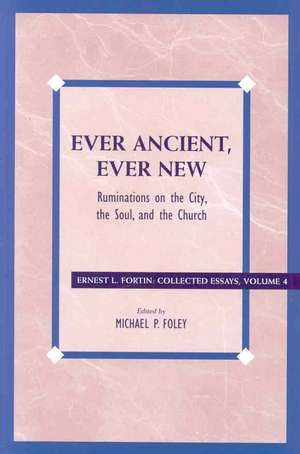
Ever Ancient, Ever New: Ruminations on the City, the Soul, and the Church
Autor Ernest L. Fortin Editat de Michael P. Foleyen Limba Engleză Paperback – 5 oct 2007
Ever Ancient Ever New is the fourth and final volume of Ernest Fortin's collected essays, compiled and edited after his death by his archivist and student Michael Foley. While it echoes the themes of the earlier three volumes-showcasing the essays that made Fortin such an authority in his field-Ever Ancient Ever New also includes articles never before published as well as articles on topics not represented in the earlier collections. Ever Ancient Ever New is indispensable for anyone wishing to continue their education in the wit and wisdom of Ernest Fortin or to begin learning from him for the first time.
Preț: 424.75 lei
Preț vechi: 629.13 lei
-32%
Puncte Express: 637
Carte tipărită la comandă
Livrare economică 28 noiembrie-12 decembrie
Livrare prin curier în România Termenul estimat este afișat lângă disponibilitate.
Transport gratuit pentru acest produs Plată online sau ramburs, în funcție de opțiunile comenzii.
Retur gratuit în 14 zile Comandă securizată și suport în română.
Specificații
ISBN-13: 9780742559202
ISBN-10: 0742559203
Pagini: 352
Dimensiuni: 153 x 235 x 28 mm
Greutate: 0.59 kg
Editura: Bloomsbury Publishing
Colecția Rowman & Littlefield
Locul publicării:New York, United States
ISBN-10: 0742559203
Pagini: 352
Dimensiuni: 153 x 235 x 28 mm
Greutate: 0.59 kg
Editura: Bloomsbury Publishing
Colecția Rowman & Littlefield
Locul publicării:New York, United States
Cuprins
Part 1 Foreword: The Propaedeutic Theology of Ernest L. Fortin
Part 2 Part I: The Early Church and the Wisdom of the Greeks
Chapter 3 Chapter 1. The Rebirth of Patristic Studies
Chapter 4 Chapter 2. The Church Fathers and the Transmission of theChristian Message
Chapter 5 Chapter 3. The Nature of the Christian Message
Chapter 6 Chapter 4. The "Rhetoric" of the Church Fathers
Chapter 7 Chapter 5. Saint Augustine and the Neoplatonic Doctrine of the Soul: Letter 137.11 (translated by Marc A. LePain)
Chapter 8 Chapter 6. The City of God
Part 9 Part II: Philosophical Culture in the Middle Ages
Chapter 10 Chapter 7. Translatio Studii
Chapter 11 Chapter 8. Thomas Aquinas as a Political Thinker
Chapter 12 Chapter 9. Dante and Averroism
Part 13 Part III: Biblical Faith and Modern Philosophy
Chapter 14 Chapter 10. The New Moral Theology: Genesis and Present State
Chapter 15 Chapter 11. Christianity and the Enlightenment: A Foreword
Chapter 16 Chapter 12. The Enlightenment and the Church: The Changing Configurations
Chapter 17 Chapter 13. A Tocquevillian Perspective on Religion and the American Regime
Chapter 18 Chapter 14. Humanae Vitae's Silver Jubilee: Twenty-Five Years Later
Chapter 19 Chapter 15. Men of Letters: The Little Known Correspondence Between Leo Strauss and Eric Voegelin
Part 20 Part IV: Catholic Education: Its Past and Its Future
Chapter 21 Chapter 16. Why I Am Not a Thomist
Chapter 22 Chapter 17. Philosophy and Democratic Education
Chapter 23 Chapter 18. The New Catholic College
Chapter 24 Chapter 19. An Academic Approach to the Teaching of Theology
Chapter 25 Chapter 20. Moral Values
Part 26 Part V: Ecumenical Dialogue
Chapter 27 Chapter 21. The Anguish of Unity: A Roman Catholic Perspective
Chapter 28 Chapter 22. The Ecumenical Venture
Chapter 29 Chapter 23. Holiness of the Church and Ministerial Holiness
Chapter 30 Chapter 24. Christian Mission and Spirituality: Roman Catholics and Methodists in Dialogue
Chapter 31 Chapter 25. Ecumenism - Where Do We Go from Here?
Part 32 Part VI: Selected Responses and Remarks
Chapter 33 Chapter 26. Public Theology: A Response to Max Stackhouse
Chapter 34 Chapter 27. Religious Consciousness: A Response to Robert Bellah
Chapter 35 Chapter 28. The Enlightenment and Freedom: Critical Remarks on Ernest van den Haag's "Desolation of Reality"
Chapter 36 Chapter 29. Religion and the American Regime
Chapter 37 Chapter 30. Comment on Hughes Regarding the Strauss-Voegelin Correspondence
Chapter 38 Chapter 31. Aristotle and the Sociobiologists: An Old Controversy Revisited
Part 39 Part VII: Selected Reviews
Chapter 40 Jean Bethke Elshtain, Augustine and the Limits of Politics
Chapter 41 Harry A. Wolfson, The Philosophy of the Church Fathers
Chapter 42 Jaroslav Pelikan, Emergence of the Christian Tradition
Chapter 43 H.Y. Jung, The Crisis of Political Understanding
Chapter 44 A.S. McGrade, The Political Thought of William of Ockham
Chapter 45 David Hollenbach, Justice, Peace, and Human Rights
Part 46 Part VIII: Facetæ Fortinianæ: The Wit of Ernest Fortin
Chapter 47 Pep Rallies
Chapter 48 Epilogue: An Intellectual Autobiography
Chapter 49 Bibliography of Fortin's Works
Part 2 Part I: The Early Church and the Wisdom of the Greeks
Chapter 3 Chapter 1. The Rebirth of Patristic Studies
Chapter 4 Chapter 2. The Church Fathers and the Transmission of theChristian Message
Chapter 5 Chapter 3. The Nature of the Christian Message
Chapter 6 Chapter 4. The "Rhetoric" of the Church Fathers
Chapter 7 Chapter 5. Saint Augustine and the Neoplatonic Doctrine of the Soul: Letter 137.11 (translated by Marc A. LePain)
Chapter 8 Chapter 6. The City of God
Part 9 Part II: Philosophical Culture in the Middle Ages
Chapter 10 Chapter 7. Translatio Studii
Chapter 11 Chapter 8. Thomas Aquinas as a Political Thinker
Chapter 12 Chapter 9. Dante and Averroism
Part 13 Part III: Biblical Faith and Modern Philosophy
Chapter 14 Chapter 10. The New Moral Theology: Genesis and Present State
Chapter 15 Chapter 11. Christianity and the Enlightenment: A Foreword
Chapter 16 Chapter 12. The Enlightenment and the Church: The Changing Configurations
Chapter 17 Chapter 13. A Tocquevillian Perspective on Religion and the American Regime
Chapter 18 Chapter 14. Humanae Vitae's Silver Jubilee: Twenty-Five Years Later
Chapter 19 Chapter 15. Men of Letters: The Little Known Correspondence Between Leo Strauss and Eric Voegelin
Part 20 Part IV: Catholic Education: Its Past and Its Future
Chapter 21 Chapter 16. Why I Am Not a Thomist
Chapter 22 Chapter 17. Philosophy and Democratic Education
Chapter 23 Chapter 18. The New Catholic College
Chapter 24 Chapter 19. An Academic Approach to the Teaching of Theology
Chapter 25 Chapter 20. Moral Values
Part 26 Part V: Ecumenical Dialogue
Chapter 27 Chapter 21. The Anguish of Unity: A Roman Catholic Perspective
Chapter 28 Chapter 22. The Ecumenical Venture
Chapter 29 Chapter 23. Holiness of the Church and Ministerial Holiness
Chapter 30 Chapter 24. Christian Mission and Spirituality: Roman Catholics and Methodists in Dialogue
Chapter 31 Chapter 25. Ecumenism - Where Do We Go from Here?
Part 32 Part VI: Selected Responses and Remarks
Chapter 33 Chapter 26. Public Theology: A Response to Max Stackhouse
Chapter 34 Chapter 27. Religious Consciousness: A Response to Robert Bellah
Chapter 35 Chapter 28. The Enlightenment and Freedom: Critical Remarks on Ernest van den Haag's "Desolation of Reality"
Chapter 36 Chapter 29. Religion and the American Regime
Chapter 37 Chapter 30. Comment on Hughes Regarding the Strauss-Voegelin Correspondence
Chapter 38 Chapter 31. Aristotle and the Sociobiologists: An Old Controversy Revisited
Part 39 Part VII: Selected Reviews
Chapter 40 Jean Bethke Elshtain, Augustine and the Limits of Politics
Chapter 41 Harry A. Wolfson, The Philosophy of the Church Fathers
Chapter 42 Jaroslav Pelikan, Emergence of the Christian Tradition
Chapter 43 H.Y. Jung, The Crisis of Political Understanding
Chapter 44 A.S. McGrade, The Political Thought of William of Ockham
Chapter 45 David Hollenbach, Justice, Peace, and Human Rights
Part 46 Part VIII: Facetæ Fortinianæ: The Wit of Ernest Fortin
Chapter 47 Pep Rallies
Chapter 48 Epilogue: An Intellectual Autobiography
Chapter 49 Bibliography of Fortin's Works
Recenzii
Such deep and wide learning is rare enough. But the cumulative effect of bringing together all these valuable contributions is to let us see something rarer still: the life of a mind that is humane, lucid, and wise.
Ernest Fortin has a place of honor at the table of quiet erudition and uncompromising curiosity, where adults try to understand how the world went crazy and what might be done about it. If we are ever so much more fortunate than we deserve, younger scholars will follow Fortin in what is best described as the path of wisdom.
The first three volumes of Ernest Fortin's works are fundamental contributions to the problem of modernity. In his analysis of rights, Catholic social thought, the state, and general questions of justice, Fortin has penetrated to the core of the misplaced ideologies and enthusiasms that have appeared in religious circles. The welcome fourth volume of Fortin's works again covers the vast range that a political philosopher-theologian must cover to make the whole intelligible. Fortin's essays are a direct challenge to, and redirection of, the major trends in political philosophy in the modern era. Few writing in intellectual circles today have Fortin's breadth of interest and profundity of analysis; his grasp of the classics and of modern theory is incomparable. Fortin is one of the few thinkers who take everything into consideration-experience, history, philosophy, revelation, the tradition of reason. His is a remarkable example of an active philosophic mind at work which knows that the pursuit of truth is both difficult and exhilarating. Fortin's works are not to be missed.
Provide[s] readers with a personal and inside look at the man so many admired and loved.
This fourth volume of the papers of the late Father Fortin underscores what a loss it is no longer to have him among us. This is simply the obverse of realizing what a blessing he was; and through his writings he will continue to influence, stimulate, and delight. And another thought comes: 'The Importance of Being Ernest' could be the title of the whole collection. Many thanks to Brian Benestad and Michael Foley.
Ernest Fortin has a place of honor at the table of quiet erudition and uncompromising curiosity, where adults try to understand how the world went crazy and what might be done about it. If we are ever so much more fortunate than we deserve, younger scholars will follow Fortin in what is best described as the path of wisdom.
The first three volumes of Ernest Fortin's works are fundamental contributions to the problem of modernity. In his analysis of rights, Catholic social thought, the state, and general questions of justice, Fortin has penetrated to the core of the misplaced ideologies and enthusiasms that have appeared in religious circles. The welcome fourth volume of Fortin's works again covers the vast range that a political philosopher-theologian must cover to make the whole intelligible. Fortin's essays are a direct challenge to, and redirection of, the major trends in political philosophy in the modern era. Few writing in intellectual circles today have Fortin's breadth of interest and profundity of analysis; his grasp of the classics and of modern theory is incomparable. Fortin is one of the few thinkers who take everything into consideration-experience, history, philosophy, revelation, the tradition of reason. His is a remarkable example of an active philosophic mind at work which knows that the pursuit of truth is both difficult and exhilarating. Fortin's works are not to be missed.
Provide[s] readers with a personal and inside look at the man so many admired and loved.
This fourth volume of the papers of the late Father Fortin underscores what a loss it is no longer to have him among us. This is simply the obverse of realizing what a blessing he was; and through his writings he will continue to influence, stimulate, and delight. And another thought comes: 'The Importance of Being Ernest' could be the title of the whole collection. Many thanks to Brian Benestad and Michael Foley.