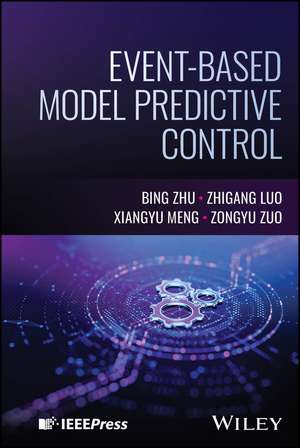
Event-Based Model Predictive Control
Autor Bing Zhu, Zhigang Luo, Xiangyu Meng, Zongyu Zuoen Limba Engleză Hardback – 30 iun 2026
Preț: 918.04 lei
Preț vechi: 1008.83 lei
-9%
Puncte Express: 1377
Carte tipărită la comandă
Livrare economică 24 decembrie 26 - 07 ianuarie 27
Livrare prin curier în România Termenul estimat este afișat lângă disponibilitate.
Transport gratuit pentru acest produs Plată online sau ramburs, în funcție de opțiunile comenzii.
Retur gratuit în 14 zile Comandă securizată și suport în română.
Specificații
ISBN-13: 9781394367788
ISBN-10: 1394367783
Pagini: 176
Dimensiuni: 152 x 229 x 11 mm
Greutate: 0.41 kg
Editura: Wiley
ISBN-10: 1394367783
Pagini: 176
Dimensiuni: 152 x 229 x 11 mm
Greutate: 0.41 kg
Editura: Wiley
Notă biografică
BING ZHU is an Associate Professor at the School of Automation Science and Electrical Engineering, Beihang University, China P.R.
ZHIGANG LUO is an Engineer at AVIC XI'AN Flight Automatic Control Research Institute, China P.R.
XIANGYU MENG is an Assistant Professor in the Division of Electrical and Computer Engineering at Louisiana State University, USA.
ZONGYU ZUO is a Professor at the School of Automation Science and Electrical Engineering, Beihang University, China P.R.
Cuprins
Foreword xi
About the Authors xiii
Preface xv
Acknowledgments xix
Acronyms xxi
1 Introduction 1
1.1 Background and Motivation 1
1.2 Model Predictive Control 3
1.3 MPC in the Presence of Uncertainties 8
1.4 Event-based MPC 12
1.5 Book Outline 16
2 Two-phase Event-based MPC for Continuous-time Systems 19
2.1 Problem Statement 20
2.2 Two-phase Event-triggered MPC Algorithm 21
2.2.1 Optimization Formulation 21
2.2.2 Event-based ¿ ¿ ß Strategy 23
2.2.3 Generalization of the ¿ ¿ ß Strategy 28
2.3 Feasibility and Stability 29
2.3.1 Recursive Feasibility of Optimization 29
2.3.2 Stability of the Closed-loop System 33
2.4 Simulation Examples 35
2.4.1 Undamped Oscillator 35
2.4.2 Simplified Spring-damper Element in Vehicle Suspension System 41
2.5 Conclusion 44
3 Event-triggered MPC for Discrete-time Systems with Aperiodic Sampling 45
3.1 Problem Statement 46
3.1.1 Plant to Be Controlled 46
3.1.2 Formulation of Optimization 47
3.2 Aperiodic Triggering Mechanism 50
3.2.1 Triggering Mechanism 50
3.2.2 Stability and Feasibility 55
3.3 Improved Aperiodic Triggering Mechanism 61
3.3.1 Statement of Improved Triggering Mechanism 61
3.3.2 Feasibility and Stability Concerning the Improved Aperiodic Triggering Mechanism 65
3.4 A Simulation Example 73
3.5 Conclusion 81
4 Composite Event-triggered MPC based on Disturbance Compensation 83
4.1 Problem Statement 84
4.2 Composite Event-triggered MPC Mechanism 85
4.2.1 Disturbance Compensation Controller Design 85
4.2.2 Model Predictive Controller Design 86
4.2.3 Composite Event-triggered MPC 87
4.2.4 Event-triggered Mechanism with Estimation 89
4.3 Feasibility and Stability 91
4.3.1 Recursive Feasibility 91
4.3.2 Closed-loop Stability 94
4.4 A Simulation Example 96
4.5 Conclusion 99
5 Event-triggered MPC with Periodic Sampling for Multi-agent Systems 101
5.1 Problem Statement 102
5.2 Distributed MPC Design 106
5.2.1 Terminal Set and Auxiliary Terminal Control Design 106
5.2.2 Distributed MPC Framework 109
5.3 Periodic Event-triggering Mechanism Design 110
5.4 Feasibility and Stability 116
5.5 A Simulation Example 126
5.6 Conclusion 130
6 Concluding Remarks and Future Directions 133
References 137
Index 143