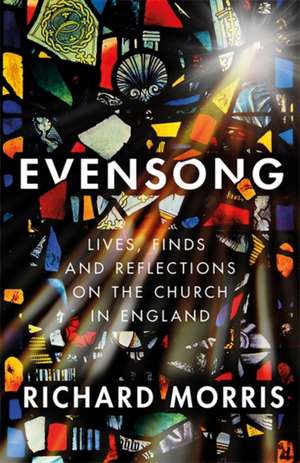
Evensong
Autor Richard Morrisen Limba Engleză Hardback – 25 noi 2021
A similar combination of familiarity and unawareness surrounds the connection between Church and nation. The UK has no national faith, but for reasons most people have forgotten the Church is woven into its government. The Church of England passes its own laws. Bishops sit in the House of Lords. About a third of England's state-funded schools are faith schools. New monarchs are initiated by the Archbishop of Canterbury. The monarch is supreme governor of a Church of England. Coins in your pocket tell you (in what was once the international language of the western Church that hardly anyone now reads) that she is FIDEI DEFENSATRIX and reigns 'by the grace of God'. Richard Morris has spent fifty years studying churches - their imagery, why they are where they are, how they were built, how they were used, where their materials came from, the dead beneath their floors, their graffiti. EVENSONG: PLACES, PEOPLE AND THR CHURCH IN ENGLAND will use case studies from his experience involving an interplay of myth, science and faith to explore connections between churches in history and people today. Alongside encounters with saints, medieval doors that still swing on their hinges, stories of secret passages, or sounds of a Tudor organ re-voiced from bits, people loom large: archbishops, parishioners, bell-ringers, musicians, gravediggers and beggars. Spanning two thousand years, linking past and present, people and places, EVENSONG is a magnificent contribution to our understanding of the nation's history and its current state.
| Toate formatele și edițiile | Preț | Express |
|---|---|---|
| Paperback (1) | 59.63 lei 3-5 săpt. | +34.32 lei 10-14 zile |
| Orion Publishing Group – 30 mar 2023 | 59.63 lei 3-5 săpt. | +34.32 lei 10-14 zile |
| Hardback (1) | 183.63 lei 3-5 săpt. | +27.37 lei 10-14 zile |
| Orion Publishing Group – 25 noi 2021 | 183.63 lei 3-5 săpt. | +27.37 lei 10-14 zile |
Preț: 183.63 lei
Puncte Express: 275
Preț estimativ în valută:
32.47€ • 38.29$ • 28.17£
32.47€ • 38.29$ • 28.17£
Carte disponibilă
Livrare economică 28 februarie-14 martie
Livrare express 17-21 februarie pentru 37.36 lei
Specificații
ISBN-13: 9781474614221
ISBN-10: 1474614221
Pagini: 336
Dimensiuni: 241 x 165 x 34 mm
Greutate: 0.58 kg
Editura: Orion Publishing Group
ISBN-10: 1474614221
Pagini: 336
Dimensiuni: 241 x 165 x 34 mm
Greutate: 0.58 kg
Editura: Orion Publishing Group
Notă biografică
Richard Morris is emeritus professor of archaeology at the University of Huddersfield. He was director of the Leeds Institute for Medieval Studies, and is a writer and composer of music. He lives in Harrogate.
Descriere
A magnificent contribution to our understanding of England's history and current state through an exploration of its churches
Recenzii
At its best when reminding us how deeply embedded these buildings are in the English landscape and when exploring, how the intimate meanings they have held can be rediscovered . . . At the book's heart is the question of the place of faith in the modern world . . . a warm, thoughtful and generous-spirited book with a profound sense of the importance of traditional spiritual devotions in the modern world.
It can sometimes be regarded as an institution out of time but, as this intimate, idiosyncratic account notes, the Church of England continues to influence public life and private morality well into the 21st century. Centred around a series of reminiscences of the author's relationship with the church's practices, places and people, the book also has much to say about issues of community and identity.
In Evensong, Richard Morris, whose father was himself a parish priest, considers the history and current fragile state of the Church of England
This memoir pulls off a difficult task . . . the story that it tells is a very human story of a father and son, a vicar and an archaeologist - and a compelling story it is . . . Richard Morris avoids nostalgia, and, as one would expect from an archaeologist, sets out a layered story of the different people and places whose character is vividly drawn here . . . On one level, it is a celebration of the parish; on another, it is a ringing affirmation of the importance of our church buildings
An exploration of the current state of the Church of England amid messy legacies of colonialism and Empire
Extraordinary . . . Again and again he picks something up and it causes his mind to roam in a new direction, so the number of subjects covered, from steam engines to an unsolved murder in Zimbabwe, is impossible to list or put into any real order . . . Morris delves archaeologically deep into the foundations of Christian belief in England and explains the survival into today of ideas and rhythms that are almost impossibly old.
A song of praise to England's vanishing Church . . . Evensong is an apt title for this beautifully written and moving meditation on the history and current state of the Church of England . . . Morris is a man of extraordinary learning . . . The result is something extraordinarily rich, which interweaves past and present and illuminates many aspects of post-war Britain, including shifting class relations, housing and industrial policy, and the cultural tensions between conservationists and gung-ho modernisers - the latter especially important for the Church, which was torn between the two . . . wonderful
Packed with quirky historical diversion . . . he writes beautifully about his parents and allows their love letters, which he discovered after his father's death, to speak largely for themselves . . . There are informative detours about bell-ringing and bell-casting, organ-building and choirs, 16th-century burial practices and a long account of Morris's involvement in a dig at Kellington, North Yorkshire, where 30 years ago the church had to be saved from subsidence caused by coal-mining . . . there is an elegiac decency to this book. In its restrained, courtly way it reminds us of the Christian context to British life that we are losing with each ahistorical shrug from our leaders
Eclectic, discursive, and multi-layered (as befits an archaeologist). Reading it is like sitting by the fire, listening to a skilled raconteur pouring out an endless stream of anecdotes . . . You could describe this wonderfully serendipitous book as an absorbing account of the history of archaeology from somebody who has played (and continues to play) an influential part - but it is so much more
With warm sentiment but no sentimentality, he communicates the ties of love that bound his family together . . . [Evensong] is like an archaeologist's diagnostic slice or test pit, exposing human history . . . Morris's narration of the wonders of Marloes, St Brides and the Pembrokeshire coast makes a moment of shared historical experience. But the greater pleasure of the book comes from its meta-narrative: if it is fair to say that the author is haunted by the past, then it must be added that the ghosts than haunt him are not fearsome but friendly
It can sometimes be regarded as an institution out of time but, as this intimate, idiosyncratic account notes, the Church of England continues to influence public life and private morality well into the 21st century. Centred around a series of reminiscences of the author's relationship with the church's practices, places and people, the book also has much to say about issues of community and identity.
In Evensong, Richard Morris, whose father was himself a parish priest, considers the history and current fragile state of the Church of England
This memoir pulls off a difficult task . . . the story that it tells is a very human story of a father and son, a vicar and an archaeologist - and a compelling story it is . . . Richard Morris avoids nostalgia, and, as one would expect from an archaeologist, sets out a layered story of the different people and places whose character is vividly drawn here . . . On one level, it is a celebration of the parish; on another, it is a ringing affirmation of the importance of our church buildings
An exploration of the current state of the Church of England amid messy legacies of colonialism and Empire
Extraordinary . . . Again and again he picks something up and it causes his mind to roam in a new direction, so the number of subjects covered, from steam engines to an unsolved murder in Zimbabwe, is impossible to list or put into any real order . . . Morris delves archaeologically deep into the foundations of Christian belief in England and explains the survival into today of ideas and rhythms that are almost impossibly old.
A song of praise to England's vanishing Church . . . Evensong is an apt title for this beautifully written and moving meditation on the history and current state of the Church of England . . . Morris is a man of extraordinary learning . . . The result is something extraordinarily rich, which interweaves past and present and illuminates many aspects of post-war Britain, including shifting class relations, housing and industrial policy, and the cultural tensions between conservationists and gung-ho modernisers - the latter especially important for the Church, which was torn between the two . . . wonderful
Packed with quirky historical diversion . . . he writes beautifully about his parents and allows their love letters, which he discovered after his father's death, to speak largely for themselves . . . There are informative detours about bell-ringing and bell-casting, organ-building and choirs, 16th-century burial practices and a long account of Morris's involvement in a dig at Kellington, North Yorkshire, where 30 years ago the church had to be saved from subsidence caused by coal-mining . . . there is an elegiac decency to this book. In its restrained, courtly way it reminds us of the Christian context to British life that we are losing with each ahistorical shrug from our leaders
Eclectic, discursive, and multi-layered (as befits an archaeologist). Reading it is like sitting by the fire, listening to a skilled raconteur pouring out an endless stream of anecdotes . . . You could describe this wonderfully serendipitous book as an absorbing account of the history of archaeology from somebody who has played (and continues to play) an influential part - but it is so much more
With warm sentiment but no sentimentality, he communicates the ties of love that bound his family together . . . [Evensong] is like an archaeologist's diagnostic slice or test pit, exposing human history . . . Morris's narration of the wonders of Marloes, St Brides and the Pembrokeshire coast makes a moment of shared historical experience. But the greater pleasure of the book comes from its meta-narrative: if it is fair to say that the author is haunted by the past, then it must be added that the ghosts than haunt him are not fearsome but friendly