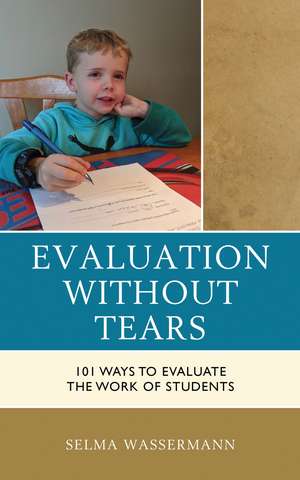
Evaluation without Tears: 101 Ways to Evaluate the Work of Students
Autor Selma Wassermannen Limba Engleză Hardback – 15 ian 2020
Preț: 381.60 lei
Preț vechi: 461.84 lei
-17%
Puncte Express: 572
Carte tipărită la comandă
Livrare economică 07-21 decembrie
Livrare prin curier în România Termenul estimat este afișat lângă disponibilitate.
Transport gratuit de la 400.00 lei Plată online sau ramburs, în funcție de opțiunile comenzii.
Retur gratuit în 14 zile Comandă securizată și suport în română.
Specificații
ISBN-13: 9781475853490
ISBN-10: 1475853491
Pagini: 150
Ilustrații: 3 tables; 5 textboxes
Dimensiuni: 152 x 232 x 16 mm
Greutate: 0.4 kg
Editura: Bloomsbury Publishing
Colecția Rowman & Littlefield
Locul publicării:New York, United States
ISBN-10: 1475853491
Pagini: 150
Ilustrații: 3 tables; 5 textboxes
Dimensiuni: 152 x 232 x 16 mm
Greutate: 0.4 kg
Editura: Bloomsbury Publishing
Colecția Rowman & Littlefield
Locul publicării:New York, United States
Descriere
Teachers evaluate students' work constantly. It is a built-in part of the job of teaching. Yet, what is hardly acknowledged is the subjectivity and unfairness of evaluation. Although grades and marks have long been discounted as having any reliability or validity, they endure as real and exact measures of ability and performance. Not only are they specious, they have little or nothing to do with the important goal of evaluation - that is to provide feedback to learners that enables their subsequent growth. Evaluation Without Tears provides teachers with specific examples of how they might provide evaluative feedback to students that is enabling and affirming, rather than punishing, respectful of the learner and protective of the learner's dignity, recognizing that one person's judgment is not truth. Teaching students to self-assess, an important dimension of growth and maturity, is a significant feature of the book.
Cuprins
Introduction
Preface
Acknowledgements
Chapter 1: What's Evaluation For?
Force of Habit
What's Evaluation For?
Chapter 2: Marking and Grading: The Tail that Wags the Dog
A House of Cards
Chapter 3: A Case for Using Evaluative Feedback
Evaluation as Feedback
Obstacles to Using Evaluative Feedback In Lieu of Grades
Chapter 4: Evaluative Feedback that Enables and Promotes Growth
Identifying the Criteria: What are we looking for?
What is Being Measured?
Learning Goals and Evaluation Practices
Chapter 5: Written Diagnostic Evaluative Feedback Across the Curriculum
Examples from the Primary Grades
Examples from the Intermediate Grades
Examples from Secondary School
Conclusion
Chapter 6: It's All About How You Say It
Reflecting in Action
Examining a Classroom Discussion
Hooked on Praise
Chapter 7: Impediments to Good Diagnostic Judgment
Taming the Impulse to Punish by Evaluative Judgment
Two Cents Worth of Advice to Teachers
Chapter 8: Reporting to Parents
Some examples of teachers' written reports
Parent-teacher-student conferences
Chapter 9: Students as Self Evaluators
Children Evaluating Themselves in the Primary Grades - The Child in the Process
Written Self-Evaluation Reports in the Primary Grades
Students Evaluating Themselves in a One-on-One Tutorial
Students Evaluating Themselves in the Secondary School
Teachers' Assessments on the Profiles
Conclusion
Chapter 10: Institutional Changes Toward Using Evaluative Feedback in Reporting to Parents
Examples of Schools that "Dare to Be Different"
Chapter 11: Evaluation as a Subversive Activity: What Can a Teacher Do?
Chapter 12: Postscript: A Personal Odyssey
A Professional Journey
References
Index
About the Author
Preface
Acknowledgements
Chapter 1: What's Evaluation For?
Force of Habit
What's Evaluation For?
Chapter 2: Marking and Grading: The Tail that Wags the Dog
A House of Cards
Chapter 3: A Case for Using Evaluative Feedback
Evaluation as Feedback
Obstacles to Using Evaluative Feedback In Lieu of Grades
Chapter 4: Evaluative Feedback that Enables and Promotes Growth
Identifying the Criteria: What are we looking for?
What is Being Measured?
Learning Goals and Evaluation Practices
Chapter 5: Written Diagnostic Evaluative Feedback Across the Curriculum
Examples from the Primary Grades
Examples from the Intermediate Grades
Examples from Secondary School
Conclusion
Chapter 6: It's All About How You Say It
Reflecting in Action
Examining a Classroom Discussion
Hooked on Praise
Chapter 7: Impediments to Good Diagnostic Judgment
Taming the Impulse to Punish by Evaluative Judgment
Two Cents Worth of Advice to Teachers
Chapter 8: Reporting to Parents
Some examples of teachers' written reports
Parent-teacher-student conferences
Chapter 9: Students as Self Evaluators
Children Evaluating Themselves in the Primary Grades - The Child in the Process
Written Self-Evaluation Reports in the Primary Grades
Students Evaluating Themselves in a One-on-One Tutorial
Students Evaluating Themselves in the Secondary School
Teachers' Assessments on the Profiles
Conclusion
Chapter 10: Institutional Changes Toward Using Evaluative Feedback in Reporting to Parents
Examples of Schools that "Dare to Be Different"
Chapter 11: Evaluation as a Subversive Activity: What Can a Teacher Do?
Chapter 12: Postscript: A Personal Odyssey
A Professional Journey
References
Index
About the Author
Recenzii
In equal parts a fascinating history of assessment and a concrete call for action. Professor Wassermann empowers readers to reflect on their own approach to evaluation and confront biases, preconceptions and challenges, taking the reader beyond already well-trodden themes of basic weaknesses in the methods and our "love affair" with numbers. Key distinctions are made between enabling or disabling feedback, complemented by a wealth of examples and specific feedback. Wassermann suggests approaches that can be adopted even when teachers are faced with pressure to conform to traditional measures from administration, parents and even students themselves.
With Evaluation Without Tears, Selma Wassermann continues her tradition of important books in teacher education. This work presents a valuable guide to evaluation techniques that are clear and comprehensive, yet concise. Real-life examples serve to amplify the concepts and contribute to more complete understanding. Evaluation is not limited to students' mastery of material but gives teachers the means to evaluate their own work. I was especially struck by the statement that a teacher should also evaluate if the concepts being taught are worthy of being learned. Altogether this is a book every teacher should own and cherish.
It is a superb, challenging and timely book, destined to change students' learning and students' lives for the better. It is an invaluable gift for educators who choose to enable students to learn in a way that offers each student opportunities for personal growth, choice and success. Wassermann provides the history and educational theory that supports the necessity for radical changes in the way learners are evaluated. The sample transcripts of learning conversations and teacher evaluative feedback are absolutely invaluable, providing a wonderful guide for teachers wanting to embark on the process of evaluative feedback.
This is a fine piece of work on the touchy subject of evaluation, one that is too often ignored. It is a thoughtful, conceptually strong and practice-focused work. Teachers and administrators and policymakers will read this book not only for the importance of evaluation in school and classrooms, but also because the writing is crisp, clear and marked by elegant brevity. Many specific examples and a wealth of metaphors and phrases stud the work. The author's gift of writing is unusual among academics and K-12 educators. The book is a pleasure to read.
If you have read any of Dr. Selma Wassermann's books, you can anticipate that Evaluation Without Tears will be beautifully written, well-constructed and designed to reach a significant audience. And this book is. Selma takes on any teacher who still uses measurement to rank or punish students for their work. She speaks of evaluation as feedback as well as to students as self-evaluators in all grades. Rich in examples, Selma's book is delightfully lucid, and filled with passion. It is a great educational ride.
With Evaluation Without Tears, Selma Wassermann continues her tradition of important books in teacher education. This work presents a valuable guide to evaluation techniques that are clear and comprehensive, yet concise. Real-life examples serve to amplify the concepts and contribute to more complete understanding. Evaluation is not limited to students' mastery of material but gives teachers the means to evaluate their own work. I was especially struck by the statement that a teacher should also evaluate if the concepts being taught are worthy of being learned. Altogether this is a book every teacher should own and cherish.
It is a superb, challenging and timely book, destined to change students' learning and students' lives for the better. It is an invaluable gift for educators who choose to enable students to learn in a way that offers each student opportunities for personal growth, choice and success. Wassermann provides the history and educational theory that supports the necessity for radical changes in the way learners are evaluated. The sample transcripts of learning conversations and teacher evaluative feedback are absolutely invaluable, providing a wonderful guide for teachers wanting to embark on the process of evaluative feedback.
This is a fine piece of work on the touchy subject of evaluation, one that is too often ignored. It is a thoughtful, conceptually strong and practice-focused work. Teachers and administrators and policymakers will read this book not only for the importance of evaluation in school and classrooms, but also because the writing is crisp, clear and marked by elegant brevity. Many specific examples and a wealth of metaphors and phrases stud the work. The author's gift of writing is unusual among academics and K-12 educators. The book is a pleasure to read.
If you have read any of Dr. Selma Wassermann's books, you can anticipate that Evaluation Without Tears will be beautifully written, well-constructed and designed to reach a significant audience. And this book is. Selma takes on any teacher who still uses measurement to rank or punish students for their work. She speaks of evaluation as feedback as well as to students as self-evaluators in all grades. Rich in examples, Selma's book is delightfully lucid, and filled with passion. It is a great educational ride.