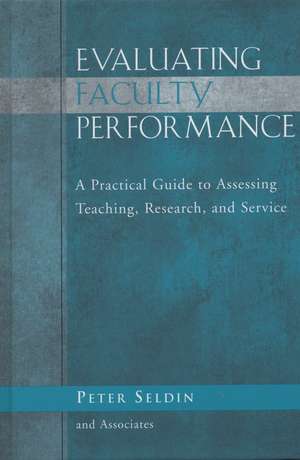
Evaluating Faculty Performance
Editat de Peter Seldinen Limba Engleză Hardback – 15 mai 2006
Preț: 306.29 lei
Puncte Express: 459
Carte tipărită la comandă
Livrare economică 19 decembrie 26 - 02 ianuarie 27
Livrare prin curier în România Termenul estimat este afișat lângă disponibilitate.
Transport gratuit de la 400.00 lei Plată online sau ramburs, în funcție de opțiunile comenzii.
Retur gratuit în 14 zile Comandă securizată și suport în română.
Specificații
ISBN-13: 9781933371047
ISBN-10: 1933371048
Pagini: 288
Dimensiuni: 157 x 235 x 20 mm
Greutate: 0.57 kg
Editura: Wiley
Locul publicării:Hoboken, United States
ISBN-10: 1933371048
Pagini: 288
Dimensiuni: 157 x 235 x 20 mm
Greutate: 0.57 kg
Editura: Wiley
Locul publicării:Hoboken, United States
V-ar putea interesa
-
 The Teaching PortfolioPeter SeldinPreț: 321.63 lei
-
 Leadership TheoryJohn P DuganPreț: 337.75 lei
-
 Assessment in Student AffairsJohn H SchuhPreț: 328.20 lei
-
 Teaching DefianceMichael NewmanPreț: 295.32 lei
-
 Preț: 139.58 lei
-
 Preț: 235.28 lei
-
 Interview Question & Answer Book, TheJames InnesPreț: 96.60 lei
-
 Bloomsbury CPD Library: Middle LeadershipPaul K. Ainsworth-45%Preț: 122.63 lei224.26 lei
-
 Education in Eastern Europe and EurasiaDr Nadiya Ivanenko-9%Preț: 353.40 lei389.95 lei
-
 Transaktionsanalyse für DummiesPaul GamberPreț: 119.77 lei
Notă biografică
Peter Seldin is Distinguished Professor of Management Emeritus at Pace University in: Pleasantville, New York. A Behavioral Scientist, educator, author, and specialist in evaluation and development of faculty and administrative performance, he has been a consultant on higher education issues to more than 350 colleges and universities throughout the United States and in 45 countries around the world. A well-known speaker at national and international conferences, Dr. Seldin regularly serves as a faculty leader in programs offered by the American Council on Education and AACSB International (Association to Advance Collegiate Schools of Business) and is codirector of the annual International Conference on Improving University Teaching.
His well-received books include:
The Teaching Portfolio, third edition (Anker, 2004)
The Administrative Portfolio, with Mary Lou Higgerson (Anker, 2002)
Changing Practices in Evaluating Teaching, with associates (Anker, 1999)
The Teaching Portfolio, second edition (Anker, 1997)
Improving College Teaching, with associates (Anker, 1995)
Successful Use of Teaching Portfolios, with associates (Anker, 1993)
The Teaching Portfolio (Anker 1991)
How Administrators Can Improve Teaching, with associates (Jossey-Bass, 1990)
Evaluating and Developing Administrative Performance (Jossey-Bass, 1988)
Coping with Faculty Stress, with associates (Jossey-Bass, 1987)
Changing Practices in Faculty Evaluation (Jossey-Bass, 1984)
Successful Faculty Evaluation Programs (Coventry Press. 1980)
Teaching Professors to Teach (Blythe-Pennington, 1977)
How Colleges Evaluate Professors (Blythe-Pennington, 1975)
He has contributed numerous articles on the teaching profession student ratings, education practice, and academic culture to such publications as The New York times, The Chronicle of Higher Education, and Change magazine. Among recent honors, he was named by the World Bank as a visiting scholar to Indonesia, In addition, he was elected a fellow of the College of Preceptors in London, England. This special honor is given to a small number of faculty and administrators who are judged to have made an "outstanding contribution to higher education on the internal level." For his contributions to the scholarship of teaching, he has received honorary degrees from Keystone College (Pennsylvania) and Columbia College (South Carolina).
Cuprins
About the Author.
About the Contributors
Preface.
1. Building a Successful Evaluation Program (Peter Seldin).
2. Essential Operating Principles and Key Guidelines (Peter Seldin).
3. Building a Climate For Faculty evaluation That Improves Teaching (Mary Lou HJiggerson).
4. Uses and Abuses of Student Ratings (William Pallett).
5. Institutional Service (Clement A. Seldin).
6. Peer Observations as a Catalyst for Faculty Development (Barbara J. Millis).
7. Self-Evaluation: Composing an Academic Life Narrative (Thomas V. McGovern).
8. Teaching Portfolios (Monica A. Devanas).
9. Evaluating Faculty Research (Teck-Kah Lim).
10. Teaching Evaluation Follies: Misperception and Misbehavior in Student Evaluations of Teachers (Jane S. Halonen, Geroge B. Ellenberg).
11. Using Evaluation Data to Improve Teaching effectiveness (Todd Zakrajsek).
12. Using Evaluation Data for Personnel Decisions (David Fite).
13. The Professional Portfolio: Expanding the Value of Portfolio Development (John Zubizarreta).
14. Summary and Recommendations for Evaluating Faculty Performance (J. Elizabeth Miller).
Appendix: Selected Forms to Evaluate Teaching, Advising, Research, and Service.
Index.