
European Modernity: A Global Approach: Europe’s Legacy in the Modern World
Autor Bo Stråth, Prof. Peter Wagneren Limba Engleză Hardback – 27 iul 2017
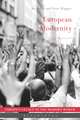
Bo Stråth and Peter Wagner re-position Europe in the global context of the 19th and 20th
centuries. They show that Europe is less modern than has been assumed, and modernity less European and thus decentre Europe in a way that makes room for a wider historical perspective. Adopting a thematic structure, the authors reconceive the idea of European modernity in relation to key topics such as democracy, capitalism and market society, individual autonomy, religion and politics.
European Modernity is an important addition to the literature that will be of interest to all students and scholars of modern European history.


Preț: 583.59 lei
Preț vechi: 678.60 lei
-14%
Puncte Express: 875
Carte tipărită la comandă
Livrare economică 13-27 noiembrie
Livrare prin curier în România Termenul estimat este afișat lângă disponibilitate.
Transport gratuit pentru acest produs Plată online sau ramburs, în funcție de opțiunile comenzii.
Retur gratuit în 14 zile Comandă securizată și suport în română.
Specificații
ISBN-13: 9781350007079
ISBN-10: 1350007072
Pagini: 260
Dimensiuni: 156 x 234 x 19 mm
Greutate: 0.54 kg
Editura: Bloomsbury Publishing
Colecția Bloomsbury Academic
Seria Europe’s Legacy in the Modern World
Locul publicării:London, United Kingdom
ISBN-10: 1350007072
Pagini: 260
Dimensiuni: 156 x 234 x 19 mm
Greutate: 0.54 kg
Editura: Bloomsbury Publishing
Colecția Bloomsbury Academic
Seria Europe’s Legacy in the Modern World
Locul publicării:London, United Kingdom
V-ar putea interesa
-
 Captain Cook's Merchant ShipsStephen BainesPreț: 164.66 lei
 -
 HistoryDavid NashPreț: 77.70 lei
 -
 -14%Preț: 166.06 lei193.87 lei
 -
 -7%Preț: 345.92 lei371.05 lei
 -
 -26%Preț: 110.90 lei148.88 lei
 -
 Four Ball One TracerAndrew HudsonPreț: 188.38 lei
 -
 -12%Preț: 83.57 lei94.45 lei
Cuprins
Part I. The Question of European Modernity
1. Introduction: Modernity - Europe - European Modernity
2. What is Europe?
Part II. Key Features of European Modernity Reconsidered
3. Europe's Hesitation with Democracy
4. The Industrial and Market Revolution in Global Perspective: The Colonial Heritage and the
Social Question
5. European Religion: The Christians and the Others
6. The European: Atom - Individual - Person - Subject?
PART III Transformations of European Modernity
7. The Axial Age and Modern Europe
8. The Great Transformation: Organized Modernity for Welfare and Warfare, 1870s - 1960s
9. The New Great Transformation: The Global Challenge of Historical injustice and Movements
for Collective Self-determination: 1960s - The present
Epilogue
Bibliography
Index
1. Introduction: Modernity - Europe - European Modernity
2. What is Europe?
Part II. Key Features of European Modernity Reconsidered
3. Europe's Hesitation with Democracy
4. The Industrial and Market Revolution in Global Perspective: The Colonial Heritage and the
Social Question
5. European Religion: The Christians and the Others
6. The European: Atom - Individual - Person - Subject?
PART III Transformations of European Modernity
7. The Axial Age and Modern Europe
8. The Great Transformation: Organized Modernity for Welfare and Warfare, 1870s - 1960s
9. The New Great Transformation: The Global Challenge of Historical injustice and Movements
for Collective Self-determination: 1960s - The present
Epilogue
Bibliography
Index
Recenzii
[The] authors do not resort to jargon, and though the authors' different writing styles manifest themselves in the work, the ideas of the whole are retained. Excellent text for historiography. Good endnotes; no separate bibliography; good index.
A highly important work operating right at the intersection of two major intellectual challenges of our time period. The authors help us to further decenter our conceptions of modernity while at the same time putting facets of European history newly into global historical contexts.
In this fluidly written and rigorously argued book, Strath and Wagner challenge the idea of 'modernity' that began in Europe and then spread elsewhere. In doing so, they offer important insights into the role of markets, trade, colonialism, and globalization in the making of the modern world. The book 'provincializes' both Europe and north America, the latter being the most important twentieth century legatee and champion of European style modernization and modernity. Far reaching in its historical and philosophical implications, this book is a landmark in scholarly analyses that seek to de-center Europe.
'What is Europe?' ask Bo Strath and Peter Wagner in this elegant and finely-argued book. For a stubborn many, Europe is the birthplace of modernity, the avant-garde that anyone and any place wishing to be considered modern must follow. Strath and Wagner challenge this European self-praise. Working in English, French, German and Spanish, and drawing on their expertise in History, Sociology and Philosophy, Strath and Wagner not only provincialize Europe but do so in ways that respect the historical specificity of Europe. That is, they pay attention to the relative uniqueness of processes both internal and external to Europe, both good and bad, both ambiguous and contradictory. It remains to be seen how many of those who insist on the discredited idea of Europe as the sole parent of modernity will be moved by this excellent book to reconsider their prejudices. But, whatever they do, they cannot ignore the sophisticated argument offered here.
The volume bundles extensive knowledge, especially of recent historiography, which sets itself apart from a Eurocentric perspective, and thus represents a good introduction to current research and its debates.
A highly important work operating right at the intersection of two major intellectual challenges of our time period. The authors help us to further decenter our conceptions of modernity while at the same time putting facets of European history newly into global historical contexts.
In this fluidly written and rigorously argued book, Strath and Wagner challenge the idea of 'modernity' that began in Europe and then spread elsewhere. In doing so, they offer important insights into the role of markets, trade, colonialism, and globalization in the making of the modern world. The book 'provincializes' both Europe and north America, the latter being the most important twentieth century legatee and champion of European style modernization and modernity. Far reaching in its historical and philosophical implications, this book is a landmark in scholarly analyses that seek to de-center Europe.
'What is Europe?' ask Bo Strath and Peter Wagner in this elegant and finely-argued book. For a stubborn many, Europe is the birthplace of modernity, the avant-garde that anyone and any place wishing to be considered modern must follow. Strath and Wagner challenge this European self-praise. Working in English, French, German and Spanish, and drawing on their expertise in History, Sociology and Philosophy, Strath and Wagner not only provincialize Europe but do so in ways that respect the historical specificity of Europe. That is, they pay attention to the relative uniqueness of processes both internal and external to Europe, both good and bad, both ambiguous and contradictory. It remains to be seen how many of those who insist on the discredited idea of Europe as the sole parent of modernity will be moved by this excellent book to reconsider their prejudices. But, whatever they do, they cannot ignore the sophisticated argument offered here.
The volume bundles extensive knowledge, especially of recent historiography, which sets itself apart from a Eurocentric perspective, and thus represents a good introduction to current research and its debates.
Notă biografică
Bo Stråth is Emeritus Professor of Nordic, European and World History at the University of Helsinki, Finland. He also taught contemporary history at the European University Institute in Florence, Italy.