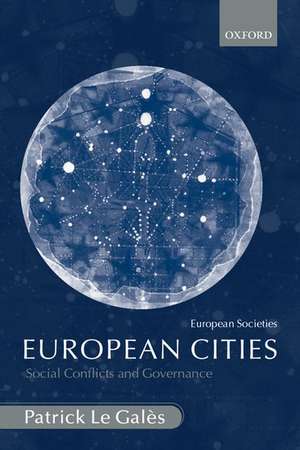
European Cities: Social Conflicts and Governance: European Societies
Autor Patrick le Galèsen Limba Engleză Hardback – 8 aug 2002
| Toate formatele și edițiile | Preț | Express |
|---|---|---|
| Paperback (1) | 366.42 lei 43-49 zile | |
| OUP OXFORD – 8 aug 2002 | 366.42 lei 43-49 zile | |
| Hardback (1) | 402.67 lei 43-49 zile | |
| OUP OXFORD – 8 aug 2002 | 402.67 lei 43-49 zile |



Preț: 402.67 lei
Preț vechi: 583.83 lei
-31%
Puncte Express: 604
Preț estimativ în valută:
71.15€ • 81.75$ • 61.63£
71.15€ • 81.75$ • 61.63£
Carte tipărită la comandă
Livrare economică 07-13 mai
Specificații
ISBN-13: 9780199243570
ISBN-10: 0199243573
Pagini: 280
Ilustrații: numerous maps and tables
Dimensiuni: 163 x 242 x 23 mm
Greutate: 0.63 kg
Ediția:Twenty-Third.
Editura: OUP OXFORD
Colecția OUP Oxford
Seria European Societies
Locul publicării:Oxford, United Kingdom
ISBN-10: 0199243573
Pagini: 280
Ilustrații: numerous maps and tables
Dimensiuni: 163 x 242 x 23 mm
Greutate: 0.63 kg
Ediția:Twenty-Third.
Editura: OUP OXFORD
Colecția OUP Oxford
Seria European Societies
Locul publicării:Oxford, United Kingdom
V-ar putea interesa
-
 The World is FlatThomas L. Friedman-20%Preț: 94.78 lei117.77 lei
 -
 In Defense of Globalization: With a New AfterwordJagdish Bhagwati-32%Preț: 87.23 lei127.48 lei
 -
 A Handbook of International Trade in ServicesAaditya Mattoo-22%Preț: 382.84 lei492.63 lei
 -
 -11%Preț: 460.25 lei517.14 lei
 -
 Global Justice: Defending CosmopolitanismCharles Jones-15%Preț: 362.61 lei425.74 lei
 -
 Regions, Globalization, and the Knowledge-Based EconomyJohn H. Dunning-34%Preț: 664.36 lei1006.02 lei
 -
 -31%Preț: 433.10 lei626.72 lei
 -
 -18%Preț: 373.94 lei453.72 lei
 -
 -22%Preț: 358.74 lei460.83 lei
 -
 Politics, Social Theory, Utopia and the World-SystemC. El-OjeiliPreț: 374.38 lei
 -
 Preț: 373.28 lei
 -
 Globalization, Institutions and GovernanceJames A. CaporasoPreț: 435.12 lei
Recenzii
This book addresses an important but complex topic and draws on an extensive, multilingual literature that ranges over sociology, political science and urban history. It is useful descriptively in understanding trends in western European cities and local governments and is effective in countering extreme claims about economic globalization. Its major success lies in demonstrating how analyses of wider processes can be integrated into analyses of cities and specifically that economic globalization does not mean the end of the city as a significant object of enquiry.
The work will interest academics, students, policy-researchers and practitioners in the fields of local governance, sociology and European studies.
Overall, this book provides a comprehensive account of the often contradictory dynamics which affect cities in Europe and a particularly useful framework for further analysis of European local societies. It represents a well-documented and interesting analysis that can meet the interest of those academics and social scientists who pay attention to the phenomenon of the 're-emergence of territories' and it is highly recommended for graduate students from diverse scientific fields and policymakers operating at various territorial levels.
Patrick Le Galès's excellent book - which focuses on medium-sized cities, the backbone of urban Europe - represents an important contribution to the debate.
...compared to many other books on the same subject, this one clearly stands out for its combination of a coherent theoretical framework with a non-formalistic and in-depth description of the intricacies of multiscalar politics coming together at city level.
The work will interest academics, students, policy-researchers and practitioners in the fields of local governance, sociology and European studies.
Overall, this book provides a comprehensive account of the often contradictory dynamics which affect cities in Europe and a particularly useful framework for further analysis of European local societies. It represents a well-documented and interesting analysis that can meet the interest of those academics and social scientists who pay attention to the phenomenon of the 're-emergence of territories' and it is highly recommended for graduate students from diverse scientific fields and policymakers operating at various territorial levels.
Patrick Le Galès's excellent book - which focuses on medium-sized cities, the backbone of urban Europe - represents an important contribution to the debate.
...compared to many other books on the same subject, this one clearly stands out for its combination of a coherent theoretical framework with a non-formalistic and in-depth description of the intricacies of multiscalar politics coming together at city level.