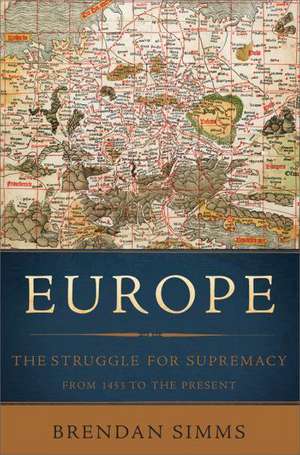
Europe: The Struggle for Supremacy, from 1453 to the Present
Autor Brendan Simmsen Limba Engleză Paperback – 6 oct 2014
În această ediție actualizată, descoperim o analiză geopolitică riguroasă care transformă modul în care înțelegem dinamica puterii pe continentul nostru. Spre deosebire de abordările pur cronologice, Brendan Simms propune o teză provocatoare: centrul Europei este pivotul în jurul căruia s-a rotit întreaga istorie mondială în ultima jumătate de mileniu. Suntem de părere că autorul reușește o performanță rară, aceea de a comprima 550 de ani de conflicte și alianțe — de la căderea Constantinopolului în 1453 până la provocările contemporane — într-un volum care rămâne coerent și extrem de relevant pentru curriculumul de istorie și științe politice.
Textul completează perspectiva oferită de A Short History of Europe de Simon Jenkins, adăugând o profunzime strategică și o analiză a relațiilor internaționale pe care o narațiune pur istorică o poate omite. În timp ce Jenkins se concentrează pe evoluția culturală și socială, Simms prioritizează „marea strategie” și controlul teritorial. Apreciem modul în care autorul poziționează această lucrare în contextul operei sale, făcând trecerea de la „micro-istoria” detaliată din The Longest Afternoon la o viziune panoramică, similară cu rigoarea cercetării din biografia Hitler. Dacă în lucrările anterioare se concentra pe momente sau figuri specifice, aici Brendan Simms sintetizează factorii structurali — geografie, religie și armată — care au forjat Occidentul. Rezultatul este un volum dens, dar fluid, care explică de ce stabilitatea europeană depinde, și astăzi, de echilibrul fragil din inima continentului.
Preț: 255.76 lei
Carte tipărită la comandă
Livrare economică 28 noiembrie-12 decembrie
Specificații
ISBN-10: 0465064868
Pagini: 720
Dimensiuni: 152 x 232 x 44 mm
Greutate: 0.89 kg
Ediția:1
Editura: BASIC BOOKS
Colecția Basic Books
V-ar putea interesa
-
 Three Victories and a DefeatBrendan SimmsPreț: 151.08 lei
 -
 The Hammer and the CrossRobert FergusonPreț: 120.92 lei
 -
 The Perfect NaziMartin Davidson-31%Preț: 64.66 lei93.34 lei
 -
 Savage ContinentKeith Lowe-18%Preț: 89.20 lei108.99 lei
 -
 Let Our Fame Be GreatOliver BulloughPreț: 125.56 lei
 -
 Vanished KingdomsNorman Davies-17%Preț: 116.44 lei139.83 lei
 -
 Russia's WarRichard OveryPreț: 120.20 lei
 -
 The Longest AfternoonBrendan SimmsPreț: 90.34 lei
 -
 The Pursuit of PowerRichard J. Evans-21%Preț: 115.96 lei146.53 lei
 -
 It Can't Happen HereSinclair Lewis-36%Preț: 60.35 lei93.86 lei
 -
 PilgermannRussell Hoban-26%Preț: 58.82 lei79.05 lei
 -
 Preț: 197.19 lei
 -
 Leon Trotsky: A Revolutionary's LifeJoshua RubensteinPreț: 114.64 lei
 -
 The Hanoverian Dimension in British History, 1714 1837Brendan SimmsPreț: 417.38 lei
 -
 Preț: 420.63 lei
 -
 The Viking BlitzkriegMartyn WhittockPreț: 127.05 lei
 -
 The Great Famine: Ireland's Agony 1845-1852Dr Ciarán Ó MurchadhaPreț: 174.77 lei
De ce să citești această carte
Pentru cititorul pasionat de istorie și geopolitică, această carte oferă o „hartă” clară a puterii europene. Veți câștiga o înțelegere profundă a motivelor pentru care anumite zone geografice rămân puncte de conflict constante. Este o recomandare esențială pentru studenți și profesioniști în relații internaționale care caută să înțeleagă rădăcinile istorice ale tensiunilor politice actuale, dincolo de evenimentele de suprafață.
Despre autor
Brendan Simms, născut în Dublin, este un distins profesor de istoria relațiilor internaționale la Departamentul de Politică și Studii Internaționale al Universității din Cambridge. Recunoscut pentru capacitatea sa neobișnuită de a sintetiza perioade vaste de timp, Simms s-a impus în literatura de specialitate prin lucrări premiate și nominalizate la premii prestigioase precum Mark Lynton History Prize. Expertiza sa se concentrează pe intersecția dintre geografie și strategia politică, fiind una dintre vocile autoritare în explicarea rolului Germaniei și al Marii Britanii în arhitectura de securitate europeană.
Descriere scurtă
InEurope, prizewinning historian Brendan Simms presents an authoritative account of the past half-millennium of European history, demonstrating how the battle for mastery there has shaped the modern world. Beginning in 1453, when the collapse of the Byzantine Empire laid Europe open to Ottoman incursion and prompted the dramatic expansion of the Holy Roman Empire, Simms leads readers through the epic struggle for the heart of Europe. Stretching from the Low Countries through Germany and into the North Italian plain, this relatively compact zone has historically been the richest and most productive on earth. For hundreds of years, its crucial strategic importance stoked a seemingly unending series of conflicts, from the English Civil War to the French Revolution to the appalling world wars of the 20th century. But when Europe is in harmony, Simms shows, the entire world benefits—a lesson that current leaders would do well to remember.
A bold and compelling work by a renowned scholar,Europeintegrates religion, politics, military strategy, and international relations to show how history—and Western civilization itself—was forged in the crucible of Europe.
Notă biografică
Recenzii
“Brilliantly successful....Simms has the breadth of knowledge and clarity of vision to make his case compelling. His book is also immensely entertaining as well as instructive. There are few pages not enlivened by sharp insight, telling vignette or memorable turn of phrase. In short, this is a great book and everyone interested in European history will want to read it.”
The Washington Times
“[A] sweeping, intelligent and enormously ambitious book.”
Paul Kennedy, J. Richardson Dilworth Professor of History, Yale University, and author ofThe Rise and Fall of the Great Powers
“Europeis a superb, sure-footed analysis of how this center of world civilization, technology, and warfare evolved since the fall of Constantinople in 1453. It is unabashedly political history, and the better for being so. Simms's acumen and sharp opinions are a joy to read. This book will be appreciated both by the general reader and by history teachers everywhere.”
“Prodigious.... If postmodern scholarship has Ranke spinning in his grave, Mr. Simms's book will give his weary soul some rest.... This is the history of Richelieu, Metternich and Kissinger, not of Luther, Newton and Beethoven. Such a summary may sound arid, butEuropeis anything but. In fact, it draws the reader forward with its grand epic of shifting alliances, clashing armies and ambitious statecraft. Simms is a skilled writer with a rare gift for compressed analysis. His focus on the military and diplomatic arc of European history lends his book a strong narrative line and thematic coherence. Patterns emerge that might have remained buried in a more various survey.”
The Economist
“Brendan Simms's new history [is] especially timely. He has, in effect, dropped a big stone into the European pond and stood back to watch the ripples spread.... It is a compelling and provocative thesis.... This is sweeping history, told with verve and panache, and it is all the more refreshing for that.”
Financial Times
“Europeis a stimulating, impressive history that starts with the Ottoman conquest of Constantinople in 1453 and extends to the present day.... An excellent read and its insights into the grand themes of European history are penetrating and lucidly argued.”
Timothy Snyder, author ofBloodlands
“World history is German history, and German history is world history.
This is the powerful case made by this gifted historian of Europe, whose expansive erudition revives the proud tradition of the history of geopolitics, and whose immanent moral sensibility reminds us that human choices made in Berlin (and London) today about the future of Europe might be decisive for the future of the world.”
Norman Davies, St. Antony's College, Oxford and Jagiellonian University, Krakow
“European history comes in many guises, but Brendan Simms's strategic and geopolitical approach provides a strong and lucid framework within which everything else fits into place. His emphasis on the centrality of Germany offsets more western-orientated accounts while also giving due prominence to Eastern Europe. Covering the whole of the modern period, this book is more than an excellent introduction; it's a major interpretational achievement.”
The Telegraph
"Brendan Simms is a historian of unusual range and ability.... His new book is nothing less than a history of Europe over the past 550 years.... Writing such a book is a colossally demanding task — the sort of challenge most sane historians would baulk at, unless they had a very clear idea of what they wanted to say. Luckily, knowing what he wants to say is one of Simms's strengths. For this book is driven by two great master-ideas, and there is hardly a page in it where their presence is not felt. So, no matter how dense the details may be of kings, wars, treaties and governments, the reader always has the exhilarating sense of moving swiftly onwards.... Like all truly powerful and original works, this is a book worth disagreeing with. But above all it is a book worth reading."
The New Statesman
"[An] unrepentantly old-fashioned, lively and erudite history of Europe since 1453.... Ambitious in scope.... Simms knows what he is talking about."
The Weekly Standard
"Sweeping and provocative."