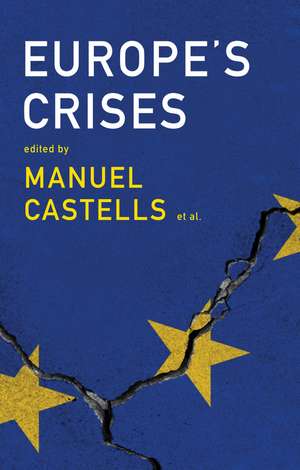
Europe's Crises
Editat de Manuel Castells, Olivier Bouin, Joao Caraça, Gustavo Cardoso, John Thompson, Michel Wieviorkaen Limba Engleză Paperback – 3 ian 2018
Adresat studenților, cercetătorilor și practicienilor din domeniul științelor politice și economice, volumul Europe's Crises oferă o analiză riguroasă a mecanismelor care pun în pericol supraviețuirea Uniunii Europene. Notăm cu interes abordarea multidisciplinară coordonată de Manuel Castells și colegii săi, care refuză să trateze evenimentele recente ca pe niște incidente izolate, propunând în schimb o viziune integrată asupra crizelor suprapuse.
Descoperim aici o structură logică, divizată în arii de impact majore: crizele economice și cele sociale. Prima parte a lucrării investighează economia politică a integrării europene, cu o atenție deosebită acordată sistemelor bancare din Italia și Grecia, în timp ce a doua parte explorează costurile umane ale austerității. Remarcăm modul în care autorii corelează deciziile politice de formare a blocului comunitar cu vulnerabilitățile structurale care au facilitat criza euro și fenomenul Brexit. Lucrarea extinde cadrul propus de The European Union in Crisis de Desmond Dinan prin adăugarea unor date noi despre impactul social al crizelor, precum efectele asupra sănătății publice în Marea Britanie și ascensiunea mișcărilor xenofobe.
Spre deosebire de alte volume care se concentrează strict pe evenimente, acest text de la Polity Press analizează modul în care procesele de luare a deciziilor la nivel înalt au creat, paradoxal, condițiile pentru instabilitatea actuală. Este o resursă academică esențială pentru înțelegerea modului în care identitatea ambivalentă a Europei influențează reziliența instituțională în fața terorismului și a populismului.
Preț: 215.52 lei
Carte disponibilă
Livrare economică 19 mai-02 iunie
Specificații
ISBN-10: 1509524878
Pagini: 476
Dimensiuni: 154 x 230 x 34 mm
Greutate: 0.72 kg
Ediția:1
Editura: Polity Press
Locul publicării:Chichester, United Kingdom
V-ar putea interesa
-
 Aftermath: The Cultures of the Economic CrisisManuel Castells-12%Preț: 234.19 lei266.40 lei
 -
 The Making of TerrorismMichel WieviorkaPreț: 283.22 lei
 -
 Winning Together – The Natural Resource Negotiation PlaybookBruno Verdini TrejoPreț: 251.40 lei
 -
 Preț: 310.60 lei
 -
 The Informational CityManuel CastellsPreț: 402.76 lei
 -
 Global Human Rights InstitutionsGerd OberleitnerPreț: 168.17 lei
 -
 Understanding Global TerrorChristopher AnkersenPreț: 209.06 lei
 -
 Divided WestJürgen HabermasPreț: 195.22 lei
 -
 Debating GlobalizationAnthony BarnettPreț: 179.28 lei
 -
 Globalization, Poverty and Inequality: Between a Rock and a Hard PlaceRaphael KaplinskyPreț: 217.89 lei
 -
 Development, Security and Unending WarMark DuffieldPreț: 219.20 lei
 -
 Crime in an Insecure WorldRichard V EricsonPreț: 192.72 lei
 -
 A Manifesto for Social ProgressMarc Fleurbaey-NaN%Preț: 144.37 lei144.37 lei
 -
 -18%Preț: 1407.50 lei1716.46 lei
 -
 Preț: 206.68 lei
 -
 -35%Preț: 483.39 lei742.88 lei
 -
 -23%Preț: 696.05 lei903.96 lei
 -
 The Media in the Network SocietyGustavo CardosoPreț: 190.91 lei
 -
 -12%Preț: 146.74 lei167.45 lei
Public țintă
Students and scholar of the financial crisis, political economy and economic sociology.De ce să citești această carte
Recomandăm această carte oricărui specialist care dorește să înțeleagă rădăcinile sistemice ale instabilității europene actuale. Cititorul câștigă o perspectivă critică asupra modului în care defectele de construcție ale Uniunii Europene au alimentat criza financiară și tensiunile sociale. Este un instrument de lucru indispensabil pentru cursuri de economie politică și sociologie, oferind studii de caz concrete și date despre consecințele umane ale politicilor de austeritate.
Despre autor
Manuel Castells este un sociolog de renume mondial, recunoscut pentru analizele sale asupra societății informaționale și a rețelelor, fiind profesor la Universitatea Southern California și la Universitatea deschisă din Catalonia. În Europe's Crises, acesta colaborează cu editori de calibru precum John Thompson și Michel Wieviorka pentru a aduce o perspectivă sociologică profundă asupra politicii europene. Experiența sa vastă în cercetarea mișcărilor sociale și a dinamicii economice globale fundamentează tezele volumului, transformându-l într-o autoritate în analiza transformărilor structurale ale statului contemporan.