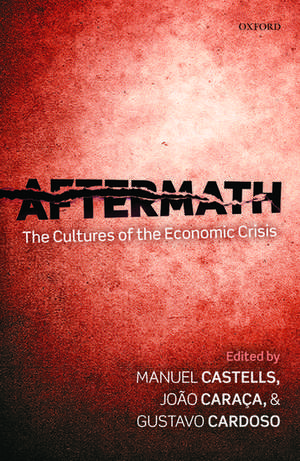
Aftermath: The Cultures of the Economic Crisis
Autor Manuel Castells, João Caraça, Gustavo Cardosoen Limba Engleză Paperback – 27 mar 2014
Preț: 260.74 lei
Preț vechi: 298.61 lei
-13%
Puncte Express: 391
Carte disponibilă
Livrare economică 05-10 noiembrie
Livrare prin curier în România Termenul estimat este afișat lângă disponibilitate.
Transport gratuit de la 400.00 lei Plată online sau ramburs, în funcție de opțiunile comenzii.
Retur gratuit în 14 zile Comandă securizată și suport în română.
Specificații
ISBN-13: 9780199677382
ISBN-10: 0199677387
Pagini: 330
Dimensiuni: 156 x 234 x 19 mm
Greutate: 0.49 kg
Editura: Oxford University Press
Colecția OUP Oxford
Locul publicării:Oxford, United Kingdom
ISBN-10: 0199677387
Pagini: 330
Dimensiuni: 156 x 234 x 19 mm
Greutate: 0.49 kg
Editura: Oxford University Press
Colecția OUP Oxford
Locul publicării:Oxford, United Kingdom
V-ar putea interesa
-
 -28%Preț: 406.17 lei562.20 lei
 -
 The Sacred Project of American SociologyChristian Smith-21%Preț: 301.32 lei379.88 lei
 -
 Reconnecting Marketing to MarketsLuis Araújo-25%Preț: 399.88 lei532.96 lei
 -
 -21%Preț: 427.29 lei542.14 lei
 -
 Process, Sensemaking, and OrganizingTor Hernes-21%Preț: 414.64 lei525.52 lei
 -
 A Dictionary of SociologyJohn Scott-16%Preț: 94.08 lei111.65 lei
 -
 The Hacker EthicPekka HimanenPreț: 113.64 lei
 -
 The Informational CityManuel CastellsPreț: 418.53 lei
 -
 The Black Family and Society: Africana StudiesMark Hulliung-18%Preț: 1112.48 lei1356.68 lei
 -
 -18%Preț: 1112.48 lei1356.68 lei
 -
 -18%Preț: 1112.48 lei1356.68 lei
 -
 The Decline of the IntellectualThomas Molnar-18%Preț: 1291.72 lei1575.27 lei
 -
 -18%Preț: 1112.48 lei1356.68 lei
 -
 -18%Preț: 1112.48 lei1356.68 lei
 -
 The Ethnobotany of Pre-Columbian PeruMargaret Towle-18%Preț: 1112.48 lei1356.68 lei
 -
 The Myth of the Madding CrowdClark McPhail-18%Preț: 1263.48 lei1540.82 lei
 -
 -18%Preț: 1112.48 lei1356.68 lei
 -
 The Punishment ResponseGraeme R. Newman-18%Preț: 1112.48 lei1356.68 lei
 -
 The Racing GameMarvin Scott-18%Preț: 1112.48 lei1356.68 lei
 -
 Another Economy Is PossibleManuel CastellsPreț: 233.82 lei
 -
 Europe's CrisesManuel CastellsPreț: 225.46 lei
 -
 The Media in the Network SocietyGustavo CardosoPreț: 199.27 lei
 -
 CAPITAL MULTINACIONAL, ESTADOS NACIONALES Y COMUNIDADES LOCALESManuel CastellsPreț: 76.41 lei
Recenzii
The discussion of the crisis of global capitalism offered in this book marks a breakthrough. The work ranges far more widely than the usual crop of purely economic analyses and rightly so.
All economies are culture-that is the lens through which this compelling analysis looks at the on-going crisis of capitalism. From this follows the imperative: cooperate or fail! This book is a thought-provoking, interdisciplinary diagnosis of a world in turmoil.
Five years of crisis and upheaval have shaken the world. Aftermath takes up the question of where we go now. Castells and his collaborators show the depth of challenges, the diversity of global circumstances and paths, andhappilyreasons for cautious optimism amid the tumult. This is an important moment in history and an important book for this moment.
All economies are culture-that is the lens through which this compelling analysis looks at the on-going crisis of capitalism. From this follows the imperative: cooperate or fail! This book is a thought-provoking, interdisciplinary diagnosis of a world in turmoil.
Five years of crisis and upheaval have shaken the world. Aftermath takes up the question of where we go now. Castells and his collaborators show the depth of challenges, the diversity of global circumstances and paths, andhappilyreasons for cautious optimism amid the tumult. This is an important moment in history and an important book for this moment.
Notă biografică
Manuel Castells is University Professor and the Wallis Annenberg Chair of Communication Technology and Society at the University of Southern California, Los Angeles, as well as Director of Research at the Department of Sociology, University of Cambridge, and holder of the Chair of Network Society at the College d' Etudes Mondiales, Paris. He has published 26 books including the trilogy The Information Age: Economy, Society, and Culture (Blackwell, 1996-2000), The Internet Galaxy (OUP, 2001), and Communication Power (OUP, 2nd Edition, 2013). He is a fellow of the American Academy of Political and Social Science, of the Academia Europaea, of the British Academy, of the Mexican Academy of Sciences, and of the Spanish Royal Academy of Economics. He has received 18 honorary doctorates, as well as the Erasmus Medal 2010, and the Holberg Memorial Prize 2012.João Caraça obtained a D. Phil. in Nuclear Physics at the University of Oxford and the Agregação in Physics at the Lisbon Faculty of Sciences. He is Director of the Science Department of the Calouste Gulbenkian Foundation, Lisbon and also Full Professor of Science and Technology Policy at the Instituto Superior de Economia e Gestão of the Universidade Técnica de Lisboa. He is member of the Governing Board of the European Institute of Innovation and Technology - EIT. He also integrates the Steering Group of the European Forum on Philanthropy and Research Funding and is President of the Advisory Board of the Portuguese Business Association for Innovation - COTEC. He was Science Adviser of the President of the Portuguese Republic (1996-2006), has published over 150 scientific papers, and co-authored Limits to Competition (1995), co-edited O Futuro Tecnológico (1999) and collaborated in Le Printemps du Politique (2007).Gustavo Cardoso is Professor of Media and Society at IUL - Lisbon University Institute. His areas of interest are the cultures of the network society, the transformations of the notions of property, distribution and production of cultural goods, and the role of online social networking. Between 1996 and 2006 he was advisor on Information Society and telecommunications policies to the Presidency of the Portuguese Republic and in 2008 was chosen by the World Economic Forum as a Young Global Leader. His international cooperation in European research networks led him to work with IN3 (Internet Interdisciplinary Institute) in Barcelona, WIP (World Internet Project) at USC Annenberg, COST A20 "The Impact of the Internet in Mass Media" and COST 298 "Broadband Society." During the last five years he has been the Director of OberCom media observatory in Lisbon and is deputy chairman of the board of LUSA, the Portuguese global news agency.
Cuprins
- 1: Manuel Castells, João Caraça and Gustavo Cardoso: The Cultures of the Economic Crisis: An Introduction
- PRELUDE
- 2: Rosalind Williams: The Rolling Apocalypse of Contemporary History
- 3: João Caraça: The Separation of Cultures and the Decline of Modernity
- WHICH CRISIS? WHOSE CRISIS?
- 4: John B. Thompson: The Metamorphosis of a Crisis
- 5: Michel Wieviorka: Financial Crisis or Societal Mutation?
- DEALING WITH THE CRISIS
- 6: Sarah Banet-Weiser: Branding the Crisis
- 7: Terhi Rantanen: In Nationalism We Trust?
- 8: Pekka Himanen: Crisis, Identity and the Welfare State
- BEYOND THE CRISIS
- 9: Gustavo Cardoso and Pedro Jacobetty: Surfing the Crisis: Cultures of Belonging and Networked Social Change
- 10: Joana Conill, Manuel Castells, Amalia Cardenas and Lisa Servon: Beyond the Crisis: The Emergence of Alternative Economic Practises
- THE NON-GLOBAL GLOBAL CRISIS
- 11: You-tien Hsing: No Crisis in China? The Rise of China's Social Crisis
- 12: Ernesto Ottone: A Non-Global Crisis? Challenging the Crisis in Latin America
- AFTERMATH?