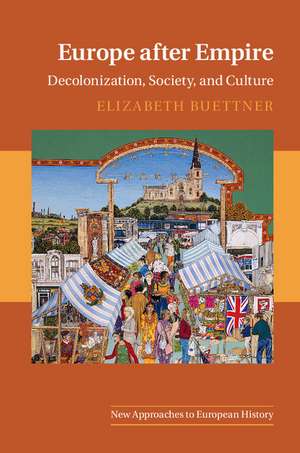
Europe after Empire
Autor Elizabeth Buettneren Limba Engleză Paperback – 24 mar 2016
Adresat studenților în istorie și științe politice, cercetătorilor și practicienilor din domeniul studiilor culturale, volumul Europe after Empire oferă o sinteză riguroasă a modului în care prăbușirea imperiilor coloniale a reconfigurat fundamental nu doar coloniile, ci și metropolele vest-europene. Observăm în această lucrare o trecere necesară de la istoria națională izolată la o perspectivă comparativă, care urmărește urmele imperiale în viața cotidiană, în consum și în structurile ideologice ale Europei contemporane. Elizabeth Buettner structurează narațiunea în jurul proceselor de decolonizare de după cel de-al Doilea Război Mondial, analizând fluxurile migratorii complexe. Găsim aici o documentare atentă a modului în care „întoarcerea acasă” a europenilor și sosirea populațiilor din fostele teritorii dependente au condus la hibridizarea culturală și la destabilizarea ipotezelor tradiționale despre rasă și apartenență. Cartea completează perspectiva oferită de Decolonising Europe? de Berny Sèbe, adăugând o analiză mai profundă a impactului pe termen lung asupra culturii de elită și a peisajului religios european, dincolo de dinamica politică imediată. În contextul operei sale, acest titlu reprezintă o extindere firească a temelor din Empire Families. Dacă în lucrarea anterioară autoarea se concentra pe experiența familiilor britanice în India, în Europe after Empire ea lărgește cadrul pentru a include experiențele franceze, olandeze, belgiene și portugheze. Stilul este academic, precis și lipsit de artificii, fiind structurat pentru a servi drept resursă de bază în curriculumul de istorie modernă europeană. Volumul reușește să demonstreze că decolonizarea nu a fost un eveniment punctiform, ci un proces fluid care continuă să modeleze identitatea Europei de astăzi prin memorii și moșteniri imperiale persistente.
Preț: 297.90 lei
Carte tipărită la comandă
Livrare economică 08-22 decembrie
Specificații
ISBN-10: 052113188X
Pagini: 564
Ilustrații: 33 b/w illus.
Dimensiuni: 152 x 229 x 30 mm
Greutate: 0.81 kg
Editura: Cambridge University Press
Locul publicării:Cambridge, United Kingdom
V-ar putea interesa
-
 Ceremony and Civility: Civic Culture in Late Medieval LondonBarbara A. Hanawalt-21%Preț: 250.45 lei315.67 lei
 -
 -17%Preț: 105.51 lei127.63 lei
 -
 Evolution of the BookFrederick G. Kilgour-27%Preț: 466.32 lei641.99 lei
 -
 Early Modern Europe: An Oxford HistoryEuan Cameron-10%Preț: 319.17 lei356.18 lei
 -
 -32%Preț: 543.99 lei800.73 lei
 -
 Preț: 322.73 lei
 -
 The Norman Kingdom of SicilyDonald MatthewPreț: 525.74 lei
 -
 Barbarian Migrations and the Roman West, 376-568Guy HalsallPreț: 320.39 lei
 -
 Reading Medieval LatinKeith SidwellPreț: 263.01 lei
 -
 The Ottoman Empire and Early Modern EuropeDaniel GoffmanPreț: 347.43 lei
 -
 Women, Family, and Gender in Islamic LawJudith E. TuckerPreț: 299.16 lei
 -
 The Byzantine LadyDonald M. NicolPreț: 206.07 lei
 -
 The Formation of Islam 1edJonathan P. BerkeyPreț: 389.06 lei
 -
 Portuguese Oceanic Expansion, 1400-1800Francisco BethencourtPreț: 376.96 lei
 -
 The Byzantine EconomyAngeliki E. LaiouPreț: 318.21 lei
 -
 The Jews of Medieval Western ChristendomRobert ChazanPreț: 334.40 lei
 -
 The Crusades, C.1071 C.1291Jean RichardPreț: 448.10 lei
 -
 Islamic HistoriographyChase RobinsonPreț: 277.60 lei
 -
 Roger II of SicilyHubert HoubenPreț: 337.74 lei
 -
 CharlemagneRosamond MckitterickPreț: 331.20 lei
 -
 German Histories in the Age of Reformations, 1400-1650Thomas A. Brady Jr.Preț: 313.18 lei
 -
 A Social History of England, 1200-1500Rosemary HorroxPreț: 441.75 lei
 -
 Medieval Africa, 1250 1800Roland OliverPreț: 386.58 lei
 -
 The Making of PolitiesJohn WattsPreț: 251.69 lei
 -
 Southeastern Europe in the Middle Ages, 500-1250Florin CurtaPreț: 434.18 lei
 -
 The Cambridge History of ChristianityMargaret M. MitchellPreț: 447.64 lei
 -
 An Economic History of EuropeKarl Gunnar PerssonPreț: 272.80 lei
 -
 Reformation EuropeUlinka RublackPreț: 232.26 lei
 -
 Medieval HeresiesChristine Caldwell AmesPreț: 274.47 lei
 -
 Preț: 501.58 lei
De ce să citești această carte
Recomandăm această carte oricărui cititor interesat de rădăcinile diversității multiculturale din Europa de Vest. Veți câștiga o înțelegere clară a legăturii dintre trecutul colonial și dezbaterile actuale despre migrație și identitate națională. Este o resursă esențială pentru a decoda complexitatea societății europene contemporane, oferind argumente istorice solide în locul generalizărilor politice, totul sub girul academic al seriei New Approaches to European History.
Despre autor
Elizabeth Buettner este Profesor de Istorie Modernă la University of Amsterdam din 2014, după o carieră academică solidă la Universitatea din York. Formarea sa include studii la Barnard College, Columbia University și un doctorat la University of Michigan. Expertiza sa în istoria imperiilor și a decolonizării este susținută de burse prestigioase, precum Senior Research Fellowship la Freiburg Institute for Advanced Studies și participarea la International Research Seminar on Decolonization. Cercetările sale se concentrează pe intersecția dintre istoria socială, migrație și impactul cultural al imperiului asupra Europei moderne.
Descriere scurtă
Cuprins
Recenzii
'This pioneering study plumbs the post-decolonization histories of multiple European societies - the Netherlands, Belgium, and Portugal alongside Britain and France - and brings them into dynamic conversation. It is a continental history, necessary reading for anyone seeking to understand how the long history of overseas empires still fashions European lives and understandings today.' Todd Shepard, Johns Hopkins University
'A book that truly demonstrates the global impacts of decolonization, Europe after Empire blends comparative and transnational analyses to illustrate how Western European societies were reimagined and remade as imperial bonds were broken. The breadth of coverage is immense, the insights are invaluable.' Martin Thomas, University of Exeter
'Europe after Empire lives up to its promise: acknowledging the ongoing present of the imperial past in Europe, it provides an important contribution to a 'new imperial history' that is sensitive to postcolonial critique on the implicit Eurocentrism in many historiographies of colonialism and decolonization. After the first two comparative parts on decolonization, immigration and multicultural society in Britain, the Netherlands, France, Belgium and Portugal, Part III urges us to reflect on European memories of empire beyond national frames.' Susan Legêne, VU University Amsterdam
'This new analytic recasting of post-imperial Europe clearly illustrates a significant scholarly shift from using a single nation-state as mirror … The volume is well illustrated and footnoted, and has a current bibliography … Summing Up: Recommended. All academic and public libraries.' M. S. Miller, Choice
'[a] thoughtful, well-organized, scrupulously researched volume. The historical narratives are complemented by strong cultural, social and political analyses. … Anyone embarking on the study of decolonization - widely understood, as in this book - will be grateful to Buettner for providing so comprehensive and perceptive an overview, the best currently available.' The Times Literary Supplement
Descriere
A pioneering comparative history of British, French, Dutch, Belgian, and Portuguese decolonization from the formal ending of empires to the postcolonial European present. Elizabeth Buettner charts the social, cultural, and political impacts of European decolonization, including postcolonial migration, multicultural societies, and divided memories of empires past.