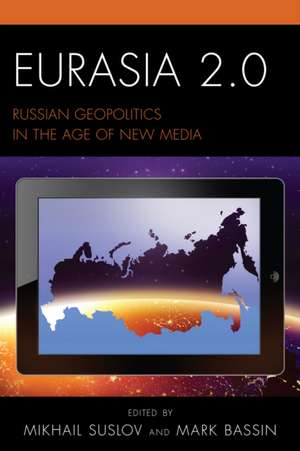
Eurasia 2.0: Russian Geopolitics in the Age of New Media: Russian, Eurasian, and Eastern European Politics
Editat de Mikhail Suslov, Mark Bassin Contribuţii de Brigit Beumers, Per-Arne Bodin, Sergiy Kurbatov, Marlene Laruelle, Fabian Linde, Sirke Mäkinen, Alla Marchenko, Ryhor Nizhnikau, Saara Ratilainen, Dr. Greg Simons, Hanna Smith, Vlad Strukov, Andrei P. Tsygankov, Dirk Uffelmann, Galina Zverevaen Limba Engleză Paperback – 31 aug 2017
This book focuses on the new phenomenon of digital geopolitics in the former Soviet Union. It considers how media serve as platforms for the contestation of geopolitical ideas and the articulation of new political identities. It explores new possibilities and threats associated with the digitalization of geopolitical knowledge and practice.
| Toate formatele și edițiile | Preț | Express |
|---|---|---|
| Paperback (1) | 344.88 lei 6-8 săpt. | |
| Bloomsbury Publishing – 31 aug 2017 | 344.88 lei 6-8 săpt. | |
| Hardback (1) | 565.56 lei 3-5 săpt. | +41.31 lei 6-10 zile |
| Bloomsbury Publishing – 17 mar 2016 | 565.56 lei 3-5 săpt. | +41.31 lei 6-10 zile |
Din seria Russian, Eurasian, and Eastern European Politics
- nou
 Preț: 553.78 lei
 - 34%
 Preț: 539.53 lei
 - 26%
 Preț: 270.63 lei
 - 22%
 Preț: 319.13 lei
 - 34%
 Preț: 645.91 lei
 - 34%
 Preț: 521.71 lei
 - 22%
 Preț: 310.00 lei
 - 34%
 Preț: 646.26 lei
 - 34%
 Preț: 670.50 lei
 - 25%
 Preț: 209.65 lei
 - 27%
 Preț: 254.84 lei
 - 34%
 Preț: 554.70 lei
 - 26%
 Preț: 242.93 lei
 - 14%
 Preț: 245.87 lei
 - 34%
 Preț: 593.39 lei
 - 34%
 Preț: 642.36 lei
 - 34%
 Preț: 566.19 lei
 - 32%
 Preț: 509.07 lei
Preț: 344.88 lei
Preț vechi: 442.70 lei
-22%
Puncte Express: 517
Preț estimativ în valută:
61.05€ • 71.32$ • 52.98£
61.05€ • 71.32$ • 52.98£
Carte tipărită la comandă
Livrare economică 25 februarie-11 martie
Preluare comenzi: 021 569.72.76
Specificații
ISBN-13: 9781498521437
ISBN-10: 1498521436
Pagini: 362
Ilustrații: 24 b/w photos; 5 tables;
Dimensiuni: 150 x 230 x 27 mm
Greutate: 0.54 kg
Editura: Bloomsbury Publishing
Colecția Lexington Books
Seria Russian, Eurasian, and Eastern European Politics
Locul publicării:New York, United States
ISBN-10: 1498521436
Pagini: 362
Ilustrații: 24 b/w photos; 5 tables;
Dimensiuni: 150 x 230 x 27 mm
Greutate: 0.54 kg
Editura: Bloomsbury Publishing
Colecția Lexington Books
Seria Russian, Eurasian, and Eastern European Politics
Locul publicării:New York, United States
Cuprins
Chapter 1. Saara Ratilainen, Russian Digital Lifestyle Media and the Construction of Global Selves
Chapter 2. Brigit Beumers, Crossing Borders/Road Movies in Russia: The Road to Nowhere? Destinations in Recent Russian Cinema
Chapter 3. Galina Zvereva, Digital Storytelling on YouTube: The Geo-Political Factor in Russian Vernacular Regional Identities
Chapter 4. Andrei Tsygankov, Uses of Eurasia: the Kremlin, the Eurasian Union, and the Izborsky Club
Chapter 5. Marlène Laruelle, Digital Geopolitics Encapsulated. Geidar Dzhemal between Islamism, Occult Fascism and Eurasianism
Chapter 6. Sirke Mäkinen, Russia as an alternative model: Geopolitical Representations and Russia's Public Diplomacy-the Case of Rossotrudnichestvo
Chapter 7. Hanna Smith, Putin's Third Term and Russia as a Great Power
Chapter 8. Fabian Linde, Future Empire: State-Sponsored Eurasian Identity Promotion Among Russian Youth
Chapter 9. Per-Arne Bodin, Russian Geopolitical Discourse: On Pseudomorphosis, Phantom Pains and Simulacra
Ch
Chapter 2. Brigit Beumers, Crossing Borders/Road Movies in Russia: The Road to Nowhere? Destinations in Recent Russian Cinema
Chapter 3. Galina Zvereva, Digital Storytelling on YouTube: The Geo-Political Factor in Russian Vernacular Regional Identities
Chapter 4. Andrei Tsygankov, Uses of Eurasia: the Kremlin, the Eurasian Union, and the Izborsky Club
Chapter 5. Marlène Laruelle, Digital Geopolitics Encapsulated. Geidar Dzhemal between Islamism, Occult Fascism and Eurasianism
Chapter 6. Sirke Mäkinen, Russia as an alternative model: Geopolitical Representations and Russia's Public Diplomacy-the Case of Rossotrudnichestvo
Chapter 7. Hanna Smith, Putin's Third Term and Russia as a Great Power
Chapter 8. Fabian Linde, Future Empire: State-Sponsored Eurasian Identity Promotion Among Russian Youth
Chapter 9. Per-Arne Bodin, Russian Geopolitical Discourse: On Pseudomorphosis, Phantom Pains and Simulacra
Ch
Recenzii
The Eurasia 2.0: Russian Geopolitics in the Age of New Media volume masterfully demonstrates that certain recurrent assumptions of geopolitics continue to be very relevant today, particularly when the issues of power and influence touch upon the questions of ideology, national character, and identity. Mikhail Suslov, Mark Bassin and all contributors to this excellent collection of essays go a long way towards uncovering the uneven and multifaceted character of changes in Russia and the politics of identity in Eurasia.... Overall, the book is an important, timely and relevant effort to understand the re-emerging concept of geopolitics in the age of new media. The amount of nuanced research in this volume is noteworthy.... Eurasia 2.0 is a valuable scholarly contribution, which provides a much-needed indication of the processes and challenges in Eurasia, and which will serve as a foundation for future projects.
As the first English-language study to focus explicitly on digital geopolitics in the context of Russia, Eurasia 2.0 has its finger on the pulse. In providing valuable analyses of emerging political narratives, it fills an important gap in the literature at a crucial historical juncture.... Overall, this is a very strong book... [T]he volume is... an excellent and timely collection that will prove invaluable to both students and more seasoned academics working on contemporary Russia.
The reader will walk away with a better understanding of how the ideas of Aleksandr Dugin, Prokhanov, and Dzhemal inform everyday understandings of place in space in the former Soviet Union . . . Eurasia 2.0 will find purchase with scholars from across the field of Russian, Slavic, and Eurasian studies, and is likely to become the text of choice for courses exploring the shifting sands of Russian geopolitics in the age of new media.
This collection of scholarly papers on the topic of Russian geopolitics in the context of new digital media is long overdue. . . especially timely because of the ongoing Ukraine crisis. . . . All of the essays are important for understanding Russian geopolitics and identities. . . all are excellent examples of digital geopolitical studies.This pioneering collection reflects the transition of geopolitical studies from classical topics to a more critical focus
on communicative environments, with a spectrum of approaches between the traditional and new media, giving the feeling that this volume has an abrupt end and should be continued.
While there is now an extensive literature examining the reemergence of Eurasianist geopolitical thinking in Russia, this volume is innovative. . . it offers a wide-ranging exploration of shifts in Russian geopolitical sensibility, thought, and practice in relation to the proliferation of online and visual media. . . . overall the writing is effective and ought to be accessible to nonspecialists. A variety of screenshots, maps, charts, photos, and other images usefully convey the visuality of digital geopolitics.
This wide-ranging and challenging collection brings together some of the world's leading scholars to provide a powerful insight into contemporary Russian and Eurasian developments. The exciting new framework of 'digital geopolitics' shows interdisciplinary studies at its best. The vivid and lively contributions range freely across geopolitics, the media, movies, and various forms of identity politics. The digital world is here presented as a new public sphere in which nations and regions look for themselves, and in so doing, provides a unique window into the soul of a people.
Eurasia 2.0: Russian Geopolitics in the Age of New Media: a most innovative important collection of essays on the geopolitical perspective of post-Soviet Eurasian identity politics and national interest analyzed in the spatial context by digital media.
As the first English-language study to focus explicitly on digital geopolitics in the context of Russia, Eurasia 2.0 has its finger on the pulse. In providing valuable analyses of emerging political narratives, it fills an important gap in the literature at a crucial historical juncture.... Overall, this is a very strong book... [T]he volume is... an excellent and timely collection that will prove invaluable to both students and more seasoned academics working on contemporary Russia.
The reader will walk away with a better understanding of how the ideas of Aleksandr Dugin, Prokhanov, and Dzhemal inform everyday understandings of place in space in the former Soviet Union . . . Eurasia 2.0 will find purchase with scholars from across the field of Russian, Slavic, and Eurasian studies, and is likely to become the text of choice for courses exploring the shifting sands of Russian geopolitics in the age of new media.
This collection of scholarly papers on the topic of Russian geopolitics in the context of new digital media is long overdue. . . especially timely because of the ongoing Ukraine crisis. . . . All of the essays are important for understanding Russian geopolitics and identities. . . all are excellent examples of digital geopolitical studies.This pioneering collection reflects the transition of geopolitical studies from classical topics to a more critical focus
on communicative environments, with a spectrum of approaches between the traditional and new media, giving the feeling that this volume has an abrupt end and should be continued.
While there is now an extensive literature examining the reemergence of Eurasianist geopolitical thinking in Russia, this volume is innovative. . . it offers a wide-ranging exploration of shifts in Russian geopolitical sensibility, thought, and practice in relation to the proliferation of online and visual media. . . . overall the writing is effective and ought to be accessible to nonspecialists. A variety of screenshots, maps, charts, photos, and other images usefully convey the visuality of digital geopolitics.
This wide-ranging and challenging collection brings together some of the world's leading scholars to provide a powerful insight into contemporary Russian and Eurasian developments. The exciting new framework of 'digital geopolitics' shows interdisciplinary studies at its best. The vivid and lively contributions range freely across geopolitics, the media, movies, and various forms of identity politics. The digital world is here presented as a new public sphere in which nations and regions look for themselves, and in so doing, provides a unique window into the soul of a people.
Eurasia 2.0: Russian Geopolitics in the Age of New Media: a most innovative important collection of essays on the geopolitical perspective of post-Soviet Eurasian identity politics and national interest analyzed in the spatial context by digital media.