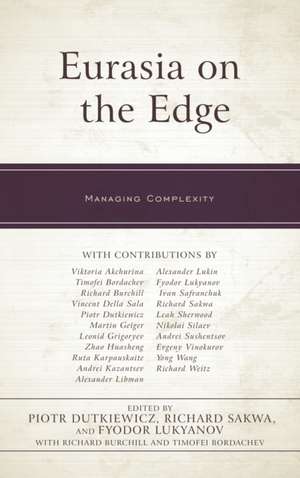
Eurasia on the Edge: Managing Complexity: Russian, Eurasian, and Eastern European Politics
Editat de Richard Sakwa Contribuţii de Piotr Dutkiewicz, Fyodor Lukyanov, Viktoria Akchurina, Martin Greiger, Leonid Grigoryev, Zhao Huasheng, Timofei Bordachev, Ruta Karpauskaite, Richard Burchill, Alexander Libman, Alexander Lukin, Ivan Safranchuk, Vincent Della Sala, Leah Sherwood, Nikolai Silaev, Andrey Sushentsov, Yong Wang, Richard Weitz, Evgeny Vinokurov, Andrei Kazantseven Limba Engleză Hardback – 15 oct 2018
The book's chapters are written by prominent experts in the field, and together contribute to the continuing debate by providing policy advice for managing crises in the region. Conflicts inevitably arise in the Eurasian space as global powers, regional powers and individual states jockey for positions and influence. These conflicts need not reach a crisis state provided the foundations of conflict, and the surrounding frameworks, can be better understood. To do this, it is necessary to examine the issue of security in Eurasia from a multi-dimensional perspective that challenges any and all assumptions about Eurasia and global order.
This volume has two overarching goals. The first is to come to a better understanding of key security threats in the Eurasian region from a multi-dimensional - social, political, economic and institutional - perspective. The second is to discuss policies directed to increase mutual security in and around the Eurasian core. Although the crisis of security affects the whole continent, the area covered by the former Soviet Union and its neighborhood is at the epicenter of the current crisis. On the one side, the Atlantic community is consolidating and extending. On the other, various 'greater Asia' ideas are in the making. All of Eurasia is in danger of becoming an extended shatter zone, a vast new, shaky 'borderland' trapped between two great systems of power and world order.
Din seria Russian, Eurasian, and Eastern European Politics
- 25%
 Preț: 363.46 lei
 - 34%
 Preț: 567.98 lei
 - 35%
 Preț: 681.03 lei
 - 32%
 Preț: 556.08 lei
 - 22%
 Preț: 325.74 lei
 - 34%
 Preț: 705.38 lei
 - 27%
 Preț: 284.77 lei
 - 33%
 Preț: 548.58 lei
 - 32%
 Preț: 583.32 lei
 - 22%
 Preț: 335.52 lei
 - 27%
 Preț: 268.15 lei
 - 27%
 Preț: 255.81 lei
 -
 Preț: 206.30 lei
 - 35%
 Preț: 624.57 lei
 - 36%
 Preț: 677.12 lei
 - 28%
 Preț: 220.96 lei
 - 35%
 Preț: 596.39 lei
 - 29%
 Preț: 551.93 lei
 - 34%
 Preț: 561.99 lei
Preț: 706.66 lei
Preț vechi: 1055.51 lei
-33%
Puncte Express: 1060
Carte tipărită la comandă
Livrare economică 07-21 decembrie
Livrare prin curier în România Termenul estimat este afișat lângă disponibilitate.
Transport gratuit pentru acest produs Plată online sau ramburs, în funcție de opțiunile comenzii.
Retur gratuit în 14 zile Comandă securizată și suport în română.
Specificații
ISBN-13: 9781498564205
ISBN-10: 1498564208
Pagini: 324
Ilustrații: 15 Tables, 3 Graphs
Dimensiuni: 159 x 228 x 31 mm
Greutate: 0.7 kg
Editura: Bloomsbury Publishing
Colecția Lexington Books
Seria Russian, Eurasian, and Eastern European Politics
Locul publicării:New York, United States
ISBN-10: 1498564208
Pagini: 324
Ilustrații: 15 Tables, 3 Graphs
Dimensiuni: 159 x 228 x 31 mm
Greutate: 0.7 kg
Editura: Bloomsbury Publishing
Colecția Lexington Books
Seria Russian, Eurasian, and Eastern European Politics
Locul publicării:New York, United States
Cuprins
1Introduction
Richard Burchill and Fyodor Lukyanov
2Strategic Security in Eurasia
Nikolai Silaev and Andrei Sushentsov
3 Regional Arrangements and Eurasian Security
Richard Burchill & Ruta Karpauskaite
4 Eurasian Integration and its Institutions: Possible Contributions to Security in Eurasia
Evgeny Vinokurov & Alexander Libman
5 Eurasian Security Constructs and Institutional Capacity
Leah Sherwood
6 Russia's Eurasia Moment: Politics, Economics, Business
Timofei Bordachev
7Eurasia: A View from China's Security Perspective
Zhao Huasheng
8 The European Union and Eurasia: Europe on the Edge
Vincent Della Sala
9. China's Belt and Road Initiative and Eurasian Security
Yong Wang
10 Security Issues in Eurasia
Richard Weitz
11Economic Security in the Eurasian Economic Union
Leonid Grigoryev
12Central Asian Regimes: Stability and Reform
Ivan Safranchuk
13 Interstate Relations in Central Asia
Andrei Kazantsev
14 Managing Eurasia's Borders: The European Union and International Organizations in Russia's 'Near Abroad'
Martin Geiger
15Borders and Waters: Compartmentalized Security in the Eurasian Heartland
Viktoria Akchurina
16Sino-Russia Strategic Understanding and the Changing International System
Alexander Lukin
17 Conclusion: Security in Eurasia - Further or Closer to the Edge?
Piotr Dutkiewicz and Richard Sakwa
Richard Burchill and Fyodor Lukyanov
2Strategic Security in Eurasia
Nikolai Silaev and Andrei Sushentsov
3 Regional Arrangements and Eurasian Security
Richard Burchill & Ruta Karpauskaite
4 Eurasian Integration and its Institutions: Possible Contributions to Security in Eurasia
Evgeny Vinokurov & Alexander Libman
5 Eurasian Security Constructs and Institutional Capacity
Leah Sherwood
6 Russia's Eurasia Moment: Politics, Economics, Business
Timofei Bordachev
7Eurasia: A View from China's Security Perspective
Zhao Huasheng
8 The European Union and Eurasia: Europe on the Edge
Vincent Della Sala
9. China's Belt and Road Initiative and Eurasian Security
Yong Wang
10 Security Issues in Eurasia
Richard Weitz
11Economic Security in the Eurasian Economic Union
Leonid Grigoryev
12Central Asian Regimes: Stability and Reform
Ivan Safranchuk
13 Interstate Relations in Central Asia
Andrei Kazantsev
14 Managing Eurasia's Borders: The European Union and International Organizations in Russia's 'Near Abroad'
Martin Geiger
15Borders and Waters: Compartmentalized Security in the Eurasian Heartland
Viktoria Akchurina
16Sino-Russia Strategic Understanding and the Changing International System
Alexander Lukin
17 Conclusion: Security in Eurasia - Further or Closer to the Edge?
Piotr Dutkiewicz and Richard Sakwa
Recenzii
Eurasia on the Edge. . . offers a number of perspectives on key security issues in the Eurasian region and examines the efficacy of policies to boost mutual security. . . . the book advocates a top-down, state-centric approach to understanding and managing security that fits with regional understandings of security based on stability through authority. Eurasia on the Edge, then, reflects a certain vision of security in the region, one that is favoured by many of its governments, including Russia and China. The book's greatest value is offering an insight into these non-Western perspectives on this key part of the world
The rapidly shifting geopolitical, economic, and security dynamics on the Eurasian supercontinent will alter the international system for decades to come in the 21st century. Richard Sakwa has assembled an impressive international team of scholars to comprehensively assess critical changes taking place and challenges ahead for peace and global governance. This book will be of great interest to scholars as well as very useful for teaching undergraduate and graduate level courses.
The tectonic plates of geopolitics are shifting towards Eurasia where the divided West and the rising 'rest' intersect. As the East led by Russia, China and India challenges the Western-dominated world order, a new contest over security is unfolding that has global reach and significance. This is a brilliant collection of essays, combining erudition with robust argument by a superb range of outstanding contributors. It sets new standards and offers the best analysis of Eurasian security questions in a fast-changing world - a must-read for scholars, students, politicians, diplomats and policy-makers.
Eurasia accounts for just over one third of the land area of the globe, but is home to over 70% of the world's population and makes up nearly 60% of global GDP. Immanuel Wallerstein once predicted that future political and economic alliances will divide Eurasia into two blocks: China and Japan together with the US will form one center, whereas Europe, Russia and India will form another. A different view is that Chinese "One Belt, One Road" initiative will unite the whole Eurasian continent. This innovative volume discusses another perspective that may be more attractive than the first two.
The rapidly shifting geopolitical, economic, and security dynamics on the Eurasian supercontinent will alter the international system for decades to come in the 21st century. Richard Sakwa has assembled an impressive international team of scholars to comprehensively assess critical changes taking place and challenges ahead for peace and global governance. This book will be of great interest to scholars as well as very useful for teaching undergraduate and graduate level courses.
The tectonic plates of geopolitics are shifting towards Eurasia where the divided West and the rising 'rest' intersect. As the East led by Russia, China and India challenges the Western-dominated world order, a new contest over security is unfolding that has global reach and significance. This is a brilliant collection of essays, combining erudition with robust argument by a superb range of outstanding contributors. It sets new standards and offers the best analysis of Eurasian security questions in a fast-changing world - a must-read for scholars, students, politicians, diplomats and policy-makers.
Eurasia accounts for just over one third of the land area of the globe, but is home to over 70% of the world's population and makes up nearly 60% of global GDP. Immanuel Wallerstein once predicted that future political and economic alliances will divide Eurasia into two blocks: China and Japan together with the US will form one center, whereas Europe, Russia and India will form another. A different view is that Chinese "One Belt, One Road" initiative will unite the whole Eurasian continent. This innovative volume discusses another perspective that may be more attractive than the first two.