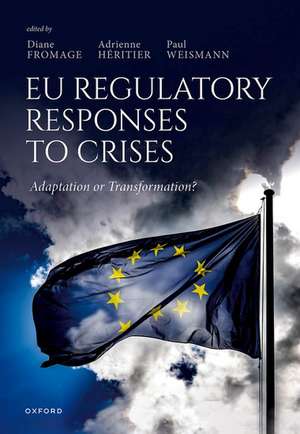
EU Regulatory Responses to Crises: Adaptation or Transformation?
Diane Fromage, Adrienne Héritier, Paul Weismannen Limba Engleză Hardback – 28 ian 2025
Pornind de la experiența academică vastă a editorilor în analiza mecanismelor europene, în special în contextul transformărilor aduse de Tratatul de la Lisabona și redefinirea calității de membru, EU Regulatory Responses to Crises oferă o radiografie autoritară a modului în care Uniunea Europeană și-a recalibrat instrumentele juridice sub presiunea evenimentelor extreme. Descoperim aici o analiză riguroasă a trecerii de la un model bazat pe consens și directive, la unul marcat de urgență, unde Regulamentele și mecanismele de tip „soft law” devin norma. Găsim în această carte o documentare precisă a modului în care criza financiară din 2007, pandemia și conflictul din Ucraina au forțat limitele tratatelor, impunând drepturi de instruire ale organismelor UE asupra autorităților naționale.
Pe linia practică a volumului EU Policies in Times of Crisis, dar cu un focus specific pe transformarea calitativă a actului de legiferare și a echilibrului instituțional, această lucrare demonstrează că răspunsurile UE nu sunt simple adaptări temporare, ci mutații structurale. Apreciem modul în care autorii corelează deciziile politice cu realitatea juridică, explicând mecanisme complexe precum votul cu majoritate calificată inversă în Consiliu. În contextul operei editorilor, care au explorat anterior rolul parlamentelor naționale în Changing Parliaments in a Changing European Union și evoluția Băncii Centrale Europene, acest nou volum reprezintă o sinteză necesară a modului în care guvernanța de criză a devenit, de fapt, noua guvernanță permanentă a spațiului european.
Preț: 639.33 lei
Preț vechi: 961.20 lei
-33%
Carte disponibilă
Livrare economică 18-24 iunie
Specificații
ISBN-10: 0198913818
Pagini: 240
Dimensiuni: 180 x 252 x 20 mm
Greutate: 0.58 kg
Editura: OUP OXFORD
Colecția OUP Oxford
Locul publicării:Oxford, United Kingdom
V-ar putea interesa
-
 The Evolution of EU LawPaul Craig-33%Preț: 1130.06 lei1687.06 lei
 -
 EU Banking Law and RegulationGianni Lo Schiavo-34%Preț: 1112.34 lei1676.14 lei
 -
 European Union Law: A Very Short IntroductionAnthony Arnull-21%Preț: 55.02 lei69.97 lei
 -
 The European Union: A Very Short IntroductionSimon UsherwoodPreț: 63.74 lei
 -
 Crises and Integration in European Banking Union: To Build or To BurnChristopher Mitchell-33%Preț: 610.91 lei915.46 lei
 -
 Policy-Making in the European UnionHelen Wallace-11%Preț: 365.26 lei411.97 lei
 -
 New Frontiers of EU Funding: Law, Policy, PoliticsClaire Kilpatrick-34%Preț: 638.03 lei960.39 lei
 -
 Pandemic Polity-Building: How Covid-19 Shaped the European UnionZbigniew Truchlewski-34%Preț: 612.34 lei921.77 lei
 -
 EU Securities and Financial Markets RegulationNiamh Moloney-28%Preț: 393.53 lei547.46 lei
 -
 Preț: 157.48 lei
 -
 European Union LawDamian ChalmersPreț: 474.78 lei
 -
 The European Union: Politics and PoliciesJonathan OlsenPreț: 357.20 lei
 -
 Crises and Challenges for the European UnionMark Rhinard-23%Preț: 248.63 lei323.30 lei
 -
 Europe's CrisesManuel CastellsPreț: 218.26 lei
 -
 The Dynamics of Powers in the European UnionProf. dr. C. Christina Eckes-21%Preț: 333.54 lei424.84 lei
 -
 -33%Preț: 578.45 lei867.21 leiNou
 -
 PandemoniumLuuk van MiddelaarPreț: 215.58 lei
 -
 Financial Regulation in the EU: From Resilience to GrowthRaphaël DouadyPreț: 342.93 lei
De ce să citești această carte
Această carte este esențială pentru specialiștii în drept european și științe politice care vor să înțeleagă cum s-a schimbat ierarhia normelor în UE. Veți câștiga o perspectivă clară asupra modului în care crizele succesive au centralizat puterea și au modificat instrumentele de reglementare, oferindu-vă argumente factuale despre trecerea de la directive la regulamente și impactul acestora asupra suveranității naționale.
Despre autor
Diane Fromage, Adrienne Héritier și Paul Weismann sunt cercetători și academicieni de prestigiu, specializați în dreptul și politica Uniunii Europene. Diane Fromage are o expertiză recunoscută în studiul parlamentelor și al uniunii bancare, în timp ce Adrienne Héritier este o figură centrală în analiza politicilor publice și a guvernanței europene la Institutul Universitar European. Contribuțiile lor anterioare, axate pe rolul instituțiilor financiare și pe dinamica democratizării europene, oferă acestui volum o fundamentare teoretică solidă, adaptată provocărilor legislative contemporane.