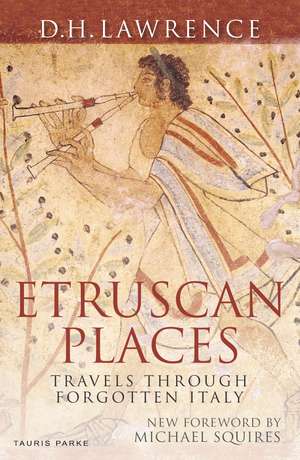
Etruscan Places: Travels Through Forgotten Italy: Tauris Parke
Autor D. H. Lawrence Cuvânt înainte de Michael Squiresen Limba Engleză Paperback – 18 apr 2019
The Etruscan civilisation, which flourished from the 8th until the 5th century BC in what is now Tuscany, is one of the most fascinating and mysterious in history. An uninhibited, elemental people, the Etruscans enthralled D.H. Lawrence, who craved their 'old wisdom', the secret of their vivacity and love of life. To him they represented the antithesis of everything he despised in the modern world, perhaps because their spontaneity and naturalness struck a chord with his own quest for personal and artistic freedom - so often censured or repressed.
Lawrence approaches the enigmatic Etruscans as a poet, passionately and searchingly, and so the reader is swept up in his luminous descriptions of a utopian world where dancing and feasting, art and music were everything. The exhilaration of Lawrence in his Etruscan adventures stands in stark contrast to his intimations of the darkness of Mussolini's Italy - at a time when Europe was beginning its inexorable drift towards tragedy.

Preț: 78.41 lei
Preț vechi: 114.90 lei
-32%
Puncte Express: 118
Carte tipărită la comandă
Livrare economică 03-17 decembrie
Livrare prin curier în România Termenul estimat este afișat lângă disponibilitate.
Transport gratuit de la 400.00 lei Plată online sau ramburs, în funcție de opțiunile comenzii.
Retur gratuit în 14 zile Comandă securizată și suport în română.
Specificații
ISBN-13: 9781838600228
ISBN-10: 1838600221
Pagini: 208
Dimensiuni: 127 x 193 x 15 mm
Greutate: 0.24 kg
Editura: Bloomsbury Publishing
Colecția Tauris Parke
Seria Tauris Parke
Locul publicării:London, United Kingdom
ISBN-10: 1838600221
Pagini: 208
Dimensiuni: 127 x 193 x 15 mm
Greutate: 0.24 kg
Editura: Bloomsbury Publishing
Colecția Tauris Parke
Seria Tauris Parke
Locul publicării:London, United Kingdom
V-ar putea interesa
-
 Preț: 237.52 lei
 -
 The Secret of the Coup D'Etat: The Life of Louis AgassizThe Early Of KerryPreț: 255.64 lei
 -
 Preț: 173.98 lei
 -
 Preț: 233.62 lei
 -
 AnglingFrancis FrancisPreț: 81.62 lei
 -
 The Navigable RhineEdwin J. ClappPreț: 212.75 lei
 -
 Short History Of The Italian People - From The Barbarian Invasion To The Attainment Of UnityJanet Penrose TravelyanPreț: 231.17 lei
 -
 Preț: 168.17 lei
 -
 Preț: 75.17 lei
 -
 Sons and Lovers. (1913) byD. H. LawrencePreț: 170.03 lei
 -
 The Trespasser (1912) byD. H. LawrencePreț: 75.42 lei
 -
 The Rainbow (1915) byD. H. LawrencePreț: 125.71 lei
 -
 Aaron's Rod (1922) byD. H. LawrencePreț: 93.15 lei
 -
 Lady Chatterley's Lover (1928) byD. H. LawrencePreț: 93.12 lei
 -
 Pornography and So onD. H. LawrencePreț: 82.72 lei
 -
 Sons and LoversD. H. LawrencePreț: 236.92 lei
Cuprins
Foreword by Michael Squires
1. Cerveteri
2. Tarquinia
3. The Painted Tombs of Tarquinia
4. The Painted Tombs of Tarquinia
5. Vulci
6. Volterra
1. Cerveteri
2. Tarquinia
3. The Painted Tombs of Tarquinia
4. The Painted Tombs of Tarquinia
5. Vulci
6. Volterra
Recenzii
He wrote something like three dozen books, of which even the worst page dances with life that could be mistaken for no other man's, while the best are admitted, even by those who hate him, to be unsurpassed.
He is an extraordinarily acute noticer of the world, human and natural. And it is not just the natural world that beckons Lawrence to flood it with beautiful language . . . he can be as precise and compact an observer of human interaction as Flaubert or Forster.
He is an extraordinarily acute noticer of the world, human and natural. And it is not just the natural world that beckons Lawrence to flood it with beautiful language . . . he can be as precise and compact an observer of human interaction as Flaubert or Forster.
Notă biografică
David Herbert Richards "D. H." Lawrence (11 September 1885 - 2 March 1930) was an English novelist, poet, playwright, essayist, literary critic and painter. His collected works represent, among other things, an extended reflection upon the dehumanising effects of modernity and industrialisation. Some of the issues Lawrence explores are emotional health, vitality, spontaneity and instinct. Lawrence's opinions earned him many enemies and he endured official persecution, censorship, and misrepresentation of his creative work throughout the second half of his life, much of which he spent in a voluntary exile which he called his "savage pilgrimage." At the time of his death, his public reputation was that of a pornographer who had wasted his considerable talents. E. M. Forster, in an obituary notice, challenged this widely held view, describing him as, "The greatest imaginative novelist of our generation." Lawrence is perhaps best known for his novels Sons and Lovers, The Rainbow, Women in Love and Lady Chatterley's Lover. Within these Lawrence explores the possibilities for life within an industrial setting. In particular Lawrence is concerned with the nature of relationships that can be had within such a setting. Though often classed as a realist, Lawrence in fact uses his characters to give form to his personal philosophy. His depiction of sexual activity, though seen as shocking when he first published in the early 20th century, has its roots in this highly personal way of thinking and being. It is worth noting that Lawrence was very interested in the sense of touch and that his focus on physical intimacy has its roots in a desire to restore an emphasis on the body, and re-balance it with what he perceived to be Western civilisation's over-emphasis on the mind.