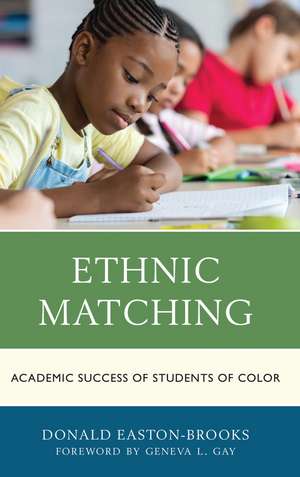
Ethnic Matching: Academic Success of Students of Color
Autor Donald Easton-Brooksen Limba Engleză Paperback – 13 mar 2019
Preț: 218.85 lei
Preț vechi: 291.90 lei
-25%
Puncte Express: 328
Carte tipărită la comandă
Livrare economică 08-22 decembrie
Livrare prin curier în România Termenul estimat este afișat lângă disponibilitate.
Transport gratuit de la 400.00 lei Plată online sau ramburs, în funcție de opțiunile comenzii.
Retur gratuit în 14 zile Comandă securizată și suport în română.
Specificații
ISBN-13: 9781475839661
ISBN-10: 1475839669
Pagini: 128
Dimensiuni: 148 x 226 x 12 mm
Greutate: 0.25 kg
Editura: Bloomsbury Publishing
Colecția Rowman & Littlefield
Locul publicării:New York, United States
ISBN-10: 1475839669
Pagini: 128
Dimensiuni: 148 x 226 x 12 mm
Greutate: 0.25 kg
Editura: Bloomsbury Publishing
Colecția Rowman & Littlefield
Locul publicării:New York, United States
Cuprins
Forward: "Ethnic Matching:" Intriguing Idea, Challenging Practice
Geneva L. Gay
Preface
Where Do We Start?
Motivation
Acknowledgements
Chapter 1: Framework of the Book
Population Change in the U.S.
Demography Shift in U.S. Public Schools
Schools Are More than Black, White, and Latinx
Systems, Challenges, and Solutions
Chapter 2: Ethnic Matching As a Concept
Developing Perspective Knowledge
The Impact of Perceptive Knowledge
Perceptive Discrimination
Perceptive Expectations
Expectation Combined With Race and Ethnicity
Explicit Expectations
Implicit Expectations
Situational Expectations
Expectations and Ethnic-Matching
Takeaways
Chapter 3: Ethnic Matching In PK-12 Education
Impacts of Ethnic Matching in P-12
Response to Diversifying Teacher Education
Takeaways
Chapter 4: What Can We Learn From Ethnic Matching?
Let's Start the Conversation
Build Positive Relationships with Students and Community
Self-Reflection and Honesty with Self
Cultural Responsive Lessons and Student Behaviors
Empathy with the Challenges Students Face
Be Patient and Resilient
Patient Teaching through a Culturally Responsive Lens
Resilient Teaching
Advocate for Justice and Believe in Students
Takeaways
Chapter 5: Practical Insight into the Impact of Teachers of Color on Students of Color
Intentional Approach to Teaching Students of Color
Oblivious Teachers
Irresponsible Teacher
Conscious Teachers
Activist Teachers
Responsive Teacher
Cultural Response to Knowledge
Takeaways
Chapter 6: Challenges In Diversifying Teacher Education: Creating a More Culturally Responsive Educator Workforce
Communities: Students of Color Populations
A Missing Conversation
Teachers of Color
The Other Side of Teachers of Color
Local and State Challenges in Diversifying Teacher Education
Teacher Preparation Programs
Takeaways
Chapter 7: Systematic Strategies For Developing A More Diverse And Culturally Responsive Workforce
Policies and Diversifying Teacher Education
School Leaders and Diverse Schooling
Grow Your Own Programs
Retention of Teachers of Color
Takeaways
Conclusion
Notes
About the Author
Index
Geneva L. Gay
Preface
Where Do We Start?
Motivation
Acknowledgements
Chapter 1: Framework of the Book
Population Change in the U.S.
Demography Shift in U.S. Public Schools
Schools Are More than Black, White, and Latinx
Systems, Challenges, and Solutions
Chapter 2: Ethnic Matching As a Concept
Developing Perspective Knowledge
The Impact of Perceptive Knowledge
Perceptive Discrimination
Perceptive Expectations
Expectation Combined With Race and Ethnicity
Explicit Expectations
Implicit Expectations
Situational Expectations
Expectations and Ethnic-Matching
Takeaways
Chapter 3: Ethnic Matching In PK-12 Education
Impacts of Ethnic Matching in P-12
Response to Diversifying Teacher Education
Takeaways
Chapter 4: What Can We Learn From Ethnic Matching?
Let's Start the Conversation
Build Positive Relationships with Students and Community
Self-Reflection and Honesty with Self
Cultural Responsive Lessons and Student Behaviors
Empathy with the Challenges Students Face
Be Patient and Resilient
Patient Teaching through a Culturally Responsive Lens
Resilient Teaching
Advocate for Justice and Believe in Students
Takeaways
Chapter 5: Practical Insight into the Impact of Teachers of Color on Students of Color
Intentional Approach to Teaching Students of Color
Oblivious Teachers
Irresponsible Teacher
Conscious Teachers
Activist Teachers
Responsive Teacher
Cultural Response to Knowledge
Takeaways
Chapter 6: Challenges In Diversifying Teacher Education: Creating a More Culturally Responsive Educator Workforce
Communities: Students of Color Populations
A Missing Conversation
Teachers of Color
The Other Side of Teachers of Color
Local and State Challenges in Diversifying Teacher Education
Teacher Preparation Programs
Takeaways
Chapter 7: Systematic Strategies For Developing A More Diverse And Culturally Responsive Workforce
Policies and Diversifying Teacher Education
School Leaders and Diverse Schooling
Grow Your Own Programs
Retention of Teachers of Color
Takeaways
Conclusion
Notes
About the Author
Index
Recenzii
This book is important and exceptionally timely as students of color become the majority across the nation. Easton-Brooks provides a lucid analysis of what educators can learn from the pedagogical practices of teachers of color that support the academic growth of students of color. This book so clearly unpacks both core concepts and myths that it should be required reading in teacher education and leadership programs.
Dean Easton-Brooks' book offers a long-awaited analysis and historical overview of the concept of ethnic-matching. He skillfully integrates his analysis of the literature with stories shared by effective teachers of color who demonstrate the power of ethnic-matching. This book offers an important complement to the bevy of research studies that examine the impact of teachers of color on the education of students of color.
Students deserve to experience learning opportunities that honor, speak from the point of view of, and recognizes the many assets of their culture and ethnicity. Easton-Brooks has demonstrated the powerful ways in which ethnic-matching can maximize students' opportunities to learn inside classrooms. This book showcases the very best of what is possible for students too often placed on the margins of teaching and learning when mechanisms - such as ethnic-matching - are in place to support their academic and social success. A call to action, a transformative way of thinking about and imagining teaching and learning, and a plausible agenda that penetrates the micro and macro, this book has the potential to make a real difference in school districts across the country that dare to think about innovative ways of recruiting and retaining a more racially and ethnically diverse teaching force for the benefit of students, particularly those of color. Grounded in research and informed by practice, this book should be required reading of educators pre- and in-service to students.
The need for greater diversity in the educator workforce as a moral imperative has long been clear. In Dr. Easton-Brooks' work, the educational benefits of ethnic-matching and greater educator diversity are brought to light. Through student perspectives, teacher reflection, and application examples, Dr. Easton-Brooks explores the tremendous value of teachers of color in American classrooms. The time for true effort on the part of all educators to recruit and hire representative teachers is now- the proof for why is found through this book.
Dean Easton-Brooks' book offers a long-awaited analysis and historical overview of the concept of ethnic-matching. He skillfully integrates his analysis of the literature with stories shared by effective teachers of color who demonstrate the power of ethnic-matching. This book offers an important complement to the bevy of research studies that examine the impact of teachers of color on the education of students of color.
Students deserve to experience learning opportunities that honor, speak from the point of view of, and recognizes the many assets of their culture and ethnicity. Easton-Brooks has demonstrated the powerful ways in which ethnic-matching can maximize students' opportunities to learn inside classrooms. This book showcases the very best of what is possible for students too often placed on the margins of teaching and learning when mechanisms - such as ethnic-matching - are in place to support their academic and social success. A call to action, a transformative way of thinking about and imagining teaching and learning, and a plausible agenda that penetrates the micro and macro, this book has the potential to make a real difference in school districts across the country that dare to think about innovative ways of recruiting and retaining a more racially and ethnically diverse teaching force for the benefit of students, particularly those of color. Grounded in research and informed by practice, this book should be required reading of educators pre- and in-service to students.
The need for greater diversity in the educator workforce as a moral imperative has long been clear. In Dr. Easton-Brooks' work, the educational benefits of ethnic-matching and greater educator diversity are brought to light. Through student perspectives, teacher reflection, and application examples, Dr. Easton-Brooks explores the tremendous value of teachers of color in American classrooms. The time for true effort on the part of all educators to recruit and hire representative teachers is now- the proof for why is found through this book.