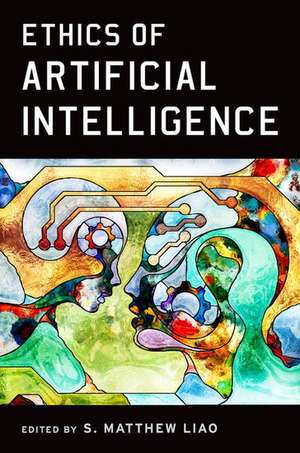
Ethics of Artificial Intelligence
Editat de S. Matthew Liaoen Limba Engleză Paperback – 6 oct 2020
Preț: 345.99 lei
Preț vechi: 386.38 lei
-10%
Puncte Express: 519
Carte disponibilă
Livrare economică 29 octombrie-04 noiembrie
Livrare express 10-16 octombrie pentru 89.15 lei
Livrare prin curier în România Termenul estimat este afișat lângă disponibilitate.
Transport gratuit de la 400.00 lei Plată online sau ramburs, în funcție de opțiunile comenzii.
Retur gratuit în 14 zile Comandă securizată și suport în română.
Specificații
ISBN-13: 9780190905040
ISBN-10: 0190905042
Pagini: 544
Dimensiuni: 155 x 231 x 38 mm
Greutate: 0.77 kg
Editura: Oxford University Press
Colecția OUP USA
Locul publicării:New York, United States
ISBN-10: 0190905042
Pagini: 544
Dimensiuni: 155 x 231 x 38 mm
Greutate: 0.77 kg
Editura: Oxford University Press
Colecția OUP USA
Locul publicării:New York, United States
V-ar putea interesa
-
 In Our Best Interest: A Defense of PaternalismJason Hanna-32%Preț: 485.96 lei715.44 lei
 -
 -15%Preț: 168.34 lei199.16 lei
 -
 The Oxford Handbook of Value TheoryIwao Hirose-20%Preț: 361.68 lei450.69 lei
 -
 Future MoralityDavid Edmonds-19%Preț: 81.20 lei99.68 lei
 -
 On Virtue EthicsRosalind Hursthouse-11%Preț: 336.85 lei380.20 lei
 -
 Moral Brains: The Neuroscience of MoralityS. Matthew Liao-19%Preț: 370.22 lei456.74 lei
 -
 Conversations on EthicsAlex Voorhoeve-16%Preț: 173.18 lei206.83 lei
 -
 Philosophical Foundations of Human RightsRowan Cruft-24%Preț: 538.91 lei711.22 lei
 -
 Preț: 221.84 lei
 -
 Moral Responsibility: The Ways of ScepticismCarlos MoyaPreț: 464.14 lei
 -
 An Introduction to the Principles of Morals and LegislationJeremy Bentham-26%Preț: 113.29 lei153.49 lei
 -
 Terrorism and the Ethics of WarStephen NathansonPreț: 210.80 lei
 -
 A Theory of JusticeJohn RawlsPreț: 297.62 lei
 -
 The Nature of DignityRon Bontekoe-27%Preț: 354.08 lei484.60 lei
 -
 Narrative Identity and Personal ResponsibilityLinda Ethell-33%Preț: 711.29 lei1054.48 lei
 -
 Niccolo Machiavelli: The Laughing Lion and the Strutting FoxRaymond Angelo Belliotti-23%Preț: 321.63 lei416.71 lei
 -
 Moral Desert: A CritiqueHoward Simmons-28%Preț: 252.16 lei349.96 lei
 -
 Law, Liberty, and MoralityH. HartPreț: 116.14 lei
 -
 The A to Z of Hume's PhilosophyKenneth R. Merrill-28%Preț: 347.76 lei485.15 lei
 -
 The Ethics of LobbyingWoodstock Theological CenterPreț: 132.70 lei
 -
 The Methods of EthicsHenry Sidgwick-14%Preț: 138.81 lei161.96 lei
 -
 Preț: 38.10 lei
 -
 The New AtlantisFrancis BaconPreț: 38.96 lei
 -
 The Mystery of YouRon GoldschlagerPreț: 187.05 lei
 -
 Soldier or ScholarJacobus PontanusPreț: 87.55 lei
 -
 Kant’s Moral Metaphysics: God, Freedom, and ImmortalityBenjamin Bruxvoort Lipscomb-23%Preț: 1475.48 lei1916.20 lei
 -
 Homo agensSabrina Ebbersmeyer-23%Preț: 1758.13 lei2283.28 lei
 -
 Normative EthikDietmar Von Der Pfordten-8%Preț: 582.15 lei632.77 lei
Recenzii
This is a superior work, particularly considering that it is an edited volume. All the articles are first-rate, and the four-part arrangement advances the argument organically...Highly recommended. Lower- and upper-division undergraduates. Graduate students, faculty, and professionals. Students in two-year technical programs. General readers.
This landmark collection offers a first-rate introduction to the ethical challenges of artificial intelligence. Wide-ranging, accessible, and authoritative, it will be an essential guide to some of the most important issues of our time.
In a world that too often asks 'Can we?' without asking 'Should we?', this exciting collection confronts us with some of the best new thinking on the ethics of AI. From the moral status of machine learning systems to algorithmic bias, it is bound to shape future discussions of this most important topic.
This volume is ideal for anyone who wants a comprehensive introduction to the ethical issues surrounding the design and use of AI technologies. Dr. S. Matthew Liao provides an outstanding collaborative exchange between AI researchers and philosophers. I have no doubt that it will become required reading in courses on AI and ethics.
This landmark collection offers a first-rate introduction to the ethical challenges of artificial intelligence. Wide-ranging, accessible, and authoritative, it will be an essential guide to some of the most important issues of our time.
In a world that too often asks 'Can we?' without asking 'Should we?', this exciting collection confronts us with some of the best new thinking on the ethics of AI. From the moral status of machine learning systems to algorithmic bias, it is bound to shape future discussions of this most important topic.
This volume is ideal for anyone who wants a comprehensive introduction to the ethical issues surrounding the design and use of AI technologies. Dr. S. Matthew Liao provides an outstanding collaborative exchange between AI researchers and philosophers. I have no doubt that it will become required reading in courses on AI and ethics.
Notă biografică
S. Matthew Liao is Arthur Zitrin Chair of Bioethics, Director of the Center for Bioethics, Professor of Global Public Health, and Affiliated Professor in the Department of Philosophy at New York University. He is the author of The Right to Be Loved (Oxford University Press 2015) and editor of Moral Brains: The Neuroscience of Morality (Oxford University Press 2016); and the co-editor of The Philosophical Foundations of Human Rights (Oxford University Press 2015) and Current Controversies in Bioethics (Routledge). He is the Editor-in-Chief for the Journal of Moral Philosophy, a peer-reviewed international journal of moral, political and legal philosophy.
Cuprins
- Acknowledgments
- List of Contributors
- A Short Introduction to the Ethics of Artificial Intelligence, S. Matthew Liao
- Part I: Building Ethics Into Machines
- 1. Machine Morality: Building or Learning, Peter Railton
- 2. The Use and Abuse of the Trolley Problem: Self Driving Cars, Innocent Threats, and the Distribution of Harm, F.M. Kamm
- 3. The Moral Psychology of AI and the Ethical Opt-Out Problem, Jean-François Bonnefon, Azim Shariff, and Iyad Rahwan
- 4. Modeling and Reasoning with Preferences and Ethical Priorities in AI Systems, Andrea Loreggia, Nicholas Mattei, Francesca Rossi, and K. Brent Venable
- 5. Computational Law, Symbolic Discourse, and the AI Constitution, Stephen Wolfram
- Part II: The Near Future of Artificial Intelligence
- 6. Planning for Mass Unemployment: Precautionary Basic Income, Aaron James
- 7. Autonomous Weapons and the Ethics of Artificial Intelligence, Peter Asaro
- 8. Near Term Artificial Intelligence and the Ethical Matrix, Cathy O'Neil and Hanna Gunn
- 9. The Ethics of Artificial Sexuality, Kate Devlin
- Part III: Long-Term Impact of Superintelligence
- 10. Public Policy and Superintelligent AI: A Vector Field Approach, Nick Bostrom, Allan Dafoe, and Carrick Flynn
- 11. Artificial Intelligence: A Binary Approach, Stuart Russell
- 12. Alignment for Advanced Machine Learning Systems, Jessica Taylor, Eliezer Yudkowsky, Patrick LaVictoire, and Andrew Critch
- 13. Moral Machines: From Value Alignment to Embodied Virtue, Wendell Wallach and Shannon Vallor
- 14. Machine Learning Values, Steve Petersen
- Part IV: Artificial Intelligence, Consciousness, and Moral Status
- 15. How to Catch an AI Zombie: Testing for Consciousness in Machines, Susan Schneider
- 16. Designing AI with Rights, Consciousness, Self-Respect, and Freedom, Eric Schwitzgebel, with Mara Garza
- 17. The Moral Status and Rights of Artificial Intelligence, S. Matthew Liao
- Index