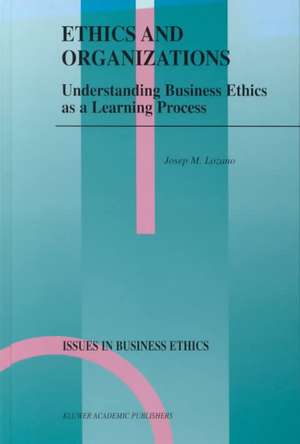
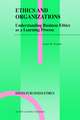
Ethics and Organizations: Issues in Business Ethics, cartea 15
Autor Josep M. Lozanoen Limba Engleză Hardback – 31 aug 2000
Din seria Issues in Business Ethics
-
 Preț: 426.17 lei
 - 15%
 Preț: 622.78 lei
 - 24%
 Preț: 954.52 lei
 - 18%
 Preț: 1186.98 lei
 - 18%
 Preț: 925.91 lei
 - 15%
 Preț: 619.12 lei
 - 15%
 Preț: 664.25 lei
 - 15%
 Preț: 618.88 lei
 - 15%
 Preț: 621.48 lei
 - 15%
 Preț: 621.84 lei
 - 20%
 Preț: 625.47 lei
 - 15%
 Preț: 626.56 lei
 - 20%
 Preț: 624.60 lei
 - 15%
 Preț: 616.45 lei
 - 15%
 Preț: 640.89 lei
 - 15%
 Preț: 664.25 lei
 - 15%
 Preț: 704.26 lei
 - 5%
 Preț: 1066.30 lei
 - 15%
 Preț: 623.89 lei
 - 18%
 Preț: 955.75 lei
 - 15%
 Preț: 625.00 lei
 - 24%
 Preț: 848.18 lei
 - 18%
 Preț: 734.15 lei
 - 15%
 Preț: 630.22 lei
 -
 Preț: 404.04 lei
 - 15%
 Preț: 663.58 lei
 - 15%
 Preț: 634.69 lei
 - 18%
 Preț: 925.40 lei
 - 15%
 Preț: 624.85 lei
 - 15%
 Preț: 615.83 lei
 - 18%
 Preț: 928.97 lei
 - 15%
 Preț: 615.20 lei
 - 15%
 Preț: 615.83 lei
 - 15%
 Preț: 614.19 lei
 - 15%
 Preț: 613.99 lei
 - 15%
 Preț: 622.50 lei
 - 15%
 Preț: 619.80 lei
 -
 Preț: 375.37 lei
Preț: 661.18 lei
Preț vechi: 777.87 lei
-15%
Puncte Express: 992
Carte tipărită la comandă
Livrare economică 18 noiembrie-02 decembrie
Livrare prin curier în România Termenul estimat este afișat lângă disponibilitate.
Transport gratuit pentru acest produs Plată online sau ramburs, în funcție de opțiunile comenzii.
Retur gratuit în 14 zile Comandă securizată și suport în română.
Specificații
ISBN-13: 9780792364634
ISBN-10: 0792364635
Pagini: 204
Ilustrații: VIII, 192 p.
Dimensiuni: 160 x 241 x 16 mm
Greutate: 0.43 kg
Ediția:2000
Editura: Springer
Colecția Issues in Business Ethics
Seria Issues in Business Ethics
Locul publicării:Dordrecht, Netherlands
ISBN-10: 0792364635
Pagini: 204
Ilustrații: VIII, 192 p.
Dimensiuni: 160 x 241 x 16 mm
Greutate: 0.43 kg
Ediția:2000
Editura: Springer
Colecția Issues in Business Ethics
Seria Issues in Business Ethics
Locul publicării:Dordrecht, Netherlands
V-ar putea interesa
-
 A ConfessionLeo TolstoyPreț: 55.44 lei
 -
 Freedom and BeliefGalen Strawson-12%Preț: 305.32 lei348.28 lei
 -
 Ethics and World PoliticsDuncan Bell-20%Preț: 381.72 lei478.68 lei
 -
 The Impartial Spectator: Adam Smith's Moral PhilosophyD. D. Raphael-12%Preț: 318.48 lei362.77 lei
 -
 The Reflective Life: Living Wisely With Our LimitsValerie Tiberius-13%Preț: 302.29 lei346.70 lei
 -
 Civilian Immunity in WarIgor Primoratz-22%Preț: 363.67 lei466.27 lei
 -
 -12%Preț: 284.45 lei323.64 lei
 -
 -13%Preț: 252.31 lei288.53 lei
 -
 Personal ValueToni Rønnow-Rasmussen-31%Preț: 563.37 lei817.55 lei
 -
 The Retrieval of EthicsTalbot Brewer-21%Preț: 348.37 lei440.81 lei
 -
 -17%Preț: 207.26 lei248.33 lei
 -
 Ethics For DummiesChristopher PanzaPreț: 148.53 lei
 -
 Perspectives on Human Dignity: A ConversationJeff Malpas-15%Preț: 663.69 lei780.81 lei
 -
 Overcoming SpeechlessnessAlice WalkerPreț: 71.33 lei
 -
 Introducing EthicsChris GarrattPreț: 63.64 lei
Public țintă
ResearchCuprins
0. Introduction: like oil and water?.- 1. Business ethics as applied ethics.- 1.1. BE: a case of applied ethics?.- 1.2. BE as “applied” ethics: a preliminary proposal for integration.- 2. Business ethics: an on-going process.- 2.1. Introduction: a progressive Self-awareness.- 2.2. A first historical approach to BE.- 2.3. The recent development of BE in Europe.- 2.4. What issues should BE address?.- 2.5. BE: a first attempt at a systematic ordering.- 2.6. The acceptance or rejection of BE as a possible (il)legitimization of predominant practices and values.- 2.7.The impossible dissolution of BE in individual ethics.- 2.8. The ethics of organizations as the core of BE.- 3. BE’s self-awareness: unresolved tension and a call for integration.- 3.1. BE: one discipline or two?.- 3.2. Managers’ moral reasoning as a metaphor for and expression of the problem.- 3.3. Integration in the framework of BE: a demand -at least-acknowledged.- 3.4. Beyond ethics as a toolbox.- 3.5. A note about civic ethics as a possible framework for BE.- 4. An illustrative debate: corporate social responsibility.- 4.1. Introduction.- 4.2. A preliminary question: Is the corporation a moral subject?.- 4.3. Corporate social responsibility.- 4.4. Is the corporation in question?.- 4.5. Friedman: the most controversial reference.- 4.6. The diversity of arguments about corporate social responsibility.- 4.7. Corporate social responsibility: a diversity of concepts.- 4.8. The place of corporate social responsibility in the framework of BE.- 5. Stakeholders: who are they and what are their interests?.- 5.1. Power in the corporation, power of the corporation.- 5.2. Stakeholders, an understanding of the corporation.- 5.3. Stakeholders: an analytical classification.- 5.4. Stakeholders: beyond analysis.- 5.5.Stakeholders in an ethics of organizations.- 6. Corporate codes: constructing criteria and goals?.- 6.1. Professional codes as a point of reference.- 6.2. Codes and their ambivalence.- 6.3. Management as a profession: a significant absence.- 6.4. Corporate codes of ethics: a descriptive approach.- 6.5. Codes of ethics: more ethics or more control?.- 7. Corporate cultures: managing values?.- 7.1. Some questions about the concept of organizational culture.- 7.2. Corporate culture and ethics: an ambigous relationship.- 7.3. Ambiguities in the search for excellence.- 7.4. Opening the door to Aristotelian tradition.- 7.5. Final considerations: the outlook for BE.- 8. Integrating ethics in organizations.- 8.1. The paths towards integration: decision-making, a fact or a process?.- 8.2. The paths towards integration: the organization as a project.- 8.3. The paths towards integration: institutionalizing ethics.- 9. Humanization (also) as a process of organizational learning.- 9.1. The emerging knowledge society.- 9.2. Transforming organizational paradigms.- 9.3. An understanding of organizations that includes acknowledging the value of individuals and individuals as value.- 10. The learning organization as the matrix of business ethics.- 10.1. BE’s three “moments” as an organizational learning process.- 11. References.- 12. Index.