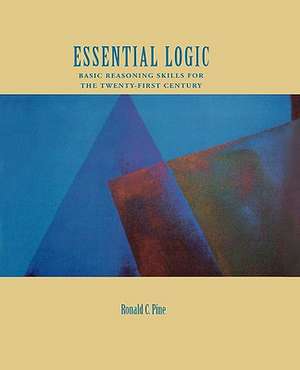
Essential Logic: Basic Reasoning Skills for the Twenty-First Century
Autor Ronald C. Pineen Limba Engleză Paperback – 5 oct 1995
Preț: 1125.94 lei
Preț vechi: 1542.39 lei
-27%
Puncte Express: 1689
Carte tipărită la comandă
Livrare economică 30 noiembrie-14 decembrie
Livrare prin curier în România Termenul estimat este afișat lângă disponibilitate.
Transport gratuit pentru acest produs Plată online sau ramburs, în funcție de opțiunile comenzii.
Retur gratuit în 14 zile Comandă securizată și suport în română.
Specificații
ISBN-13: 9780195155051
ISBN-10: 019515505X
Pagini: 432
Ilustrații: numerous boxes and line drawings
Dimensiuni: 177 x 232 x 20 mm
Greutate: 0.69 kg
Editura: Oxford University Press
Colecția OUP USA
Locul publicării:New York, United States
ISBN-10: 019515505X
Pagini: 432
Ilustrații: numerous boxes and line drawings
Dimensiuni: 177 x 232 x 20 mm
Greutate: 0.69 kg
Editura: Oxford University Press
Colecția OUP USA
Locul publicării:New York, United States
V-ar putea interesa
-
 Slippery Slope ArgumentsDouglas Walton-33%Preț: 788.09 lei1171.61 lei
 -
 Formal LogicPrior-21%Preț: 289.33 lei368.19 lei
 -
 Past, Present and FutureArthur Prior-33%Preț: 722.95 lei1075.70 lei
 -
 Probability and Hume's Inductive ScepticismD. C. Stove-21%Preț: 372.01 lei473.04 lei
 -
 Plural PredicationThomas McKay-33%Preț: 787.10 lei1171.01 lei
 -
 -13%Preț: 279.98 lei321.31 lei
 -
 Varieties of LogicStewart Shapiro-31%Preț: 555.84 lei806.74 lei
 -
 If A, Then B – How the World Discovered LogicMichael ShenefeltPreț: 260.44 lei
 -
 Philosophy of Logic (Routledge Revivals)Hilary PutnamPreț: 488.21 lei
 -
 The Critical Thinking ToolkitGalen A. ForesmanPreț: 195.00 lei
 -
 An Introduction to Philosophical LogicAnthony C. GraylingPreț: 334.08 lei
 -
 Logic as a Tool: A Guide to Formal Logical ReasoningValentin Goranko-23%Preț: 445.67 lei578.79 lei
 -
 Set TheoryAbhijit Dasgupta-19%Preț: 537.42 lei663.48 lei
 -
 Student EssentialsDebra HillsPreț: 70.64 lei
 -
 Corroborations and Criticisms. Forays with the Philosophy of Karl PopperIvor Grattan-GuinnessPreț: 186.45 lei
 -
 Logik für DummiesMark ZegarelliPreț: 119.72 lei
Cuprins
- Preface
- Introduction
- Chapter 1 - Why Study Logic
- Logic as a Defensive Tool
- Deductive Reasoning
- Valid, Invalid, and Sound Arguments
- Logic and Belief Testing
- Key Terminology
- Concept Summary
- Exercises
- Chapter 2 - Arguments and Language
- Recognizing Arguments
- Other Uses of Language
- Meaning and Clarification
- What is Truth?
- Key Terminology
- Concept Summary
- Exercises
- Chapter 3 - Inductive Reasoning and Reasonable Beliefs
- Deduction and Induction
- Induction and Reliable Beliefs
- Induction: A Case Study
- Logic and Creativity
- Key Terminology
- Concept Summary
- Exercises
- Chapter 4 - Informal Fallacies I
- Introduction
- The Value of Abstraction
- Fallacies of Relevance
- Appeal to Popularity
- Appeal to Authority
- Traditional Wisdom
- Provincialism
- Appeal to Loyalty
- Two Wrongs Make a Right
- Ad Hominem Abusive and Circumstantial
- Irrelevant Reason
- Key Terminology
- Concept Summary
- Exercises
- Chapter 5 - Informal Fallacies II
- Introduction
- Fallacies of Questionable Premise
- Slippery Slope
- Questionable Dilemma
- Straw Person
- Fallacies of Weak Induction
- Hasty Conclusion
- Questionable Cause
- Appeal to Ignorance
- Fallacies of Presumption
- Begging the Question
- Complex Question
- Ambiguity-Equivocation
- Questionable Analogy
- Suppressed Evidence
- Key Terminology
- Concept Summary
- Exercises
- Chapter 6 - Logic and Hope
- Exercises
- Chapter 7 - Symbolic Translation
- Introduction
- Logical Connectives
- Usage Dictionary of Logical Connectives
- Exercise I
- Exercise II
- Complex Translations, the Use of Parentheses, and Arguments
- Exercise III
- Exercise IV
- Exercise V
- Chapter 8 - Bit Brains Logical Connectives, and Truth Tables
- Introduction
- Symbolic Pictures of Logical Connectives: And, Or, and Not
- Exercise I
- Logical Connectives Continued: If . . . then . . . and If and only if
- Exercise II
- Short Cuts and Human Learning
- Truth Tables, Validity, and Logical Pictures
- Exercise III
- Exercise IV
- Argument Forms and Variables
- Exercise V
- Brief Truth Tables
- Exercise VI
- Chapter 9 - Symbolic Trails and Formal Proofs of Validity
- Introduction
- Constructing Formal Proofs of Validity
- Step 1: Recognizing Forms: Copi's "Nine" Rules of Inference
- Step 1 Exercises
- Strategies for Pattern Recognition
- Step 2: Justifying Reasoning Trails with the Rules of Inference
- Step 2 Exercises
- Step 3: On Your Own, Constructing Formal Proofs with the Rules of Inference
- Step 3 Exercises
- Translations and Formal Proofs
- Chapter 10 - Symbolic Trails and Formal Proofs of Validity, Part 2
- Introduction
- Application Practice
- The Nineteen Rules
- Step 4: Rules of Replacement Exercises
- Commonsense Origins
- Strategies for Pattern Recognition Revisited
- Step 5 Exercises
- Subroutines
- Direction, Strategies, and Working Backward
- Step 6 Exercises
- Brief Truth Tables Revisited and Decision Strategies
- Translation and Formal Proof Exercises
- Holiday Adventures
- Clarification Exercises
- Chapter 11 - Other Logical Tools: Syllogisms and Quantification
- Introduction
- Syllogisms and Quantification Logic
- Usage Dictionary
- Dictionary Elaboration
- Exercise I
- Proving Validity in Quantification Logic
- The Square of Opposition and Change of Quantifier Rules
- Exercise II
- Exercise III
- Exercise IV
- Exercise V
- Exercise VI
- Exercise VII
- Final Note
- Chapter 12 - Frontiers of Logic--Fuzzy Logic: Can Aristotle and Buddha Get Along?
- Introduction
- Bivalent Logic and Paradoxes
- Fuzzy Interpretations and Degrees of Truth
- Fuzzy Conditionals and Fuzzy Validity
- Resolution of Paradoxes and Implications
- Philosophy: What about reality?
- Exercise I
- Exercises II-IV
- Exercises V