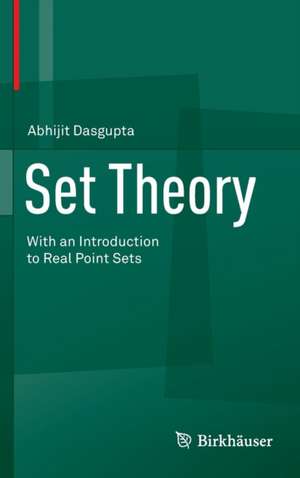
Set Theory
Autor Abhijit Dasguptaen Limba Engleză Hardback – 7 dec 2013
Ne-a atras atenția acest manual de referință publicat de Springer sub amprenta Birkhäuser, care propune o incursiune riguroasă, dar intuitivă, în fundamentele matematicii moderne. Structurat în patru secțiuni distincte, volumul semnat de Abhijit Dasgupta urmărește evoluția conceptelor de număr, infinit și continuitate, pornind de la contribuțiile fundamentale ale lui Dedekind și Cantor. Considerăm că forța acestui text rezidă în flexibilitatea sa didactică: Partea I reconstruiește numerele reale, Partea II explorează cardinalele și ordinalele, în timp ce Partea III se concentrează pe mulțimile de puncte reale, lăsând chestiunile de metamatematică și axiomele formale pentru final. Această organizare permite utilizarea cărții atât pentru cursuri semestriale, cât și pentru un an întreg de studiu la nivel universitar. Spre deosebire de Classic Set Theory de D.C. Goldrei, care oferă o perspectivă modernă asupra lucrărilor clasice într-un format compact, Set Theory de Abhijit Dasgupta extinde cadrul teoretic cu date noi din analiza modernă a mulțimilor Borel și analitice. De asemenea, dacă The Real Numbers de John Stillwell utilizează teoria mulțimilor ca suport pentru analiză, lucrarea de față tratează teoria mulțimilor ca disciplină de sine stătătoare, oferind în plus secțiuni de postscript care deschid ferestre către rezultate de frontieră, precum rezolvarea problemelor lui Lusin. Stilul autorului este unul proactiv, integrând cele peste 630 de exerciții în corpul lecțiilor pentru a asigura o învățare activă, marcând o evoluție clară față de abordările pur teoretice din alte lucrări de profil.
Preț: 537.42 lei
Preț vechi: 663.48 lei
-19%
Carte disponibilă
Livrare economică 10-16 noiembrie
Livrare express 31 octombrie-06 noiembrie pentru 57.78 lei
Specificații
ISBN-10: 1461488532
Pagini: 460
Ilustrații: XV, 444 p. 17 illus.
Dimensiuni: 160 x 241 x 31 mm
Greutate: 0.8 kg
Ediția:2014
Editura: birkhäuser
Locul publicării:New York, NY, United States
V-ar putea interesa
-
 Formal LogicPrior-21%Preț: 289.33 lei368.19 lei
 -
 Past, Present and FutureArthur Prior-32%Preț: 747.34 lei1094.73 lei
 -
 Probability and Hume's Inductive ScepticismD. C. Stove-20%Preț: 384.45 lei481.33 lei
 -
 Plural PredicationThomas McKay-32%Preț: 813.65 lei1191.73 lei
 -
 Philosophy of Logic (Routledge Revivals)Hilary PutnamPreț: 488.21 lei
 -
 Fallacies and Argument AppraisalChristopher W. TindalePreț: 230.25 lei
 -
 Informal LogicDouglas WaltonPreț: 282.91 lei
 -
 Preț: 419.54 lei
 -
 An Introduction to Philosophical LogicAnthony C. GraylingPreț: 334.08 lei
 -
 Student EssentialsDebra HillsPreț: 70.64 lei
 -
 Corroborations and Criticisms. Forays with the Philosophy of Karl PopperIvor Grattan-GuinnessPreț: 186.45 lei
Public țintă
Upper undergraduateDe ce să citești această carte
Recomandăm acest manual studenților de la facultățile de matematică și filozofie care doresc să înțeleagă nu doar cum funcționează seturile, ci și de ce au apărut ele ca necesitate logică. Cititorul câștigă o bază solidă în aritmetica transfinită și topologia mulțimilor de puncte, beneficiind de un aparat pedagogic bogat. Este o resursă esențială pentru cei care vor să facă trecerea de la intuiția elementară la rigoarea axiomatică a sistemului Zermelo-Fraenkel.
Descriere scurtă
To allow flexibility of topic selection in courses, the book is organized into four relatively independent parts with distinct mathematical flavors. Part I begins with the Dedekind–Peano axioms and ends with the construction of the real numbers. The core Cantor–Dedekind theory of cardinals, orders, and ordinals appears in Part II. Part III focuses on the real continuum. Finally, foundational issues and formal axioms are introduced in Part IV. Each part ends with a postscript chapter discussing topics beyond the scope of the main text, ranging from philosophical remarks to glimpses into landmark results of modern set theory such as the resolution of Lusin's problems on projective sets using determinacy of infinite games and large cardinals.
Separating the metamathematical issues into an optional fourth part at the end makes this textbook suitable for students interested in any field of mathematics, not just for those planning to specialize in logic or foundations. There is enough material in the text for a year-long course at the upper-undergraduate level. For shorter one-semester or one-quarter courses, a variety of arrangements of topics are possible. The book will be a useful resource for both experts working in a relevant or adjacent area and beginners wanting to learn set theory via self-study.
Cuprins
Recenzii
“This book is an excellent introduction to set theory. Dasgupta (Univ. of Detroit Mercy) promotes reader/student interaction by integrating problems throughout the text instead of just providing occasional exercise sets. … The book contains more than 630 frequently challenging exercises that will interest both upper-division students and readers with strong mathematical backgrounds. Summing Up: Highly Recommended. Upper-division undergraduates and above.” (D. P. Turner, Choice, Vol. 52 (6), February, 2015)
“This undergraduate textbook provides a thorough examination of the cardinals, ordinals, and the continuum. … This work is a good introduction and would serve for two semesters of upper undergraduate study. … Each part ends with remarks that are a departure point for further exploration. … The author’s clear interest in the subject matter and economy of presentation makes this an effective tool for learning set theory in the lecture hall or through self-study.” (Tom Schulte, MAA Reviews, November, 2014)
“The present undergraduate textbook develops the core material on cardinals, ordinals, and the real line ℝ in an informal, predominantly intuitive but nevertheless concrete and rigorous manner. … this lucidly written undergraduate set theory textbook is a welcome addition to the relevant literature, with many individual features and a remarkably high degree of thematic versatility.” (Werner Kleinert, zbMATH, Vol. 1286 (2), 2014)