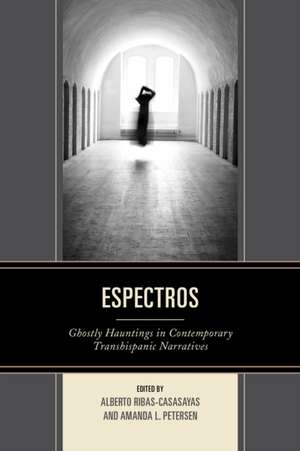
Espectros: Ghostly Hauntings in Contemporary Transhispanic Narratives
Editat de Alberto Ribas-Casasayas, Amanda L. Petersen Contribuţii de María del Carmen Caña Jiménez, Edward M. Chauca, Megan Corbin, Isabel Cuñado, Victoria L. Garrett, Juan Pablo Lupi, Karen Wooley Martin, Juliana Martínez, Susana S. Martínez, N. Michelle Murray, Sarah Thomas, Marta Sierra, Charles St-Georgesen Limba Engleză Paperback – 3 apr 2017
Ribas and Petersen's detailed introductory analysis grounds haunting as a theoretical tool for literary and cultural criticism in the Transhispanic world, with an emphasis on the contemporary period from the end of the Cold War to the present. The chapters in this volume explore haunting from a diversity of perspectives, in particular engaging haunting as a manifestation of trauma, absence, and mourning. The editors carefully distinguish the collective, cultural dimension of historical trauma from the individual, psychological experience of the aftermath of a violent history, always taking into account unresolved social justice issues. The volume also addresses the association of the spectral photographic image with the concept of haunting because of the photograph's ability to reveal a presence that is traditionally absent or has been excluded from hegemonic representations of society. The volume concludes with a series of studies that address the unseen effects and progressive deterioration of the social fabric as a result of a globalized economy and neoliberal policies, from the modernization of the nation-state to present.
Preț: 351.53 lei
Preț vechi: 483.26 lei
-27%
Puncte Express: 527
Carte tipărită la comandă
Livrare economică 08-22 decembrie
Livrare prin curier în România Termenul estimat este afișat lângă disponibilitate.
Transport gratuit de la 400.00 lei Plată online sau ramburs, în funcție de opțiunile comenzii.
Retur gratuit în 14 zile Comandă securizată și suport în română.
Specificații
ISBN-13: 9781611487381
ISBN-10: 1611487382
Pagini: 270
Ilustrații: 6 b/w photos;
Dimensiuni: 150 x 226 x 16 mm
Greutate: 0.36 kg
Editura: Bloomsbury Publishing
Colecția Bucknell University Press
Locul publicării:New York, United States
ISBN-10: 1611487382
Pagini: 270
Ilustrații: 6 b/w photos;
Dimensiuni: 150 x 226 x 16 mm
Greutate: 0.36 kg
Editura: Bloomsbury Publishing
Colecția Bucknell University Press
Locul publicării:New York, United States
V-ar putea interesa
-
 Antonin Artaud: A Critical ReaderEdward ScheerPreț: 389.18 lei
 -
 A.R. GurneyArvid F. Sponberg-18%Preț: 1118.30 lei1363.78 lei
 -
 The Carver Chronotope: Contextualizing Raymond CarverG.P. Lainsbury-18%Preț: 1144.15 lei1395.31 lei
 -
 -29%Preț: 343.67 lei482.99 lei
 -
 John Irving and Cultural MourningBouchra Belgaid-35%Preț: 594.95 lei910.81 lei
 -
 Metaphysics and AbsurdityH. Gene BlockerPreț: 356.99 lei
 -
 Evelyn Waugh and the Modernist TraditionGeorge McCartneyPreț: 478.47 lei
 -
 Hybrid Fictions: American Literature and Generation XDaniel GrassianPreț: 295.25 lei
 -
 Preț: 295.97 lei
 -
 Eugene O'Neill: A Playwright's TheatreEgil TornqvistPreț: 298.18 lei
 -
 Virginia Woolf as FeministNaomi BlackPreț: 306.45 lei
 -
 Adventures in Reading Cormac McCarthyPeter Josyph-29%Preț: 344.79 lei483.59 lei
 -
 Harper Lee's To Kill a Mockingbird: New EssaysMichael J. Meyer-28%Preț: 429.60 lei599.72 lei
 -
 Zora Neale Hurston: An Annotated Bibliography of Works and CriticismProfessor Cynthia Davis-33%Preț: 710.40 lei1053.96 lei
 -
 Lord Dunsany, H.P. Lovecraft, and Ray BradburyWilliam F. Touponce-33%Preț: 612.46 lei909.96 lei
 -
 Critical Essays on Lord DunsanyS. T. Joshi-36%Preț: 679.72 lei1054.48 lei
 -
 Trumpeting a Fiery SoundJacqueline Miller CarmichaelPreț: 197.80 lei
 -
 Life in Search of Readers: Reading (In) Chicano/A LiteratureManuel M. Martin-RodriquezPreț: 303.72 lei
 -
 With the First Dream of Fire They Hunt the ColdTrevor JoycePreț: 143.09 lei
 -
 Vita Sackville-WestMary Ann CawsPreț: 156.57 lei
 -
 Nordic Narratives of Nature and the EnvironmentReinhard Hennig-18%Preț: 729.10 lei889.15 lei
Cuprins
Contents
Introduction: Theories of the Ghost in a Transhispanic Context by Alberto Ribas-Casasayas and Amanda L. Petersen
Part I. Ghostly Encounters: Haunted Histories
Chapter 1: The Museum of Memory: Spectral Presences and Metaphoric Re-membering by Megan Corbin
Chapter 2: The Bright Future of the Ghost: Memory in the Work of Javier Marías by Isabel Cuñado
Chapter 3: The Spectrality of Political Violence: Exhuming Guatemala's Haunted Past in Tanya Maria Barrientos's Family Resemblance and Sylvia Sellers's When The Ground Turns in its Sleep by Susana S. Martínez
Part II. The Persistence of Violence: Trauma as Haunting
Chapter 4: Apparitions and Absence: Spectrality in Contemporary Novels of the Disappeared
by Karen Wooley Martin
Chapter 5: The Literalization of Trauma's Specter and the Problematization of Time in
Aparecidos by Charles St-Georges
Chapter 6: Phantom Children: Spectral Presences and the Violent Past in Two Films of Contemporary Spain by Sarah Thomas
Chapter 7: Fog Instead of
Introduction: Theories of the Ghost in a Transhispanic Context by Alberto Ribas-Casasayas and Amanda L. Petersen
Part I. Ghostly Encounters: Haunted Histories
Chapter 1: The Museum of Memory: Spectral Presences and Metaphoric Re-membering by Megan Corbin
Chapter 2: The Bright Future of the Ghost: Memory in the Work of Javier Marías by Isabel Cuñado
Chapter 3: The Spectrality of Political Violence: Exhuming Guatemala's Haunted Past in Tanya Maria Barrientos's Family Resemblance and Sylvia Sellers's When The Ground Turns in its Sleep by Susana S. Martínez
Part II. The Persistence of Violence: Trauma as Haunting
Chapter 4: Apparitions and Absence: Spectrality in Contemporary Novels of the Disappeared
by Karen Wooley Martin
Chapter 5: The Literalization of Trauma's Specter and the Problematization of Time in
Aparecidos by Charles St-Georges
Chapter 6: Phantom Children: Spectral Presences and the Violent Past in Two Films of Contemporary Spain by Sarah Thomas
Chapter 7: Fog Instead of
Recenzii
The contributors provide welcome and pertinent insights into the ways in which transhispanic writers, artists, and directors have conceptualized historical and contemporary traumas. . . it will no doubt be a key text for years to come.
A consistently illuminating collection of essays, Espectros: Ghostly Hauntings in Contemporary Transhispanic Narratives is the first critical anthology about the figure of the ghost and the aesthetic of haunting to focus on narrative, film, and photography produced in Latin America, Spain, and the Latino Diaspora.... A skillfully organized collection, this anthology represents a pioneering effort to explore a neglected arena in Transhispanic cultural studies. The authors of these twelve essays persuasively illustrate the relevance of studying the figure of the ghost in its many forms, challenging us to expand the scope of Hispanic Studies as a whole. Ribas-Casasayas and Petersen offer an important and influential anthology. Readable, thought-provoking, and at times deeply moving, Espectros: Ghostly Hauntings in Contemporary Transhispanic Narratives is an essential companion to any scholar working in Latin American, Latino, or Peninsular Studies who is interested in spectral criticism.
To the growing list of studies on the horror genre we will need to add Alberto Ribas Casasayas and Amanda L. Petersen's Espectros: Ghostly Hauntings in Contemporary Transhispanic Narratives, a compilation of never-before published essays that posits itself as the "first volume-length exploration of the spectral in literature, film, and photography of Latin America, Spain, and the Latino diaspora." Indeed it is a multifaceted and interdisciplinary study that presents the reader with an amalgam of works that show an inherent connection between differing art formats and to the horror of specters in our everyday waking-and sleeping-life.... In the end, this compilation goes beyond simply being a book dedicated to horror.... This collection leaves behind the recourse of a facile analysis of a tried-and-true (or widely recognized) horror text, instead choosing to offer a fresh take on the ways in which espectros can be a relevant and committed force in our daily existence.
Espectros: Ghostly Hauntings in Contemporary Transhispanic Narratives is a unique and welcome collaboration, the cultural and geographical breadth of which is inspiring, and the theoretical aim of which is most timely and provocative.
The editors and authors of the remarkable collection Espectros: Ghostly Hauntings in Contemporary Transhispanic Narratives trace a spectral geography that connects the violent histories of Spain and Spanish America. This is an interesting lens through which to explore the use and aesthetics of haunting. . . . The body of writing compiled in Espectros allows readers to understand how trauma is woven into the very fabric of Hispanic history, on both sides of the Atlantic. However, these essays also help us consider ways of treating and moving forward with our conditions as subjects who are always and already haunted-of envisioning treatments of our collective pasts and presents that denote a greater and more meaningful sense of mutual respect and responsibility.
Ultimately, this collection is a welcome contribution to its field, as it provides convincing summaries for some of the key aspects of theory relating to specters and brings together a number of intelligent articles that capture a noteworthy rise in themes of haunting among transhispanic narratives. It attempts to relay subtle distinctions in approaches to these concepts with no pretense of being the last word on the subject. Casting a wide net across both a theoretical and a territorial perspective, Espectros handles ghosts and specters just as they might demand, with respect and attention but without a sense of definitiveness or foreclosure.
Ghosts can be very fierce and instructive. They cast strange shadows, particularly in our literature." So writes Flannery O'Connor in "The Grotesque in Southern Fiction." Her statement is now amplified well beyond the US South in the excellent essays collected in Espectros. They address recent Spanish and Latin American literature and film, and the instruction of their ghosts is less theological (as it was for O'Connor) than political and economic. Military and civilian violence has taken a terrible toll from Mexico to Guatemala and Salvador, from Colombia to Argentina, with Spain's specters also appearing to give us instruction. Los desaparecidos [the disappeared] populate these essays, as do those who have died from economic oppression and its consequences: immigration, detention, corruption, abandonment. The collection as a whole considers how memory works to recover collective traumas, and how haunting is necessarily a part of this process. Ghosts are always figures of our essential displacement, whether spiritual or political, but their instruction is particularly urgent when they remind us of multiple human horrors. The essays in Espectros should be read by everyone interested in Latin America's recent political past, and in the many ways that its literature and film, like ghosts, can "cast strange shadows.
Alberto Ribas-Casasayas and Amanda L. Petersen contribute critical readings of the ghostly in Transhispanic cultural production to spectral studies. . . . As investigations of the ghostly continue, this volume will provide valuable insight for future studies that can expand to other areas of Latin America, including the Caribbean. Alongside the insightful remarks of Ribas-Casasayas and Petersen, the chapters advance scholarly work on spectral studies, specifically in the sphere of Transhispanic contemporary cultural production.
Overall, Espectrosis a compelling and thought-provoking compilation of articles that serves both as an introduction to and an in-depth analysis of Transhispanicspectral studies.
A consistently illuminating collection of essays, Espectros: Ghostly Hauntings in Contemporary Transhispanic Narratives is the first critical anthology about the figure of the ghost and the aesthetic of haunting to focus on narrative, film, and photography produced in Latin America, Spain, and the Latino Diaspora.... A skillfully organized collection, this anthology represents a pioneering effort to explore a neglected arena in Transhispanic cultural studies. The authors of these twelve essays persuasively illustrate the relevance of studying the figure of the ghost in its many forms, challenging us to expand the scope of Hispanic Studies as a whole. Ribas-Casasayas and Petersen offer an important and influential anthology. Readable, thought-provoking, and at times deeply moving, Espectros: Ghostly Hauntings in Contemporary Transhispanic Narratives is an essential companion to any scholar working in Latin American, Latino, or Peninsular Studies who is interested in spectral criticism.
To the growing list of studies on the horror genre we will need to add Alberto Ribas Casasayas and Amanda L. Petersen's Espectros: Ghostly Hauntings in Contemporary Transhispanic Narratives, a compilation of never-before published essays that posits itself as the "first volume-length exploration of the spectral in literature, film, and photography of Latin America, Spain, and the Latino diaspora." Indeed it is a multifaceted and interdisciplinary study that presents the reader with an amalgam of works that show an inherent connection between differing art formats and to the horror of specters in our everyday waking-and sleeping-life.... In the end, this compilation goes beyond simply being a book dedicated to horror.... This collection leaves behind the recourse of a facile analysis of a tried-and-true (or widely recognized) horror text, instead choosing to offer a fresh take on the ways in which espectros can be a relevant and committed force in our daily existence.
Espectros: Ghostly Hauntings in Contemporary Transhispanic Narratives is a unique and welcome collaboration, the cultural and geographical breadth of which is inspiring, and the theoretical aim of which is most timely and provocative.
The editors and authors of the remarkable collection Espectros: Ghostly Hauntings in Contemporary Transhispanic Narratives trace a spectral geography that connects the violent histories of Spain and Spanish America. This is an interesting lens through which to explore the use and aesthetics of haunting. . . . The body of writing compiled in Espectros allows readers to understand how trauma is woven into the very fabric of Hispanic history, on both sides of the Atlantic. However, these essays also help us consider ways of treating and moving forward with our conditions as subjects who are always and already haunted-of envisioning treatments of our collective pasts and presents that denote a greater and more meaningful sense of mutual respect and responsibility.
Ultimately, this collection is a welcome contribution to its field, as it provides convincing summaries for some of the key aspects of theory relating to specters and brings together a number of intelligent articles that capture a noteworthy rise in themes of haunting among transhispanic narratives. It attempts to relay subtle distinctions in approaches to these concepts with no pretense of being the last word on the subject. Casting a wide net across both a theoretical and a territorial perspective, Espectros handles ghosts and specters just as they might demand, with respect and attention but without a sense of definitiveness or foreclosure.
Ghosts can be very fierce and instructive. They cast strange shadows, particularly in our literature." So writes Flannery O'Connor in "The Grotesque in Southern Fiction." Her statement is now amplified well beyond the US South in the excellent essays collected in Espectros. They address recent Spanish and Latin American literature and film, and the instruction of their ghosts is less theological (as it was for O'Connor) than political and economic. Military and civilian violence has taken a terrible toll from Mexico to Guatemala and Salvador, from Colombia to Argentina, with Spain's specters also appearing to give us instruction. Los desaparecidos [the disappeared] populate these essays, as do those who have died from economic oppression and its consequences: immigration, detention, corruption, abandonment. The collection as a whole considers how memory works to recover collective traumas, and how haunting is necessarily a part of this process. Ghosts are always figures of our essential displacement, whether spiritual or political, but their instruction is particularly urgent when they remind us of multiple human horrors. The essays in Espectros should be read by everyone interested in Latin America's recent political past, and in the many ways that its literature and film, like ghosts, can "cast strange shadows.
Alberto Ribas-Casasayas and Amanda L. Petersen contribute critical readings of the ghostly in Transhispanic cultural production to spectral studies. . . . As investigations of the ghostly continue, this volume will provide valuable insight for future studies that can expand to other areas of Latin America, including the Caribbean. Alongside the insightful remarks of Ribas-Casasayas and Petersen, the chapters advance scholarly work on spectral studies, specifically in the sphere of Transhispanic contemporary cultural production.
Overall, Espectrosis a compelling and thought-provoking compilation of articles that serves both as an introduction to and an in-depth analysis of Transhispanicspectral studies.