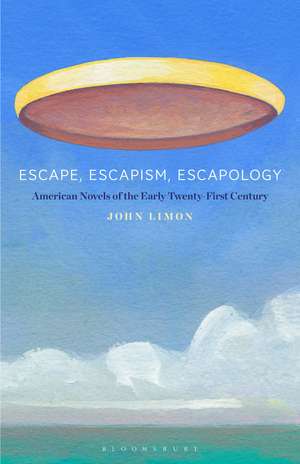
Escape, Escapism, Escapology: American Novels of the Early Twenty-First Century
Autor Professor John Limonen Limba Engleză Hardback – 29 sep 2022
When contemporary novelists feature actual historical escape, pervasively from slavery or Nazism, it appears in their novels as escape envy or escape nostalgia-as if globalization like slavery or Nazism could be escaped in a direction, from this place to another. Thus the closing of the world frontier inspires a mirror messianism and utopianism that in US novels can only be rendered as a performative, momentary, chiasmic relationship between precocious kids and their ludic guardians.
Preț: 476.88 lei
Preț vechi: 692.26 lei
-31%
Puncte Express: 715
Carte tipărită la comandă
Livrare economică 23 noiembrie-07 decembrie
Livrare prin curier în România Termenul estimat este afișat lângă disponibilitate.
Transport gratuit pentru acest produs Plată online sau ramburs, în funcție de opțiunile comenzii.
Retur gratuit în 14 zile Comandă securizată și suport în română.
Specificații
ISBN-13: 9781501391118
ISBN-10: 1501391119
Pagini: 248
Dimensiuni: 148 x 218 x 20 mm
Greutate: 0.72 kg
Editura: Bloomsbury Publishing
Colecția Bloomsbury Academic
Locul publicării:New York, United States
ISBN-10: 1501391119
Pagini: 248
Dimensiuni: 148 x 218 x 20 mm
Greutate: 0.72 kg
Editura: Bloomsbury Publishing
Colecția Bloomsbury Academic
Locul publicării:New York, United States
Cuprins
Introduction
Part I: Escape, Escapism, Escapology
1. Notes from Neverland
2. I Flit, I Float, I Fleetly Flee, I Fly [on The Sound of Music]
Part II: Family Likenesses
3. The Escapist [on Michael Chabon]
4. Mellon [on Junot Diaz]
5. Bath and Bathos [on Dave Eggers and Jonathan Safran Foer]
6. The Beauty! The Horror! [on Emma Donoghue]
7. Et in Nobis Arcadia [on Lauren Groff]
8. The Ethics of Immortality [on Colson Whitehead]
9. The Songs of Murdered Souls [On Jesmyn Ward and George Saunders]
Part III: Foreign Correspondents
10. Choice and the Chosen [on David Grossman]
11. Categorical Denial [on Arundhati Roy]
Part IV: Prequel
12. The Tunnel Out [on William H. Gass]
Acknowledgments
References
Index
Part I: Escape, Escapism, Escapology
1. Notes from Neverland
2. I Flit, I Float, I Fleetly Flee, I Fly [on The Sound of Music]
Part II: Family Likenesses
3. The Escapist [on Michael Chabon]
4. Mellon [on Junot Diaz]
5. Bath and Bathos [on Dave Eggers and Jonathan Safran Foer]
6. The Beauty! The Horror! [on Emma Donoghue]
7. Et in Nobis Arcadia [on Lauren Groff]
8. The Ethics of Immortality [on Colson Whitehead]
9. The Songs of Murdered Souls [On Jesmyn Ward and George Saunders]
Part III: Foreign Correspondents
10. Choice and the Chosen [on David Grossman]
11. Categorical Denial [on Arundhati Roy]
Part IV: Prequel
12. The Tunnel Out [on William H. Gass]
Acknowledgments
References
Index
Recenzii
If you haven't yet encountered John Limon's work, you have some exhilarating surprises ahead: it's witty, keenly idiosyncratic, beautifully adroit at drawing unexpected connections, and spectacularly attuned to the evocative possibilities of both paradox and pathos. Escape, Escapism, Escapology: American Novels of the Early Twenty-First Century is a savvy examination of crucial obsessions in some of our most ambitious and canonical contemporary fictions, helping us through the problem of conceiving not only what we're escaping from but also what we're escaping to. The result is an argument that will compel both the ornithologists and the birds: one that our Michael Chabons will find as illuminating as our Stanley Cavells.
Limon's bleakly funny and effortlessly learned study examines novels for which this, the world now before us, is 'as good as it gets.' That equivocal and confounding prospect, it turns out, haunts contemporary fiction in previously unimaginable ways. This is literary criticism at its very best.
John Limon's Escape, Escapism, Escapology will stand as a landmark study of the early twenty-first century Anglophone novel. Its elaboration of escapism offers a brilliantly original and suggestive framework for a widescale reconsideration of the force and interest of contemporary fiction. I can think of very few recent works of criticism that can match its interpretive verve and its contagious curiosity. It is thrilling to read such an intellectually forceful engagement with aesthetic culture of the present moment.
Limon's bleakly funny and effortlessly learned study examines novels for which this, the world now before us, is 'as good as it gets.' That equivocal and confounding prospect, it turns out, haunts contemporary fiction in previously unimaginable ways. This is literary criticism at its very best.
John Limon's Escape, Escapism, Escapology will stand as a landmark study of the early twenty-first century Anglophone novel. Its elaboration of escapism offers a brilliantly original and suggestive framework for a widescale reconsideration of the force and interest of contemporary fiction. I can think of very few recent works of criticism that can match its interpretive verve and its contagious curiosity. It is thrilling to read such an intellectually forceful engagement with aesthetic culture of the present moment.