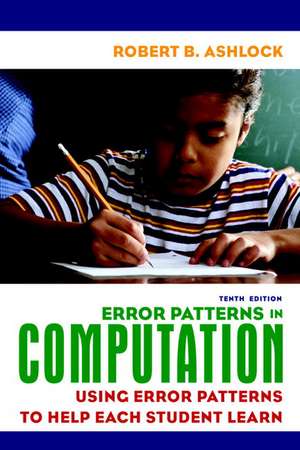
Error Patterns in Computation: Using Error Patterns to Help Each Student Learn
Autor Robert B. Ashlocken Limba Engleză Paperback – 31 dec 2008
Preț: 487.68 lei
Preț vechi: 602.08 lei
-19%
Puncte Express: 732
Carte tipărită la comandă
Livrare economică 07-21 decembrie
Livrare prin curier în România Termenul estimat este afișat lângă disponibilitate.
Transport gratuit pentru acest produs Plată online sau ramburs, în funcție de opțiunile comenzii.
Retur gratuit în 14 zile Comandă securizată și suport în română.
Specificații
ISBN-13: 9780135009109
ISBN-10: 0135009103
Pagini: 274
Dimensiuni: 150 x 226 x 13 mm
Greutate: 0.32 kg
Ediția:10
Editura: Allyn & Bacon
Locul publicării:Boston, United States
ISBN-10: 0135009103
Pagini: 274
Dimensiuni: 150 x 226 x 13 mm
Greutate: 0.32 kg
Ediția:10
Editura: Allyn & Bacon
Locul publicării:Boston, United States
V-ar putea interesa
-
 -13%Preț: 545.21 lei626.68 lei
 -
 Preț: 411.68 lei
 -
 How to Teach SpeakingScott ThornburyPreț: 398.92 lei
 -
 Teaching with FireSam M IntratorPreț: 183.06 lei
Descriere
“Students must learn mathematics with understanding, actively building new knowledge from experience and prior knowledge.” From the Principles for School Mathematics of NCTM standards, copyright NCTM 2000-2004.
Yet sometimes when students are learning mathematics, they learn misconceptions and adopt erroneous procedures despite the best efforts of their teacher. This book was written to help teachers to detect the systematic errors many students make–whether using paper and pencil, or calculators or computers. Emphasizing concepts and skills, in accordance with the NCTM standards, this readable and engaging supplementary text will help all teachers of math methods to become more proficient at diagnosing and correcting computational procedures. Teachers will gain skills by actually looking for error patterns, making decisions, and planning instruction.
The book is organized into two parts with appendices. The first part is mainly devoted to instructional issues and considers the place of computation in today’s world of technology and then focuses on various aspects of assessment and instruction for both concepts and skills. Part Two presents sample student papers within topical chapters. These papers provide opportunities to identify patterns of error and to reflect on the best course of corrective instruction. Readers can then compare their responses with those of the author. The appendices provide additional papers for even more practice in identifying error patterns.
New To This Edition:
Yet sometimes when students are learning mathematics, they learn misconceptions and adopt erroneous procedures despite the best efforts of their teacher. This book was written to help teachers to detect the systematic errors many students make–whether using paper and pencil, or calculators or computers. Emphasizing concepts and skills, in accordance with the NCTM standards, this readable and engaging supplementary text will help all teachers of math methods to become more proficient at diagnosing and correcting computational procedures. Teachers will gain skills by actually looking for error patterns, making decisions, and planning instruction.
The book is organized into two parts with appendices. The first part is mainly devoted to instructional issues and considers the place of computation in today’s world of technology and then focuses on various aspects of assessment and instruction for both concepts and skills. Part Two presents sample student papers within topical chapters. These papers provide opportunities to identify patterns of error and to reflect on the best course of corrective instruction. Readers can then compare their responses with those of the author. The appendices provide additional papers for even more practice in identifying error patterns.
New To This Edition:
- NEW! Gives greater emphasis on diagnosis as a part of formative assessment.
- NEW! Includes more material on understanding the meanings of operations to help teachers and students understand the operations of arithmetic so they will know when to use each operation when solving problems.
- NEW! Enables teachers to plan varied instruction that involves connections with other mathematics and varied applications.
Cuprins
Part I: Misconceptions and Error Patterns
1. Computation, Misconceptions, and Error Patterns
2. Error Patterns: Addition and Subtraction with Whole Numbers
3. Error Patterns: Multiplication and Division with Whole Numbers
4. Misconceptions and Error Patterns: Concepts and Equivalents with Fractions and Decimals
5. Error Patterns: Addition and Subtraction with Fractions and Decimals
6. Error Patterns: Multiplication and Division with Fractions and Decimals
7. Introduction to Misconceptions and Error Patterns: Geometry and Measurement
8. Introduction to Misconceptions and Error Patterns: Percent, Proportion, Integers, and Algebra
Part II: Diagnosis and Instruction
9. Diagnosing Misconception and Error Patters in Computation and in Other Mathematical Topics
10. Providing Data-Driven Instruction in Computation
11. Enriching Instruction in Computation and Other Mathematical Topics
Glossary
Key for Additional Practice
Selected Resources
Appendices
1. Computation, Misconceptions, and Error Patterns
2. Error Patterns: Addition and Subtraction with Whole Numbers
3. Error Patterns: Multiplication and Division with Whole Numbers
4. Misconceptions and Error Patterns: Concepts and Equivalents with Fractions and Decimals
5. Error Patterns: Addition and Subtraction with Fractions and Decimals
6. Error Patterns: Multiplication and Division with Fractions and Decimals
7. Introduction to Misconceptions and Error Patterns: Geometry and Measurement
8. Introduction to Misconceptions and Error Patterns: Percent, Proportion, Integers, and Algebra
Part II: Diagnosis and Instruction
9. Diagnosing Misconception and Error Patters in Computation and in Other Mathematical Topics
10. Providing Data-Driven Instruction in Computation
11. Enriching Instruction in Computation and Other Mathematical Topics
Glossary
Key for Additional Practice
Selected Resources
Appendices
Notă biografică
Robert Ashlock began his career in 1957 as a fourth and fifth grade teacher with a bachelor’s degree in elementary education. He later received a master’s degree in elementary school administration from Butler University and a doctorate in elementary education from Indiana University. He became a graduate assistant and teaching associate at Indiana University in 1964 and went on to teach at several institutions including the University of Maryland, Reformed Theological Seminary, Belhaven College, and finally, Covenant College in Lookout Mountain, Georgia. Ashlock came to Covenant in 1988 to fill the need for a specialist in elementary education who could also teach on the graduate level. He directed the Master of Education Program, taught both undergraduate and graduate education courses, and coordinated the process necessary for the teacher education program to be approved by the Georgia Professional Standards Commission.
He is one of only two professors ever to receive the title Professor Emeritus at Covenant. He is known throughout the education community for his book, Error Patterns in Computation: Using Error Patterns to Improve Instruction, which is currently in its tenth edition. Although retired, Ashlock continues to teach a few classes.
He is one of only two professors ever to receive the title Professor Emeritus at Covenant. He is known throughout the education community for his book, Error Patterns in Computation: Using Error Patterns to Improve Instruction, which is currently in its tenth edition. Although retired, Ashlock continues to teach a few classes.
Textul de pe ultima copertă
Error Patterns in Computation: Using Error Patterns to Help Each Student Learn, Tenth Edition
Robert B. Ashlock, Covenant College
The only text of its kind to show teachers how to identify common error patterns in mathematics!
As students learn about mathematical operations and methods of computation, they may adopt erroneous procedures and misconceptions. This engaging book was written to model how the instructor can make thoughtful analyses of their students’ work and in so doing, discover patterns in errors made. This supplementary text guides teachers to consider reasons why students may have learned erroneous procedures in the first place and presents strategies for helping those students. Readers come away from the book with a clear vision of how to use student error patterns to gain more specific knowledge of students' understanding and to use that information to inform their future instruction.
In addition to being substantially revised, the new edition offers greater emphasis on the following important topics:
- Use of diagnosis as a part of formative assessment, including open-ended assessment and problem writing as examples
- Application of Big Ideas--including compensation principles, relations between operations, and “There are many names for a number”--to form connections among facts, procedures, and concepts by applying big ideas
- Distinction between misconceptions and error patterns in computation
- Understanding of our system of numeration
- Understanding the meanings of operations of arithmetic so students will know when to use each operation when solving problems
- Representation of concepts and procedures in a variety of ways
- Use of classroom discourse, careful listening, and probing questions
- Assessment of dispositions
- Planning for varied instruction
Caracteristici
- Emphasizes assessment and the role of diagnosis within formative assessment.
- Provides guidance and resources for assessing and interviewing students.
- Incorporates students’ papers in which readers identify patterns of responses and compare their instructional recommendations with those of the author.
- Readers also practice identifying misconceptions and error patterns.
- Focuses on concepts and principles.
- Allows an instructor to teach computation in accordance with the NCTM Standards.
- Gives students an understanding of the meanings of operations and not just methods of computation.
- Enables students to know when particular operations are needed for solving a problem.
- Retains its emphasis on computational fluency.
- Stresses estimation and the best computing choice (mental computation, paper-and-pencil, calculator) in specific scenarios.
- Stresses estimation.
- Encourages readers to ask their students, “Is it reasonable?”
- Provides current strategies.
- Examines models and concrete materials, graphic organizers, self-assessment, portfolios, peer tutoring, and cooperative groups used when teaching computation.
- Incorporates reader recommendations that increase the text’s user-friendly and pragmatic appeal.
Caracteristici noi
- NEW! Gives new emphasis to diagnosis as a part of formative assessment--Teachers can use varied approaches to diagnosis before instruction and also as they intervene during instruction.
- Open-ended assessment and problem writing are examples of procedures illustrated.
- NEW! Supplies more coverage ofmaking connections among facts, procedures, and concepts–Will help teachers and students make connections by applying big ideas.
- Compensation principles, relations between operations, and “There are many names for a number” are examples.
- NEW! Furnishes adistinction between misconceptions and error patterns in computation–Encourages teachers to focus on concept development when appropriate rather than merely reviewing procedures.
- NEW! Offers an increased understanding of our system of numeration–Provides additional material that enables teachers to diagnose understanding of multi-digit numerals at a deeper level.
- NEW! Helps teachers and students to better understand the meanings of operations--additional material is provided to help teachers and students understand the operations of arithmetic so they will know when to use each operation when solving problems.
- NEW! Provides greater emphasis on representations--Teachers are instructed to represent concepts and procedures in a variety of ways.
- NEW! Includes a newsection on using classroom discourse--Teachers listen carefully to classroom discourse and then ask questions that probe and guide thinking.
- NEW! Features a newfocus on dispositions–Helps teachers to assess disposition.
- NEW! Incorporates a newsection illustrating a thematic unit in mathematics--Enables teachers to plan varied instruction that involves connections with other mathematics and numerous applications.