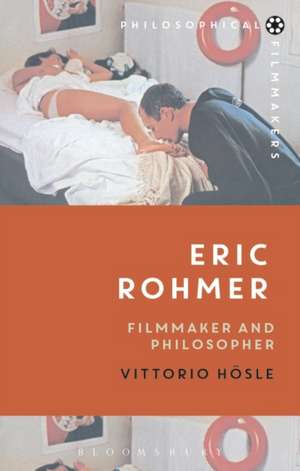
Eric Rohmer: Filmmaker and Philosopher: Philosophical Filmmakers
Autor Professor Vittorio Hösleen Limba Engleză Paperback – 28 iul 2016
Hösle's book puts Rohmer in the context of a long French tradition of reflected eroticism, with Marivaux, Musset, Stendhal, and Jean Renoir as crucial figures, and shows how Rohmer both recognizes the inner logic of eroticism and subjects it to moral demands that he inherits from his Catholic background. For Rohmer, the tension between the two can usually only be solved by some unexpected event that can be interpreted as an equivalent of grace.
Din seria Philosophical Filmmakers
- 15%
 Preț: 157.30 lei
 - 20%
 Preț: 146.64 lei
 - 17%
 Preț: 143.53 lei
 - 15%
 Preț: 148.94 lei
 - 9%
 Preț: 164.68 lei
 - 17%
 Preț: 158.15 lei
 - 25%
 Preț: 171.38 lei
 - 19%
 Preț: 178.19 lei
 - 26%
 Preț: 163.17 lei
 - 19%
 Preț: 176.60 lei
 - 20%
 Preț: 168.05 lei
 - 19%
 Preț: 178.19 lei
 - 14%
 Preț: 162.47 lei
 - 13%
 Preț: 170.44 lei
 - 15%
 Preț: 157.13 lei
 - 27%
 Preț: 438.23 lei
Preț: 177.94 lei
Preț vechi: 197.95 lei
-10%
Puncte Express: 267
Carte tipărită la comandă
Livrare economică 08-22 decembrie
Livrare prin curier în România Termenul estimat este afișat lângă disponibilitate.
Transport gratuit de la 400.00 lei Plată online sau ramburs, în funcție de opțiunile comenzii.
Retur gratuit în 14 zile Comandă securizată și suport în română.
Specificații
ISBN-13: 9781474221122
ISBN-10: 1474221122
Pagini: 216
Dimensiuni: 134 x 214 x 14 mm
Greutate: 0.41 kg
Editura: Bloomsbury Publishing
Colecția Bloomsbury Academic
Seria Philosophical Filmmakers
Locul publicării:London, United Kingdom
ISBN-10: 1474221122
Pagini: 216
Dimensiuni: 134 x 214 x 14 mm
Greutate: 0.41 kg
Editura: Bloomsbury Publishing
Colecția Bloomsbury Academic
Seria Philosophical Filmmakers
Locul publicării:London, United Kingdom
V-ar putea interesa
-
 Orson Welles, Volume 1Simon Callow-40%Preț: 90.66 lei150.73 lei
 -
 Entirely Up to You DarlingDiana HawkinsPreț: 116.48 lei
 -
 Spellbound by BeautyDonald SpotoPreț: 115.08 lei
 -
 The Men Who Knew Too Much: Henry James and Alfred HitchcockSusan M. Griffin-11%Preț: 297.97 lei335.95 lei
 -
 Mike Leigh on Mike LeighAmy RaphaelPreț: 188.56 lei
 -
 -26%Preț: 57.45 lei78.14 lei
 -
 -18%Preț: 111.02 lei135.76 lei
 -
 Screen Epiphanies: Film-makers on the films that inspired themGeoffrey MacnabPreț: 483.26 lei
 -
 Ken Loach: The Politics of Film and TelevisionResearch Fellow - Emeritus John Hill-23%Preț: 253.16 lei327.97 lei
 -
 Kenji Mizoguchi and the Art of Japanese CinemaLatika Padgaonkar-43%Preț: 195.73 lei340.41 lei
 -
 The Stanley Kubrick ArchivesAlison Castle-8%Preț: 592.15 lei643.64 lei
Cuprins
Preface
1. Rohmer and the Description of Contemporary Eroticism
2. From Dialogue to Film
3. Les Contes des Quatre Saisons as a Coherent Universe
4. The Implied Morals
5. Conclusion
Bibliography
Index
1. Rohmer and the Description of Contemporary Eroticism
2. From Dialogue to Film
3. Les Contes des Quatre Saisons as a Coherent Universe
4. The Implied Morals
5. Conclusion
Bibliography
Index
Recenzii
Hösle offers a valuable contribution to Anglophone Rohmer scholarship, bringing his philosophical background to the thorny topic of religion and film. For readers interested in a Christian interpretation of Rohmer's films, I can warmly recommend this book; Hösle's over-arching thesis about the religious basis of Rohmer's films is supported by concise readings of individual films in Rohmer's oeuvre, all of which illustrate with sensitivity and insight the religious implications of Rohmer's comic morality tales.
In this through and detailed account of Eric Rohmer's three great film cycles, The Moral Tales, Comedies and Proverbs, and The Tales of the Four Seasons, Vittorio Hösle demonstrates how Rohmer undertook one of the great studies of modern erotic life in his cinematic depictions of love relations between men and women. Understanding Rohmer as both a Catholic filmmaker and as well versed in the Germanic philosophical tradition, Hösle shows us how his acutely realist films, always based in a recognizable time and place, nevertheless offer a view of the metaphysical, spiritual and transcendent possibilities that may lie behind our romantic and amorous entanglements. This engaging book encourages us to return to Rohmer's films with a vivid understanding of both their suggestive religious and philosophical resonances and their sympathy with the complexities of the human condition.
In this through and detailed account of Eric Rohmer's three great film cycles, The Moral Tales, Comedies and Proverbs, and The Tales of the Four Seasons, Vittorio Hösle demonstrates how Rohmer undertook one of the great studies of modern erotic life in his cinematic depictions of love relations between men and women. Understanding Rohmer as both a Catholic filmmaker and as well versed in the Germanic philosophical tradition, Hösle shows us how his acutely realist films, always based in a recognizable time and place, nevertheless offer a view of the metaphysical, spiritual and transcendent possibilities that may lie behind our romantic and amorous entanglements. This engaging book encourages us to return to Rohmer's films with a vivid understanding of both their suggestive religious and philosophical resonances and their sympathy with the complexities of the human condition.