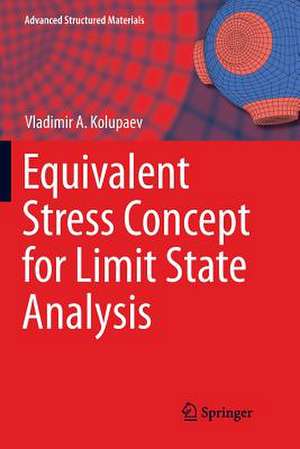
Equivalent Stress Concept for Limit State Analysis: Advanced Structured Materials, cartea 86
Autor Vladimir A. Kolupaeven Limba Engleză Paperback – 7 iun 2019
The most useful criteria can be applied best when the plausibility assumptions are known. Accordingly, the book introduces fitting methods based on mathematical, physical, and geometrical objective functions. It also features a wealth of examples that demonstrate the application of different approaches in modeling certain limit behaviors.
Din seria Advanced Structured Materials
- 18%
 Preț: 1161.45 lei
 - 18%
 Preț: 1149.12 lei
 - 18%
 Preț: 1072.28 lei
 - 15%
 Preț: 739.55 lei
 - 18%
 Preț: 1157.20 lei
 - 18%
 Preț: 1156.74 lei
 - 18%
 Preț: 1162.44 lei
 - 18%
 Preț: 813.56 lei
 - 18%
 Preț: 925.58 lei
 - 18%
 Preț: 1267.33 lei
 - 18%
 Preț: 1149.59 lei
 - 18%
 Preț: 822.58 lei
 - 18%
 Preț: 834.70 lei
 - 18%
 Preț: 1154.82 lei
 - 18%
 Preț: 1159.79 lei
 - 24%
 Preț: 1186.26 lei
 - 18%
 Preț: 773.24 lei
 - 18%
 Preț: 1145.76 lei
 - 18%
 Preț: 779.87 lei
 - 18%
 Preț: 809.27 lei
 - 18%
 Preț: 832.10 lei
 - 18%
 Preț: 827.80 lei
 - 18%
 Preț: 1164.57 lei
 - 18%
 Preț: 1155.03 lei
 - 18%
 Preț: 927.24 lei
 - 18%
 Preț: 1158.61 lei
 - 18%
 Preț: 1043.06 lei
 - 18%
 Preț: 975.86 lei
 - 18%
 Preț: 922.04 lei
 - 18%
 Preț: 939.59 lei
 - 15%
 Preț: 665.20 lei
 - 15%
 Preț: 661.76 lei
 - 15%
 Preț: 739.55 lei
 - 18%
 Preț: 988.22 lei
 - 15%
 Preț: 674.07 lei
 - 18%
 Preț: 1235.06 lei
 - 15%
 Preț: 640.28 lei
 - 15%
 Preț: 656.12 lei
 - 15%
 Preț: 664.14 lei
 - 15%
 Preț: 672.46 lei
 - 15%
 Preț: 682.97 lei
 - 15%
 Preț: 666.33 lei
 - 15%
 Preț: 668.72 lei
 - 15%
 Preț: 669.40 lei
 - 18%
 Preț: 975.56 lei
Preț: 648.32 lei
Preț vechi: 762.73 lei
-15%
Carte tipărită la comandă
Livrare economică 04-18 decembrie
Specificații
ISBN-10: 3319892312
Pagini: 384
Ilustrații: XVII, 365 p. 210 illus., 205 illus. in color.
Dimensiuni: 155 x 235 x 21 mm
Greutate: 0.58 kg
Ediția:Softcover reprint of the original 1st edition 2018
Editura: Springer
Colecția Advanced Structured Materials
Seria Advanced Structured Materials
Locul publicării:Cham, Switzerland
Cuprins
Descriere
This book discusses arbitrary multiaxial stress states using the concept of equivalent stress. It highlights the most useful criteria, which can be applied to various classes of isotropic materials. Due to its simplicity and clarity, this concept is now widely used in component design, and many strength and yield criteria based on the equivalent stress concept have been formulated. Choosing the appropriate criterion for a given material remains the main challenge in applications.
The most useful criteria can be applied best when the plausibility assumptions are known. Accordingly, the book introduces fitting methods based on mathematical, physical, and geometrical objective functions. It also features a wealth of examples that demonstrate the application of different approaches in modeling certain limit behaviors.