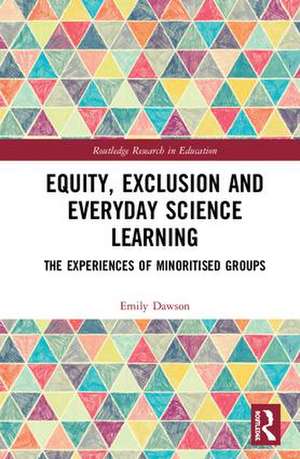
Equity, Exclusion and Everyday Science Learning: The Experiences of Minoritised Groups: Routledge Research in Education
Autor Emily Dawsonen Limba Engleză Hardback – 30 ian 2019
This book presents a theoretically informed, empirically detailed analysis of how people from minoritised groups in the UK experience science and everyday science learning resources in their daily lives. The book draws on two years of ethnographic research carried out in London with five community groups who identified as Asian, Somali, Afro-Caribbean, Latin American and Sierra Leonean. Exploring their experiences of everyday science learning from a sociological perspective, with social justice as a guiding concern, this book opens with a theory of exclusion and closes with a theory of inclusion.
Equity, Exclusion and Everyday Science Learning is not only an essential text for postgraduate students and postdoctoral researchers of Science Education, Science Communication and Museum Studies, but for any professional working in museums, science centres and institutional public engagement.
Din seria Routledge Research in Education
-
 Preț: 365.41 lei
 - 24%
 Preț: 1128.22 lei
 - 21%
 Preț: 362.10 lei
 - 18%
 Preț: 1253.42 lei
 - 18%
 Preț: 1307.06 lei
 - 18%
 Preț: 1244.34 lei
 - 15%
 Preț: 462.57 lei
 - 18%
 Preț: 1310.81 lei
 - 18%
 Preț: 1252.71 lei
 - 18%
 Preț: 1252.71 lei
 - 18%
 Preț: 1309.41 lei
 - 18%
 Preț: 1361.94 lei
 - 18%
 Preț: 1319.89 lei
 - 18%
 Preț: 1252.37 lei
 - 18%
 Preț: 1250.55 lei
 - 18%
 Preț: 1257.26 lei
 - 18%
 Preț: 1307.32 lei
 - 18%
 Preț: 1256.55 lei
 - 18%
 Preț: 1607.24 lei
 -
 Preț: 518.30 lei
 - 18%
 Preț: 1255.87 lei
 - 18%
 Preț: 1523.65 lei
 - 18%
 Preț: 1252.93 lei
 -
 Preț: 415.81 lei
 -
 Preț: 431.00 lei
 - 18%
 Preț: 1315.35 lei
 -
 Preț: 432.71 lei
 - 18%
 Preț: 1252.37 lei
 - 18%
 Preț: 1302.78 lei
 - 18%
 Preț: 1252.01 lei
 - 18%
 Preț: 1256.91 lei
 - 18%
 Preț: 1252.01 lei
 - 18%
 Preț: 1318.85 lei
 - 18%
 Preț: 1254.81 lei
 - 18%
 Preț: 1357.75 lei
 - 18%
 Preț: 1254.47 lei
 - 18%
 Preț: 1254.81 lei
 - 18%
 Preț: 1259.00 lei
 - 18%
 Preț: 1255.17 lei
 - 18%
 Preț: 1250.28 lei
 - 18%
 Preț: 1257.60 lei
 - 18%
 Preț: 1366.81 lei
 - 15%
 Preț: 456.05 lei
 - 18%
 Preț: 1250.55 lei
 - 18%
 Preț: 1261.45 lei
 - 18%
 Preț: 1258.30 lei
 - 18%
 Preț: 1262.84 lei
 - 18%
 Preț: 1471.36 lei
Preț: 1331.57 lei
Preț vechi: 1623.86 lei
-18%
Puncte Express: 1997
Carte tipărită la comandă
Livrare economică 03-17 decembrie
Livrare prin curier în România Termenul estimat este afișat lângă disponibilitate.
Transport gratuit pentru acest produs Plată online sau ramburs, în funcție de opțiunile comenzii.
Retur gratuit în 14 zile Comandă securizată și suport în română.
Specificații
ISBN-13: 9781138289949
ISBN-10: 1138289949
Pagini: 194
Ilustrații: 4 Line drawings, black and white; 1 Halftones, black and white; 5 Illustrations, black and white
Dimensiuni: 156 x 234 x 18 mm
Greutate: 2.82 kg
Ediția:1
Editura: Taylor & Francis
Colecția Routledge
Seria Routledge Research in Education
Locul publicării:Oxford, United Kingdom
ISBN-10: 1138289949
Pagini: 194
Ilustrații: 4 Line drawings, black and white; 1 Halftones, black and white; 5 Illustrations, black and white
Dimensiuni: 156 x 234 x 18 mm
Greutate: 2.82 kg
Ediția:1
Editura: Taylor & Francis
Colecția Routledge
Seria Routledge Research in Education
Locul publicării:Oxford, United Kingdom
Public țintă
Academic and PostgraduateCuprins
Preface and acknowledgements; ONE. Introduction: exploring exclusion; TWO. Understanding exclusion; THREE. Mapping participation; FOUR. No ‘taste’ for science?; FIVE. Feeling excluded; SIX. Being excluded; SEVEN. Transforming everyday science learning; EIGHT. Afterword; APPENDIX. Research methods
Notă biografică
Emily Dawson is an Associate Professor in the Department of Science and Technology Studies at University College London. Her work focuses on how people engage with and learn about science, with an emphasis on equity, in particular the construction of publics and ‘non’ publics for science, and the role of privilege in such processes.
Recenzii
"Dr. Emily Dawson provides a much-needed perspective on science education, pointing out the issues that are difficult to grasp or even see from our privileged vantage points."
Marianne Achiam, Department of Science Education, University of Copenhagen
"Issues of equity and exclusion are vital considerations for informal science learning research, policy and practice. This book offers a powerful and much-needed analysis based, crucially, on the views and experiences of those who are usually excluded from settings such as science museums and centres due to inequalities of 'race', social class and gender. A 'must read' for anyone concerned with equity and inclusion in informal science learning"
Louise Archer, Karl Mannheim Professor of Sociology of Education, UCL Institute of Education.
"Equity, Exclusion and Everyday Science Learning is critically important for the field, and deserves attention from all - museum and science center leaders, funders, theoreticians and practitioners. Hopefully, it can help us move toward a shared understanding of what it really takes for us to become relevant to all, and to make a real difference in our communities and in the world."
Karen Wise, Informal Learning Review
Marianne Achiam, Department of Science Education, University of Copenhagen
"Issues of equity and exclusion are vital considerations for informal science learning research, policy and practice. This book offers a powerful and much-needed analysis based, crucially, on the views and experiences of those who are usually excluded from settings such as science museums and centres due to inequalities of 'race', social class and gender. A 'must read' for anyone concerned with equity and inclusion in informal science learning"
Louise Archer, Karl Mannheim Professor of Sociology of Education, UCL Institute of Education.
"Equity, Exclusion and Everyday Science Learning is critically important for the field, and deserves attention from all - museum and science center leaders, funders, theoreticians and practitioners. Hopefully, it can help us move toward a shared understanding of what it really takes for us to become relevant to all, and to make a real difference in our communities and in the world."
Karen Wise, Informal Learning Review
Descriere
Science plays an important role in our societies and permeates cultural practices through the mass media, schooling and museums, as well as politics and personal decision-making. But to what extent is public or everyday science learning an educational, cultural or political resource accessible to everyone?