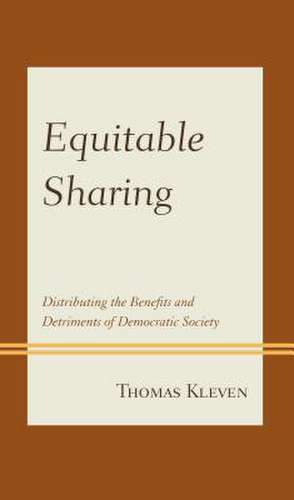
Equitable Sharing
Autor Thomas Klevenen Limba Engleză Paperback – 25 aug 2015
The task of U.S. society throughout its existence has been to engage in an on-going dialogue that gives life to the commitment to equitable sharing set forth in its founding documents. As the elected representatives of the people and the repository of the powers through which to implement much of what equitable sharing requires, the primary responsibility for implementation rests with the legislative branch. This book argues that the Supreme Court, interacting with the public and the legislature, also has a meaningful role to play in the dialogue over the requirements of equitable sharing and can play this role in a manner consistent with democratic principles. This point is illustrated through a discussion of several contemporary issues: same sex marriage, racial integration in public schools, health care, and the regulation of the electoral process.
| Toate formatele și edițiile | Preț | Express |
|---|---|---|
| Paperback (1) | 349.32 lei 6-8 săpt. | |
| Bloomsbury Publishing – 25 aug 2015 | 349.32 lei 6-8 săpt. | |
| Hardback (1) | 687.86 lei 6-8 săpt. | |
| Rowman & Littlefield – 16 dec 2013 | 687.86 lei 6-8 săpt. |
Preț: 349.32 lei
Preț vechi: 450.08 lei
-22%
Puncte Express: 524
Preț estimativ în valută:
61.83€ • 71.82$ • 53.57£
61.83€ • 71.82$ • 53.57£
Carte tipărită la comandă
Livrare economică 02-16 martie
Preluare comenzi: 021 569.72.76
Specificații
ISBN-13: 9781498521062
ISBN-10: 1498521061
Pagini: 246
Dimensiuni: 150 x 229 x 20 mm
Greutate: 0.39 kg
Editura: Bloomsbury Publishing
Locul publicării:New York, United States
ISBN-10: 1498521061
Pagini: 246
Dimensiuni: 150 x 229 x 20 mm
Greutate: 0.39 kg
Editura: Bloomsbury Publishing
Locul publicării:New York, United States
Cuprins
Introduction
Chapter 1: Equitable Sharing and Democratic Theory
Chapter 2: Equitable Sharing and the American Ideal
Chapter 3: Equitable Sharing in Practice
Chapter 4: Equitable Sharing and the Supreme Court
Chapter 5: Equitable Sharing and Same Sex Marriage
Chapter 6: Equitable Sharing and School Integration
Chapter 7: Equitable Sharing and the Electoral Process
Chapter 8: Equitable Sharing and States' Rights
Conclusion
Selected Bibliography
Cases Cited
Chapter 1: Equitable Sharing and Democratic Theory
Chapter 2: Equitable Sharing and the American Ideal
Chapter 3: Equitable Sharing in Practice
Chapter 4: Equitable Sharing and the Supreme Court
Chapter 5: Equitable Sharing and Same Sex Marriage
Chapter 6: Equitable Sharing and School Integration
Chapter 7: Equitable Sharing and the Electoral Process
Chapter 8: Equitable Sharing and States' Rights
Conclusion
Selected Bibliography
Cases Cited
Recenzii
Kleven makes three related claims: the principle of equitable sharing- 'all the benefits and detriments of social life must be fairly distributed among members of society'-is fundamental to the concept of democracy; the principle is implicit in America's founding documents; and the principle requires a right to same sex marriage, use of race in assigning students, and laws guaranteeing equal opportunity to participate in the electoral process, among others. Kleven argues that the principle was violated when the Court overturned campaign finance spending limits in Citizens United v. FEC, and when it prevented Congress from withholding Medicaid funds from states that opt out of the Affordable Care Act's expanded Medicaid requirement. . . .Is the reductio ad absurdum of the equitable sharing principle Kurt Vonnegut's 'Harrison Bergeron'? . . .[T]he work does address one of the central issues facing US democracy. Summing Up: Recommended. General readers, upper-division undergraduate students, and graduate students.
Equitable Sharing holds democratic societies to the ideal and building on the work of John Locke, John Mills, and John Rawls, contends that a truly democratic society must ensure that social benefits and detriments are fairly distributed among all its members. This breath-taking observation is carefully scrutinized in a practical as well as theoretical matter in a clear, concise, and persuasive way. This ambitious book thoughtfully analyzes the relative roles of the courts (including the Supreme Court) and the legislature in bringing about the ideal of equitable sharing. Any person interested in social justice for American society-and societies generally-must read Equitable Sharing.
Constitutional law sorely needs the fresh, judicious, and visionary thinking this book offers. It develops a compelling framework showing how equality is necessary to basic ideals of freedom and democracy. Equitable sharing has potential to outshine the similarly broad fundamental principles that have held sway over U.S. legal theory and doctrine in recent years, such as federalism or economic efficiency. The book astutely shows how equitable sharing can improve analysis of many current controversies, including affirmative action, campaign finance, same-sex marriage, and health insurance reform.
A wonderful book that should be read by all who care about social justice. Professor Kleven explains the concept of 'equitable sharing' and why it is essential for a just society and what it would mean. In a world with a growing gap between 'haves' and 'have nots' this book provides a brilliant progressive path forward.
Equitable Sharing holds democratic societies to the ideal and building on the work of John Locke, John Mills, and John Rawls, contends that a truly democratic society must ensure that social benefits and detriments are fairly distributed among all its members. This breath-taking observation is carefully scrutinized in a practical as well as theoretical matter in a clear, concise, and persuasive way. This ambitious book thoughtfully analyzes the relative roles of the courts (including the Supreme Court) and the legislature in bringing about the ideal of equitable sharing. Any person interested in social justice for American society-and societies generally-must read Equitable Sharing.
Constitutional law sorely needs the fresh, judicious, and visionary thinking this book offers. It develops a compelling framework showing how equality is necessary to basic ideals of freedom and democracy. Equitable sharing has potential to outshine the similarly broad fundamental principles that have held sway over U.S. legal theory and doctrine in recent years, such as federalism or economic efficiency. The book astutely shows how equitable sharing can improve analysis of many current controversies, including affirmative action, campaign finance, same-sex marriage, and health insurance reform.
A wonderful book that should be read by all who care about social justice. Professor Kleven explains the concept of 'equitable sharing' and why it is essential for a just society and what it would mean. In a world with a growing gap between 'haves' and 'have nots' this book provides a brilliant progressive path forward.