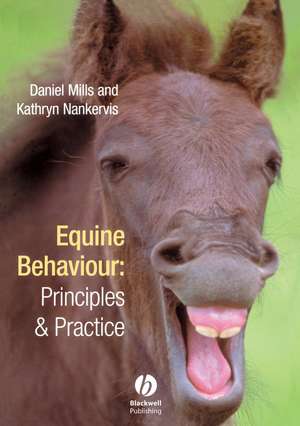
Equine Behaviour
Autor Daniel S Mills, Kathryn J Nankervisen Limba Engleză Paperback – 23 sep 1998
Organizarea acestui volum pornește de la o premisă pe cât de simplă, pe atât de riguroasă: înțelegerea lumii perceptuale a calului este fundamentul oricărei interacțiuni reușite. Descoperim în Equine Behaviour o structură ce facilitează trecerea de la teorie la practică, analizând influențele asupra comportamentului ecvin prin prisma nivelului de dificultate al antrenamentului și a timpului necesar pentru consolidarea deprinderilor. Autorii Daniel S. Mills și Kathryn J. Nankervis nu se limitează la observații generale, ci detaliază tehnici specifice precum „join-up” sau „imprint training”, oferind cititorului instrumente concrete pentru a evalua flexibilitatea și limitele răspunsurilor animalului. Cine a studiat abordările din Equine Behaviour in Practice va aprecia aici rigoarea academică aplicată direct în teren. În timp ce alte lucrări se concentrează pe relația bilaterală om-cal, acest volum pune un accent deosebit pe fundamentele științifice ale învățării, explicând „de ce”-ul din spatele reacțiilor, nu doar „cum”-ul remedierii lor. Putem afirma că experiența lui Daniel S. Mills, reflectată și în BSAVA Manual of Canine and Feline Behavioural Medicine, aduce o perspectivă clinică valoroasă, tratând bunăstarea psihologică a calului ca pe un pilon esențial al performanței sportive. Față de The Domestic Horse, unde accentul cade pe evoluția istorică și managementul general, Equine Behaviour este un manual de lucru mai aplicat. Ritmul textului este unul dens, dar accesibil, orientat către rezultate măsurabile în manej. Este o resursă care transformă intuiția în competență, oferind o bază solidă pentru oricine dorește să înțeleagă biologia și psihologia din spatele fiecărei mișcări a calului.
Preț: 432.86 lei
Preț vechi: 534.39 lei
-19%
Carte disponibilă
Livrare economică 09-23 noiembrie
Livrare express 23-29 octombrie pentru 32.27 lei
Specificații
ISBN-10: 0632048786
Pagini: 240
Ilustrații: illustrations
Dimensiuni: 172 x 243 x 18 mm
Greutate: 0.44 kg
Ediția:1
Editura: Wiley
Locul publicării:Chichester, United Kingdom
De ce să citești această carte
Această carte se adresează proprietarilor și antrenorilor care doresc să depășească nivelul empiric al dresajului. Cititorul câștigă o înțelegere profundă a modului în care caii procesează informația, ceea ce duce la o comunicare mai clară și la reducerea stresului în timpul antrenamentelor. Este un ghid esențial pentru îmbunătățirea performanței prin respectarea limitelor naturale și a bunăstării animalului.
Descriere
Notă biografică
Cuprins
Acknowledgements viii
Part One: Understanding Behaviour Concepts 1
1 Approaches to the Study of Behaviour 3
What is behavior 3
Ethology versus psychology 6
A brief guide to conducting a behaviour study 9
Conclusion 15
Topics for discussion 16
References and further reading 16
2 Origins of Behaviour 18
An evolutionary approach to understanding behavior 18
Lamarck versus Darwin 19
Genes not individuals 22
Evolutionary throwbacks and genetic jumps 26
Adaptation and apparent stupidity in domestic horses 27
Evolution and the variety of behavior 29
Conclusion 31
Topics for discussion 31
References and further reading 32
3 The Evolutionary History of the Horse 33
Introduction 33
Early evolution of the horse 38
The arrival of Equus 43
The origins of the modern breeds 45
Domestication and its consequences 47
Topics for discussion 52
References and further reading 52
4 The Lifetime Development of Behaviour 53
Instinctive and learned behaviour, what is the difference? 53
Sensitive phases for specia1 times specific associations 56
Using play for better management 58
Using natural biases in development to improve management 60
Conclusion 65
Topics for discussion 65
References and further reading 66
Part Two: Mechanisms of Behaviour 67
5 The Processing, of Information 69
Introduction 69
The nervous system 69
Neural transmission 72
Central processing 80
Behavioural motivation 84
Autonomic and somatic nervous system 88
Topics·for discussion 89
References and further reading 90
6 The Special Senses 91
Sight 91
Hearing 99
Chemoreception 102
Cutaneous sensation 107
Topics for discussion 108
References and further reading 108
7 Communication and Social Organisation 110
Communication 110
Social organisation 125
The composition of the group 129
The social structure of the group 129
The dynamics of the group 133
How horses defend their resources 134
Conclusion 136
Topics for discussion 137
References and further reading 137
8 Sexual and Reproductive Behaviour of Horses 139
Basic genetic foundation of the individual's sexuality 139
Normal mare specific behavior 140
Normal sexual specific behaviour l49
Modifiers of the genetic blueprint 153
Conclusion 160
Topics for discussion 160
References and further reading l60
Part Three: The flexibility of Behaviour and its Management 163
9 Learning and Training 165
Psychological processes 165
A few basic procedures 167
App1ying reinforcement to train new behaviours 176
Punishment and its problems 180
General guidelines to training new behaviours 182
Learning beyond a change in behaviour 183
Training techniques for problem behaviours 186
Conclusion 193
Topics for discussion 164
References and further reading 194
10 Welfare 196
Understanding welfare 196
What is right is not always the same as what is good 196
Measuring welfare 197
ls the domestic horse a fish out of water? 205
Stereotypies 210
Principles of treatment for stereotypies and other behaviour problems 220
Conclusion 224
Topics for discussion 224
References and further reading 225
Appendix 226
Index 227