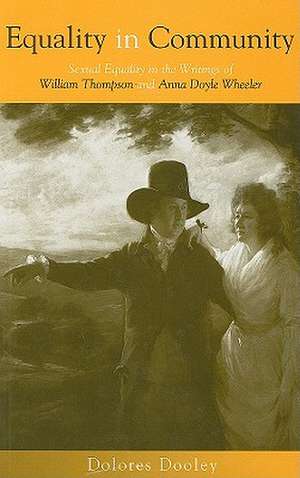
Equality in Community: Sexual Equality in the Writings of William Thompson and Anna Doyle Wheeler: Women's studies/philosophy
Autor Dolores Dooleyen Limba Engleză Hardback – 31 mai 1996
| Toate formatele și edițiile | Preț | Express |
|---|---|---|
| Paperback (1) | 252.71 lei 3-5 săpt. | |
| Cork University Press – 30 iun 1996 | 252.71 lei 3-5 săpt. | |
| Hardback (1) | 392.33 lei 3-5 săpt. | |
| Cork University Press – 31 mai 1996 | 392.33 lei 3-5 săpt. |
Preț: 392.33 lei
Puncte Express: 588
Preț estimativ în valută:
69.37€ • 80.71$ • 60.01£
69.37€ • 80.71$ • 60.01£
Carte disponibilă
Livrare economică 02-16 aprilie
Specificații
ISBN-13: 9781859180044
ISBN-10: 1859180043
Pagini: 448
Dimensiuni: 157 x 236 x 36 mm
Greutate: 0.88 kg
Editura: Cork University Press
Seria Women's studies/philosophy
ISBN-10: 1859180043
Pagini: 448
Dimensiuni: 157 x 236 x 36 mm
Greutate: 0.88 kg
Editura: Cork University Press
Seria Women's studies/philosophy
V-ar putea interesa
-
 Resisting Reality: Social Construction and Social CritiqueSally Haslanger-22%Preț: 361.19 lei462.63 lei
 -
 -27%Preț: 50.25 lei68.85 lei
 -
 We Should All Be FeministsChimamanda Ngozi AdichiePreț: 52.55 lei
 -
 Preț: 469.89 lei
 -
 -27%Preț: 756.65 lei1036.52 lei
 -
 Letters to my FannyCherry Healey-38%Preț: 47.95 lei77.18 lei
 -
 -28%Preț: 64.40 lei88.99 lei
 -
 Everyday SexismLaura Bates-5%Preț: 57.51 lei60.22 lei
 -
 Girl UpLaura Bates-5%Preț: 73.60 lei77.57 lei
 -
 The Ethics of New Reproductive Technologies: Cases and QuestionsEsther Van Der Hertzog-23%Preț: 717.15 lei931.36 lei
 -
 Slaughter, A: Unfinished BusinessAnne-Marie SlaughterPreț: 89.80 lei
Textul de pe ultima copertă
Equality in Community calls for a reassessment of the traditional canon of the 'notables' in the history of utilitarian philosophy, political economy and women's history. This illuminating and original study looks at the lives and ideas of two nineteenth-century Irish philosophers and collaborators, William Thompson and Anna Doyle Wheeler, who co-authored a treatise on sexual inequality. Thompson and Wheeler are given visibility in a biographical sketch of their lives; their ideas are uncovered showing amazing anticipations of contemporary views on equality, knowledge and power, competition, self-knowledge, justice and community living. Thompson has long been recognized by economists as a radical and careful utilitarian critic of capitalism but Equality in Community shows that his economic thought is misunderstood if it is not seen in the light of his larger philosophy of life. Wheeler's contribution in this unique partnership gives a woman's consciousness to the philosophy of sexual equality. Wheeler and Thompson were radicals in criticizing the narrow-mindedness of the fathers of utilitarianism. They challenged its core concepts of happiness, human nature and justice and exposed them as misunderstood, misapplied and misanthropic. Equality in Community asks whether utilitarian philosophy can be women-friendly, or is it conceptually irretrievable as it seems to leave little room for valuing women's lives in the nineteenth century? Thompson's proposals for a co-operative community are scrunitized carefully to see if they are genuinely conducive to gender equality.