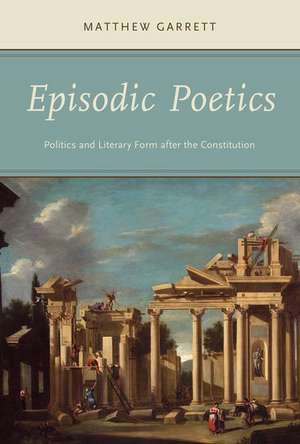
Episodic Poetics: Politics and Literary Form after the Constitution
Autor Matthew Garretten Limba Engleză Paperback – 28 iun 2018
Preț: 285.40 lei
Preț vechi: 367.90 lei
-22%
Puncte Express: 428
Carte tipărită la comandă
Livrare economică 04-15 decembrie
Livrare prin curier în România Termenul estimat este afișat lângă disponibilitate.
Transport gratuit de la 400.00 lei Plată online sau ramburs, în funcție de opțiunile comenzii.
Retur gratuit în 14 zile Comandă securizată și suport în română.
Specificații
ISBN-13: 9780190887445
ISBN-10: 0190887443
Pagini: 244
Dimensiuni: 155 x 231 x 18 mm
Greutate: 0.36 kg
Editura: Oxford University Press
Colecția OUP USA
Locul publicării:New York, United States
ISBN-10: 0190887443
Pagini: 244
Dimensiuni: 155 x 231 x 18 mm
Greutate: 0.36 kg
Editura: Oxford University Press
Colecția OUP USA
Locul publicării:New York, United States
V-ar putea interesa
-
 The Aztecs: A Very Short IntroductionDavid Carrasco-20%Preț: 56.62 lei70.82 lei
 -
 American History: A Very Short IntroductionPaul S. Boyer-19%Preț: 58.09 lei71.48 lei
 -
 -23%Preț: 219.42 lei285.99 lei
 -
 From Colony to Superpower: U.S. Foreign Relations since 1776George C. Herring-9%Preț: 124.86 lei136.91 lei
 -
 Colonial America: A Very Short IntroductionAlan Taylor-19%Preț: 57.46 lei71.12 lei
 -
 Theodore RooseveltLewis L. Gould-18%Preț: 77.08 lei93.70 lei
 -
 This Republic of SufferingDrew Gilpin FaustPreț: 108.89 lei
 -
 American-MadeNick TaylorPreț: 168.00 lei
 -
 Land of DesireWilliam R. LeachPreț: 160.14 lei
 -
 Preț: 252.98 lei
Recenzii
The book's theoretical commitments bear special mention because they mark its relatively unique relationship to ongoing debates about historicism and literary form. Episodic Poetics is part of the resurgence of new scholarship on aesthetics, but Marxist criticism has not been particularly popular in this work, which has tended to identify Marxism (via Jameson) with the mandates of historical contextualization. And yet, perhaps for this very reason, the book's engagement with a range of older formalisms moves it toward a newly flexible, structural account of the form of politics.
For Garrett, literary form is both a reflection of and engagement with social practices. Texts simultaneously represent and 'make' history. Garrett reads these particular works as symbols of the factionlism, unrest, and divisions within the early republic.
Garrett's book is learned and imaginatively expansive, and I took great pleasure in following him as he navigated discussions of Russian formalism, analyses of eighteenth-century business manuals, close readings of The Odyssey, examinations of the aesthetic theories of Lord Kames and Hugh Blair, a consideration of Roland Barthes's distinction between cardinal and catalytic functions-to identify only some of the literary avenues through which he guides us. ...[A] delightful exercise in reading episodically.
Matthew Garrett's extraordinary Episodic Poetics: Politics and Literary Form After the Constitution explores the complex textures that resulted when the post-constitutional moment's consolidating energies found verbal expression in the fragmentary form of the period's literary production. ... The representative texts of Garrett's four genres, via their respective logics of contagion, error, hesitation, and volubility helped delineate the contours of the political. Episodic Poetics' investigation of these dynamics is as theoretically sophisticated as it is elegantly constructed, and in what follows I can only gesture at the readerly pleasures that attend following the involutions of its nuanced argument.
How did pluribus become unum in the early United States? Matthew Garrett's Episodic Poetics reveals that the formal problem of integrating and consolidating parts into a whole connected politics with literature in the early republic. Focusing on the serialization of political tracts, the organization of events in autobiography, and the marketing of digressive fictions, Garrett makes a provocative case for the history of literary form as an integral part of political history.
Episodic Poetics is an innovative, learned, challenging account of the politics of form and the form of politics in the early Republic. Garrett makes a persuasive case that narrative plotting is key to understanding both the richness of early national writing and the ideological contradictions of U.S. nation formation.
A powerful, unexpected new roadmap to the culture of the early republic. In Garrett's hands, literary form becomes the place where theory and history meet to tell a new story about a tired corner of American culture. A maverick and often beautiful book that resets the table for early Americanists.
In this erudite study, Garrett resuscitates the episode
Matthew Garret's Episodic Poetics: Politics and Literary Form after the Constitution (2014), examines...the sub-generic feature of the "episode." Bringing this often overlooked narrative unit to the forefront allows Garrett to examine works from the early American Republic, not only revealing unexpected connections and resonances but also shedding light on formal aspects of Early Republic literature
For Garrett, literary form is both a reflection of and engagement with social practices. Texts simultaneously represent and 'make' history. Garrett reads these particular works as symbols of the factionlism, unrest, and divisions within the early republic.
Garrett's book is learned and imaginatively expansive, and I took great pleasure in following him as he navigated discussions of Russian formalism, analyses of eighteenth-century business manuals, close readings of The Odyssey, examinations of the aesthetic theories of Lord Kames and Hugh Blair, a consideration of Roland Barthes's distinction between cardinal and catalytic functions-to identify only some of the literary avenues through which he guides us. ...[A] delightful exercise in reading episodically.
Matthew Garrett's extraordinary Episodic Poetics: Politics and Literary Form After the Constitution explores the complex textures that resulted when the post-constitutional moment's consolidating energies found verbal expression in the fragmentary form of the period's literary production. ... The representative texts of Garrett's four genres, via their respective logics of contagion, error, hesitation, and volubility helped delineate the contours of the political. Episodic Poetics' investigation of these dynamics is as theoretically sophisticated as it is elegantly constructed, and in what follows I can only gesture at the readerly pleasures that attend following the involutions of its nuanced argument.
How did pluribus become unum in the early United States? Matthew Garrett's Episodic Poetics reveals that the formal problem of integrating and consolidating parts into a whole connected politics with literature in the early republic. Focusing on the serialization of political tracts, the organization of events in autobiography, and the marketing of digressive fictions, Garrett makes a provocative case for the history of literary form as an integral part of political history.
Episodic Poetics is an innovative, learned, challenging account of the politics of form and the form of politics in the early Republic. Garrett makes a persuasive case that narrative plotting is key to understanding both the richness of early national writing and the ideological contradictions of U.S. nation formation.
A powerful, unexpected new roadmap to the culture of the early republic. In Garrett's hands, literary form becomes the place where theory and history meet to tell a new story about a tired corner of American culture. A maverick and often beautiful book that resets the table for early Americanists.
In this erudite study, Garrett resuscitates the episode
Matthew Garret's Episodic Poetics: Politics and Literary Form after the Constitution (2014), examines...the sub-generic feature of the "episode." Bringing this often overlooked narrative unit to the forefront allows Garrett to examine works from the early American Republic, not only revealing unexpected connections and resonances but also shedding light on formal aspects of Early Republic literature
Notă biografică
Dr. Matthew Garrett is a retired professor and celebrated educator specializing in Native American History. He is the author of the award-winning monograph Making Lamanites, as well as Critical Thinking & Writing in History and Native American History: An Ethnic Studies Curriculum. His writings have also appeared in academic journals and popular mediums. He is the President and Founding Professor of the California Curriculum Center.
Cuprins
- Introduction: Reading the Episode in the Early Republic
- The Episode between Part and Whole
- Telemachus's Doubt: Toward a Theory of Episodic Poetics
- The Whole against the Parts: Narrative Theory
- From Event to Episode: Historical Poetics
- The Hillock and the Mountain
- Chapter One: The Poetics of Constitutional Consolidation
- Complexity and Consolidation: Out of Many, One
- Common and Finer: The Legacy of 1787-88
- The Chain of Reading: Commerce, Episodic Poetics, Politics
- Hierarchy and Literary Form 1: Commerce and Contagion
- Hierarchy and Literary Form 2: Governing the Splintered Society
- Hierarchy and Literary Form 3: Faction as Form
- Mercantile Time and the Periodical Plot
- Debt and the Rhythm of Exchange
- Unreadability and Nationalism's Chain of Reading
- Chapter Two: The Life in Episodes
- Structure and Dispersion
- Erratum and Episode: Duration and Narrative Binding
- Character and Competition, Success and Failure
- Society, Mischief, and the Episode
- Experience, Selection, and Narrative Unity
- Chapter Three: The Fiction of Hesitation
- Reading the Episode in the Novel
- Adventure and Didacticism
- Incipits and the Incitement to Reading: From Clarissa to Constantia
- Against the Episode: Morality and Form in the Literary Market
- Nothing Happens
- Endless Prolixity
- Episode versus Futurity
- Episode and Ideology
- Chapter Four: Miscellany and the Structure of Style
- Commodity Writing
- Whim-Whams on the Market
- Criticism and the Work of the Writer
- Salmagundi: An Arthrology of the Literary Miscellany
- The Rejection of Reference
- Volubility and Formal Compromise
- Appendix to Chapter Four: Table of Contents and Collation of Salmagundi
- Conclusion
- Works Cited
- Index