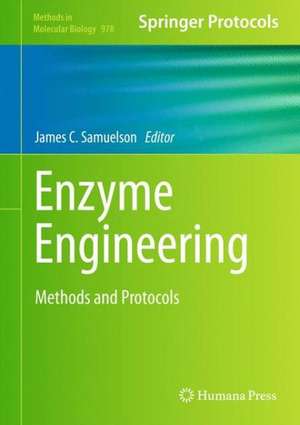
Enzyme Engineering
Editat de James C. Samuelsonen Limba Engleză Hardback – 20 feb 2013
Authoritative and easily accessible Enzyme Engineering: Methods and Protocols will be valuable for scientists with a budding interest in protein engineering as well as veterans looking for new approaches to apply in established discovery programs.
Preț: 983.55 lei
Preț vechi: 1199.45 lei
-18%
Puncte Express: 1475
Carte tipărită la comandă
Livrare economică 25 noiembrie-09 decembrie
Livrare prin curier în România Termenul estimat este afișat lângă disponibilitate.
Transport gratuit pentru acest produs Plată online sau ramburs, în funcție de opțiunile comenzii.
Retur gratuit în 14 zile Comandă securizată și suport în română.
Specificații
ISBN-13: 9781627032926
ISBN-10: 1627032924
Pagini: 264
Ilustrații: XI, 252 p.
Dimensiuni: 183 x 260 x 19 mm
Greutate: 0.64 kg
Ediția:2013
Editura: Humana
Locul publicării:Totowa, NJ, United States
ISBN-10: 1627032924
Pagini: 264
Ilustrații: XI, 252 p.
Dimensiuni: 183 x 260 x 19 mm
Greutate: 0.64 kg
Ediția:2013
Editura: Humana
Locul publicării:Totowa, NJ, United States
V-ar putea interesa
-
 Essential Ion Channel MethodsP. Michael Conn-23%Preț: 540.34 lei701.74 lei
 -
 The Machinery of LifeDavid S. GoodsellPreț: 220.59 lei
 -
 TelomerasesLue-9%Preț: 863.45 lei948.84 lei
 -
 Chemistry for the Life SciencesRaul Sutton-15%Preț: 436.31 lei513.30 lei
 -
 Cysteine: Biosynthesis, Chemical Structure & ToxicityFyodor V Chorkina-27%Preț: 889.95 lei1211.29 lei
 -
 Bioelectronic Vision: Retina Models, Evaluation Metrics and System DesignJOAO CARLOS MARTINS-18%Preț: 705.65 lei860.55 lei
Public țintă
Professional/practitionerCuprins
A Tripartite Fusion System for the Selection of Protein Variants with Increased Stability in vivo.- Determining Enzyme Kinetics via Isothermal Titration Calorimetry.- GFP Reporter Screens for the Engineering of Amino Acid Degrading Enzymes from Libraries Expressed in Bacteria.- Flow Cytometric Assays for Interrogating LAGLIDADG Homing Endonuclease DNA Binding and Cleavage Properties.- TAL Effector Nuclease (TALEN) Engineering.- In vitro Evolution of Enzymes.- Residue-Specific Incorporation of Unnatural Amino Acids into Proteins In vitro and In vivo.- Reconstructing Evolutionary Adaptive Paths for Protein Engineering.- Oligonucleotide Recombination Enabled Site-Specific Mutagenesis in Bacteria.- FX Cloning: A Versatile High-Throughput Cloning System for Characterization of Enzyme Variants.- Use of Sulfolobus solfataricus PCNA Subunit Proteins to Direct the Assembly of Multimeric Enzyme Complexes.- Gene Synthesis by Assembly of Deoxyuridine Containing Oligonucleotides.- Protein Engineering: Single or Multiple Site-Directed Mutagenesis.- Gene Assembly and Combinatorial Libraries in S. cerevisiae via Reiterative Recombination.- Promiscuity-Based Enzyme Selection for Rational Directed Evolution Experiments.- Rational Protein Sequence Diversification by Multi-Codon Scanning Mutagenesis.- Screening Libraries for Improved Solubility: Using E. coli Dihydrofolate Reductase as a Reporter.- In Vitro Directed Evolution of Enzymes Expressed by E. coli in Micro-Titre Plates.
Textul de pe ultima copertă
Whether the pursuit is commercially motivated or purely academic, engineering a novel biological catalyst is an enticing challenge. High-resolution protein structure analysis allows for rational alteration of enzyme function, yet many useful enzyme variants are the product of well-designed selection schemes or screening strategies. Enzyme Engineering: Methods and Protocols provides guidance to investigators wishing to create enzyme variants with desired properties. This detailed volume covers such topics as a simple method for generating site-specific mutations within bacterial chromosomes. It also highlights the engineering of two difference types of rare-cutting endonucleases that show great potential in gene therapy applications: The newest development is the emergence of TAL effector nucleases or TALENs. Chapters describe newly developed technologies in sufficient detail so that each method can be practiced in a standard molecular biology laboratory. Written in the successful Methods in Molecular Biology™ series format, chapters include introductions to their respective topics, lists of the necessary materials and reagents, step-by-step, readily reproducible protocols, and notes on troubleshooting and avoiding known pitfalls.
Authoritative and easily accessible Enzyme Engineering: Methods and Protocols will be valuable for scientists with a budding interest in protein engineering as well as veterans looking for new approaches to apply in established discovery programs.
Authoritative and easily accessible Enzyme Engineering: Methods and Protocols will be valuable for scientists with a budding interest in protein engineering as well as veterans looking for new approaches to apply in established discovery programs.
Caracteristici
Includes cutting-edge methods and protocols Provides step-by-step detail essential for reproducible results Contains key notes and implementation advice from the experts