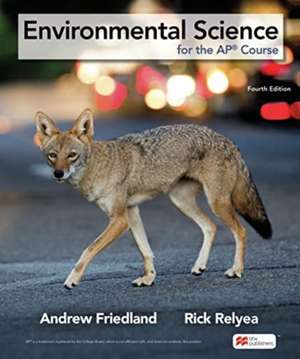
Environmental Science for the AP® Course
Autor Andrew Friedland, Relyea Ricken Limba Engleză Hardback – 15 apr 2023
Analizând resursele educaționale de la Macmillan Learning, constatăm că Environmental Science for the AP® Course rămâne un pilon fundamental pentru studiul disciplinelor ecologice la nivel de liceu și universitate. Această a patra ediție reprezintă o rafinare a materialului didactic, fiind structurată riguros pe cerințele specifice ale examenului AP®. Găsim în acest manual o abordare echilibrată între teoria științifică pură și aplicațiile practice, autorii Andrew Friedland și Relyea Rick reușind să sintetizeze concepte complexe de chimie, biologie și geologie într-un format accesibil de 832 de pagini. Ediția actuală aduce îmbunătățiri în ceea ce privește suportul pedagogic integrat, oferind elevilor instrumentele necesare pentru a naviga prin subiecte dificile precum amprenta de carbon sau dinamica ecosistemelor. Recomandăm acest titlu ca resursă principală de curs, deoarece depășește simpla prezentare a faptelor, punând accent pe gândirea critică și analiza datelor. Această lucrare extinde cadrul propus de Understanding the Chemistry of the Environment de Francisco G Calvo-Flores cu date noi din curriculumul actualizat AP® și o metodologie axată pe performanța la testările standardizate. Față de ghidurile de revizuire rapidă, cum este cel de la Barron's Educational Series, acest manual oferă contextul teoretic profund necesar pentru înțelegerea sistemică a mediului înconjurător.
Preț: 657.73 lei
Preț vechi: 888.82 lei
-26%
Carte disponibilă
Livrare economică 27 octombrie-10 noiembrie
Livrare express 10-16 octombrie pentru 90.41 lei
Specificații
ISBN-10: 1319409288
Pagini: 832
Dimensiuni: 285 x 239 x 34 mm
Greutate: 2.1 kg
Ediția:Fourth Edition
Editura: Macmillan Learning
De ce să citești această carte
Această carte se adresează elevilor și profesorilor din cadrul programului AP, dar și studenților la început de drum în științele mediului. Cititorul câștigă o înțelegere riguroasă a proceselor chimice și biologice care guvernează planeta, beneficiind de un suport didactic care facilitează obținerea unui punctaj ridicat la examene prin secțiunile dedicate de practică și recapitulare.
Despre autor
Andrew Friedland este profesor la Dartmouth College, specializat în studiul ecosistemelor forestiere și al ciclurilor biogeochimice, având o experiență vastă în predarea cursurilor introductive de știința mediului. Rick Relyea este un cercetător recunoscut în domeniul ecologiei și profesor la Rensselaer Polytechnic Institute, unde conduce programe dedicate biodiversității și impactului poluanților asupra mediului acvatic. Împreună, cei doi autori combină expertiza în cercetarea de teren cu o metodologie pedagogică modernă, adaptată nevoilor noii generații de studenți.
Descriere
Cuprins
Unit 1 - The Living World: Ecosystems
Module 1 - Introduction to EcosystemsUnit 2 - The Living World: Biodiversity
Module 2 - Terrestrial Biomes
Module 3 - Aquatic Biomes
Module 4 - The Carbon and Nitrogen Cycles
Module 5 - The Phosphorus and Hydrologic (Water) Cycles
Module 6 - Primary Productivity
Module 7 - Trophic Levels, Energy Flow and the 10% Rule, Food Chains and Food Webs
Unit 1 Practice Your Science Skills
Unit 1: AP® Environmental Science Practice Exam
Module 8 - Introduction to BiodiversityUnit 3 - Populations
Module 9 - Ecosystem Services
Module 10 - Island Biogeography
Module 11 - Ecological Tolerance
Module 12 - Natural Disruptions to Ecosystems
Module 13 - Adaptations
Module 14 - Ecological Succession
Unit 2 Practice Your Science Skills
Unit 2: AP® Environmental Science Practice Exam
Module 15 - Generalist and Specialist Species, K-selected and r-selected Species, and Survivorship Curves Module 16 - Carrying Capacity, Population Growth, and Resource AvailabilityUnit 4 - Earth Systems and Resources
Module 17 - Age Structure Diagrams and Total Fertility Rates
Module 18 - Human Population Dynamics and the Demographic Transition
Unit 3 Practice Your Science Skills
Unit 3: AP® Environmental Science Practice Exam
Module 19 - Plate TectonicsUnit 5 - Land and Water Use
Module 20 - Soil Formation, Erosion, Composition, and its Properties
Module 21 - Watersheds
Module 22 - Earth's Atmosphere, Global Wind Patterns, Solar Radiation and Earth's Seasons
Module 23 - Earth's Geography and Climate; El Niño and La Niña
Unit 4 Practice Your Science Skills
Unit 4: AP® Environmental Science Practice Exam
Module 24 - The Tragedy of the Commons and ClearcuttingUnit 6 - Energy Resources and Consumption
Module 25 - The Green Revolution
Module 26 - Impacts of Agricultural Practices
Module 27 - Irrigation and Pest Control Methods
Module 28 - Meat Production Methods and the Impacts of Overfishing
Module 29 - Impacts of Mining
Module 30 - Impacts of Urbanizations and the Methods to Reduce Urban Runoff
Module 31 - Ecological Footprints
Module 32 - Introduction to Sustainability
Module 33 - Integrated Pest Management and Sustainable Agriculture
Module 34 - Aquaculture and Sustainable Forestry
Unit 5 Practice Your Science Skills
Unit 5: AP® Environmental Science Practice Exam
Module 35 - Renewable and Nonrenewable Resources and the Global Energy ConsumptionUnit 7 - Atmospheric Pollution
Module 36 - Fuel Types and Uses
Module 37 - Distribution of Natural Energy Resources: Fossil Fuels
Module 38 - Nuclear Power
Module 39 - Biomass and Solar Energies, and Hydroelectric Power
Module 40 - Geothermal Energy and Hydrogen Fuel Cells
Module 41 - Wind Energy and Energy Conservation
Unit 6 Practice Your Science Skills
Unit 6: AP® Environmental Science Practice Exam
Module 42 - Introduction to Air PollutionUnit 8 - Aquatic & Terrestrial Pollution
Module 43 - Photochemical Smog, Thermal Inversion, Atmospheric CO2 and Particulates
Module 44 - Indoor Air Pollutants
Module 45 - Reduction of Air Pollutants
Module 46 - Acid Rain and Noise Pollution
Unit 7 Practice Your Science Skills
Unit 7: AP® Environmental Science Practice Exam
Module 47 - Sources of Pollution, Human Impacts on Ecosystems, and Endocrine DisruptorsUnit 9 - Global Change
Module 48 - Human Impacts on Wetlands and Mangroves, Eutrophication, and Thermal Pollution
Module 49 - Persistent Organic Pollutants (POPs), Bioaccumulation, and Biomagnification
Module 50 - Solid Waste Disposal
Module 51 - Waste Reduction Methods
Module 52 - Sewage Treatment
Module 53 - Lethal Dose 50% (LD50) and Dose Response Curves
Module 54 - Pollution, Human Health, Pathogens, and Infectious Diseases
Unit 8 Practice Your Science Skills
Unit 8: AP® Environmental Science Practice Exam
Module 55 - Stratospheric Ozone Depletion and its Reduction
Module 56 - The Greenhouse Effect
Module 57 - Increases in the Greenhouse Gases Global Climate Change
Module 58 - Ocean Warming and Ocean Acidification
Module 59 - Invasive Species, Endangered Species, and Human Impacts on Biodiversity
Unit 9 Practice Your Science Skills
Unit 9: AP® Environmental Science Practice Exam